Saed News: American astronomers, in collaboration with Iranian scientist Mehdi Zamani, succeeded in photographing the moment of a supernova explosion using the Hubble Space Telescope.
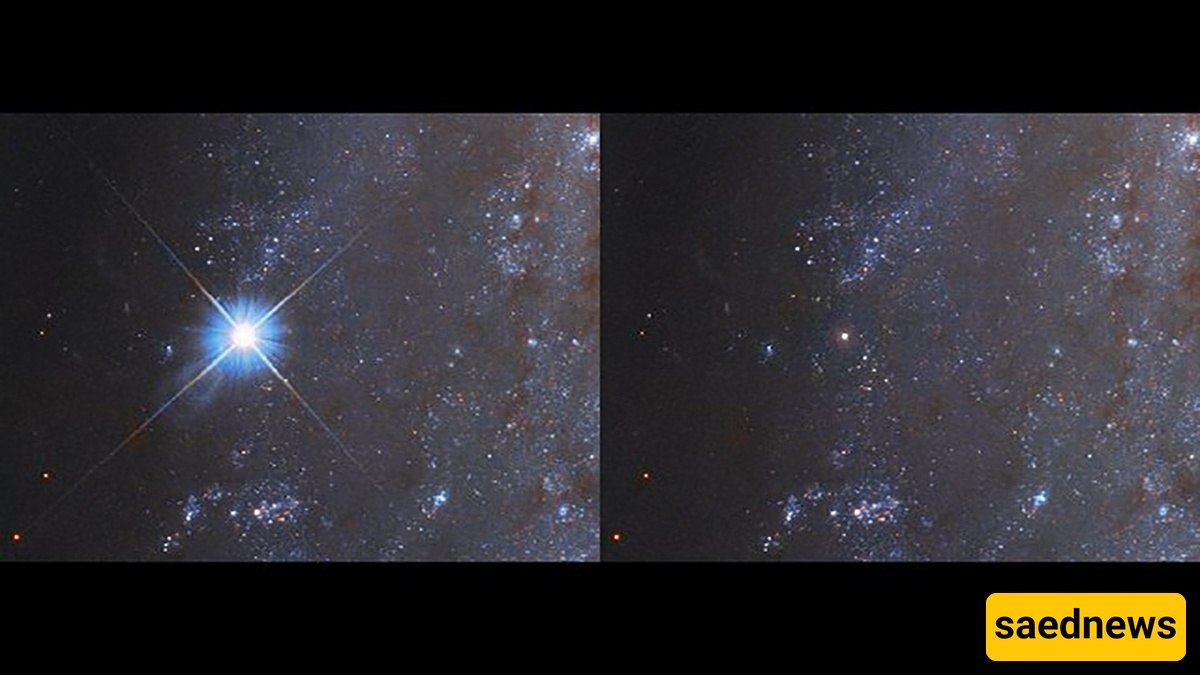
According to SAEDNEWS, the Hubble Space Telescope captured images from before and after the brilliant explosion of a star. The contrast between the two images, taken one year apart, shows how bright a supernova can become and how its brightness fades over time.
According to Space, this supernova explosion, known as SN 2018gv, was discovered in the spiral galaxy NGC 2525.
According to NASA, after an amateur astronomer named Koichi Itagaki first identified the supernova in early 2018, Hubble began observing it. NGC 2525 is located approximately 70 million light-years away from Earth.
SN 2018gv is classified as a Type Ia supernova, which is a rare kind of stellar explosion. Supernovae of this type are also known as “standard candles” because they can reach a consistent peak brightness that astronomers use to calculate distances with very high precision. By comparing their intrinsic brightness with how bright they appear from Earth, scientists can determine the exact distance of these exploding stars.
Astronomers also use this type of supernova to study the expansion rate of the universe and how it changes over time. Nancy Grace Roman Space Telescope, which is still under construction by NASA, has been designed to study explosions like this one so it can look even farther back in time than the Hubble Space Telescope and examine the expansion rate of the universe with greater accuracy.