SAEDNEWS: Do you know how people in Iran were buried 5,000 years ago? Join us as we explore this fascinating subject and uncover the mysteries hidden within ancient burial grounds.
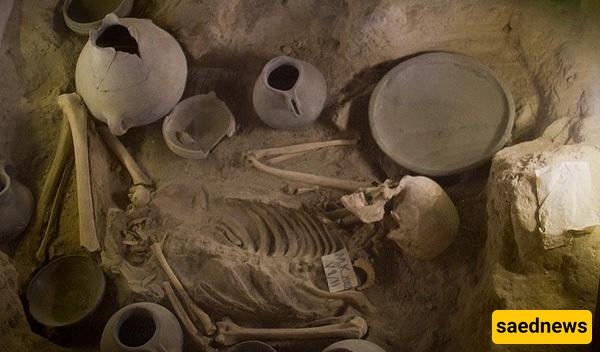
According to Saednews, In ancient Iran, the burial of the dead was carried out in various ways that differed considerably from modern practices. Shahr-e Sukhteh, or the “Burnt City,” is one of the largest archaeological sites associated with the beginnings of urbanization on the Iranian Plateau. This city, dating back to around 3000 BC, lies along the Zabol–Zahedan road beneath the scorching sun and contains one of the largest cemeteries from the early historical period. It is estimated to have contained between 20,000 and 40,000 graves, of which more than 1,000 have so far been identified. Archaeologists working in this vast cemetery, accidentally discovered in 1972, have identified nearly ten different types of graves and burial practices. These provide evidence of the cultural and religious diversity of the people who lived in the region, most of whom were engaged in trade.
The cemetery of Shahr-e Sukhteh has so far revealed many secrets about an urban civilization at the dawn of the historical period.
Dr. Rouhollah Shirazi, an archaeologist and director of the Shahr-e Sukhteh archaeological site, says that among the ten types of graves identified in the cemetery, four were particularly distinctive and widely used. These included simple pit graves, two-compartment pits, and chamber or crypt-like graves.
He explains the characteristics of these commonly used graves:
“Around 3000 BC, a rectangular, oval, or square pit was dug into the ground, and the body was placed inside in a crouched position. The deceased was usually buried with various offerings and belongings, including pottery vessels, jewelry, cosmetic containers, decorative beads, cylindrical and flat seals, mats, baskets, textiles, sacrificed animals, stone mortars, bronze mirrors, wooden combs, and tools.
“This practice was based on the belief that life continued after death. People believed that the deceased would need these objects in the next life. The graves were then filled with soil, meaning that the body came into direct contact with the earth and decomposition occurred relatively quickly. These graves were sometimes used once and sometimes twice. In some cases, more than one skeleton was placed inside them.
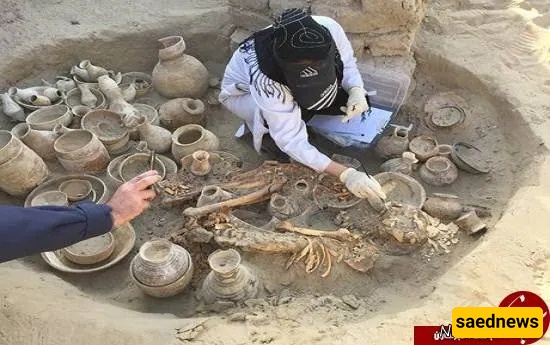
“The two-compartment pits, which represent the largest number of graves discovered at Shahr-e Sukhteh, were somewhat similar to the simple pits. The main difference was that their exterior shape was generally circular, and a wall consisting of one to eight mudbricks divided the grave into two separate sections. These graves were somewhat larger than the simple pits, and the bodies were buried facing either north or south.
“Graves discovered at an archaeological site in Quetta, Pakistan, are remarkably similar to these graves at Shahr-e Sukhteh, which was undoubtedly related to the commercial connections between the two regions.”
The chamber or crypt-like graves are particularly noteworthy. These graves consisted of two distinct sections: an entrance pit and the burial chamber. First, a pit approximately 120 centimeters deep was dug. Then, on one side of the pit, an underground chamber resembling an oval-shaped room was excavated to a depth of about 180 centimeters.
The deceased was placed inside the chamber along with offerings and various objects, after which the entrance was sealed with several rows of mudbricks. Because there was less pressure from the surrounding soil, the skeletons and objects in these graves remained better preserved than those in other types.
Excavations indicate that when these graves were reused, the remains of the earlier skeleton were collected and moved aside to create enough space for another burial. Studies of the objects found in these graves suggest that their occupants were socially and economically distinguished members of Shahr-e Sukhteh society. They appear to have held relatively high social and economic status and possessed considerably more personal wealth than those buried in other types of graves. The number of objects found in these graves ranges from approximately 20 to 120.
Another type of grave found in the cemetery is known as a semi-crypt grave. It resembled the chamber graves, except that the passage between the burial pit and the chamber remained open, allowing soil to enter the chamber. As a result, the body decomposed more extensively than in the fully enclosed chamber graves.
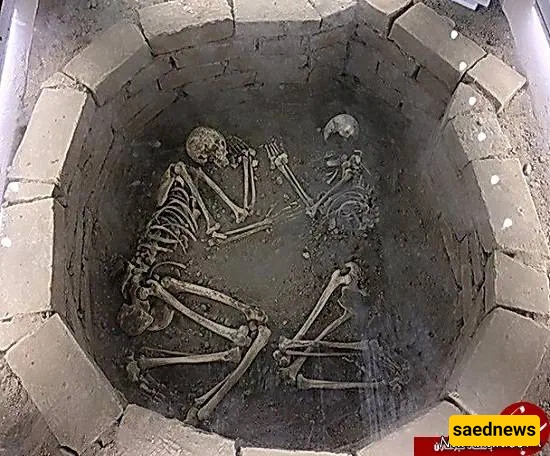
An example of these chamber graves can be seen at the Regional Museum of Zahedan.
“Besides rectangular and square mudbrick graves, double-walled graves, circular graves, and circular pits with sealed entrances, another type known as a bowl-shaped grave has also been discovered. These were specifically used for infants.
“About 5,000 years ago, an infant's body was placed in a simple pit and then covered with a large pottery bowl. Soil was subsequently placed over the entire burial.”
Several of these graves are also displayed at the Shahr-e Sukhteh Museum. Among them, a grave containing two skeletons facing one another has attracted considerable attention. It has sometimes evoked the image of the “oldest Iranian lovers”—the famous 3,000-year-old skeletons discovered at Hasanlu, where two individuals were found seemingly embracing one another. An image of those skeletons has been displayed under the title “the oldest Iranian lovers” at the University of Pennsylvania Museum of Archaeology and Anthropology in the United States.
However, Rouhollah Shirazi rejects the comparison between the Shahr-e Sukhteh grave and the so-called lovers' grave. He explains that anthropological studies can readily determine the sex, age, and even cause of death of ancient skeletons.
The grave containing the two skeletons was a circular mudbrick grave, a type of which only one example has so far been discovered at Shahr-e Sukhteh. For this reason, it was reconstructed in the museum to demonstrate its original form.
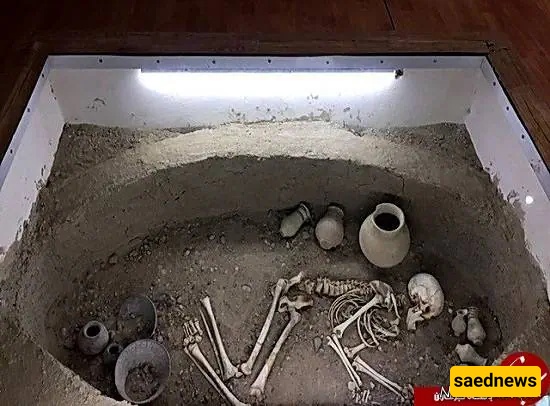
Shirazi continues:
“These two skeletons actually came from a collective burial and were placed in this reconstructed grave only for exhibition purposes. The skeletons, which anthropological studies have determined were both female, originally belonged to Grave 1003. Thirteen burials took place in this grave at different periods, and thirteen skulls were recovered from it. The skull of a 13-year-old girl who had undergone cranial surgery was also found in this same grave.
“Burials provide valuable information about the customs, diet, and lifestyle of ancient populations. The discoveries from the cemetery of Shahr-e Sukhteh, for example, indicate that more than 5,000 years ago, a multiethnic and multicultural society with diverse beliefs lived peacefully and in a highly organized manner alongside one another in the eastern Iranian Plateau.”