Saed News: Advanced scans performed on one of the victims of the Mount Vesuvius volcanic eruption have revealed his identity after two thousand years.
According to SAEDNEWS, and citing Popsci, the disaster of the ancient city of Pompeii, after nearly two thousand years, is still revealing new secrets from beneath the ash. Archaeologists now say that one of the famous victims of the Mount Vesuvius eruption was likely a physician who, while trying to escape, carried his medical tools in order to help others.
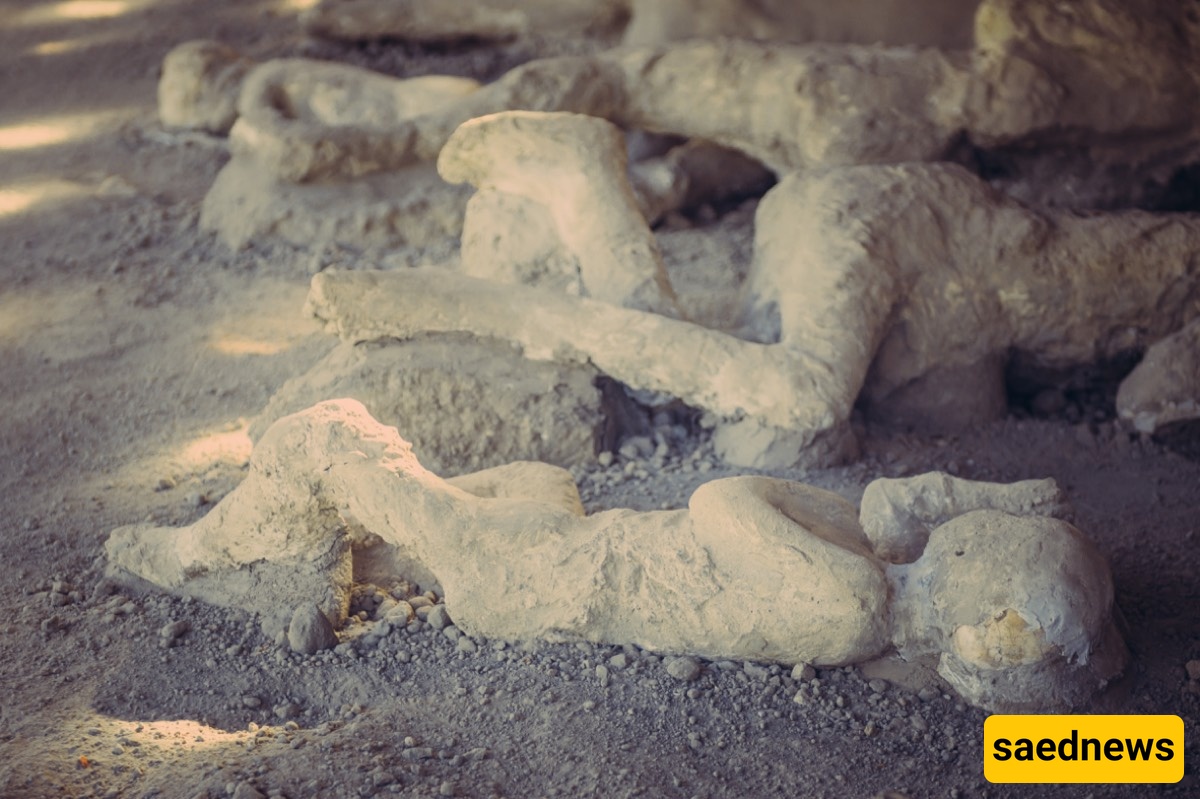
The discovery relates to one of the most famous areas of Pompeii, known as the “Garden of the Fugitives,” a site discovered in the 1960s that contains the remains of more than ten individuals. These people died in 79 AD, when the suffocating, scorching clouds from the eruption of Vesuvius engulfed the city.
Over centuries, the bodies of the victims decomposed under ash and volcanic material, but the empty spaces left behind in the soil remained. Archaeologists later filled these cavities with plaster, creating the famous and striking casts of the final moments of life in Pompeii—statues that capture fear, pain, and the struggle to escape in an unprecedented way.
Now modern imaging technology has revealed new details from one of these casts. Researchers used X-rays and CT scans to examine the inside of a plaster cast of a man found curled up on the ground. The images showed that he carried a fabric bag containing bronze and silver coins, a small box, and delicate metal tools.
According to archaeologists, these tools closely resemble those used in ancient Roman medicine. Among the items, a stone tablet was also found that was likely used for preparing medicines or cosmetic and therapeutic materials—tools typically carried by Roman physicians, or “medici.”
Although researchers emphasize that it cannot be stated with certainty that this man was a doctor, the evidence strongly supports this hypothesis. This possibility offers a more human image of one of Pompeii’s thousands of unnamed victims—someone who perhaps, even in the midst of fleeing death, did not abandon his tools of healing.
Gabriel Zuchtriegel, director of the Pompeii Archaeological Park, said regarding the discovery: “Two thousand years ago, there were people for whom medicine was not just a job; they were always doctors.” He believes the man likely carried his tools either to help others or to start a new life elsewhere.
This discovery once again shows how modern technology can give identity to the silent victims of history—people who for centuries were only plaster casts, but whose life stories are now slowly being told from beneath the ash.