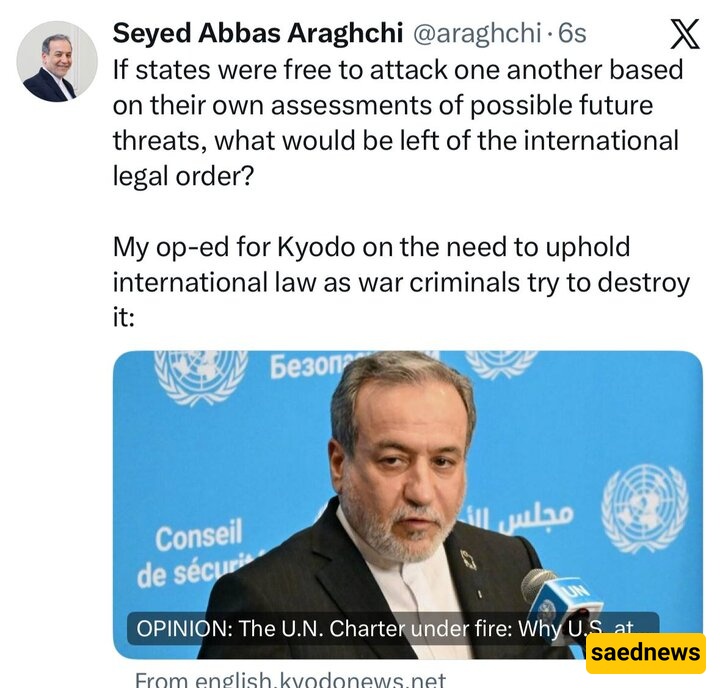
SAEDNEWS: If states were free to attack one another based on their own assessments of potential future threats, what would remain of the international legal order? This question extends far beyond the political dispute between Iran and the United States.
According to Saednews, What would remain of the international legal system if countries were allowed to launch military attacks against one another based solely on their own assessments of potential future threats? This question extends far beyond the political tensions between Iran and the United States. It strikes at one of the central principles of the post-World War II international order: the use of military force must be governed by international law, and no country, regardless of its military or political power, can place itself above internationally binding rules.
The military strikes carried out by the United States and the Israeli regime against Iran represent a serious breach of the prohibition on the use of force and a violation of Iran's national sovereignty. Their legality must be evaluated under the United Nations Charter and established principles of international law, rather than political claims or justifications presented after military operations have already begun.
Article 2(4) of the UN Charter explicitly prohibits the threat or use of force against the territorial integrity or political independence of any state. This principle is not simply a contractual obligation between nations; it is also a fundamental rule of customary international law, as confirmed by the International Court of Justice in its 1986 ruling in the Nicaragua case.
International law recognizes only limited exceptions to this prohibition, most notably the inherent right of self-defense under Article 51 of the UN Charter. However, the U.S. military operation against Iran was not authorized by the UN Security Council. Furthermore, claims about hypothetical or potential future threats cannot, on their own, establish a legitimate legal justification for military intervention.
Article 51 recognizes the right of self-defense when an armed attack occurs. Expanding this principle to cover speculative future dangers would effectively legitimize preventive warfare based on individual states' unilateral assessments. Such an approach would weaken the prohibition on the use of force and undermine one of the fundamental pillars of the international legal system.
The legality of Washington's military action has also attracted criticism within the American legal community. On March 6, 2026, the president of the American Branch of the International Law Association issued a statement describing the attack on Iran as unlawful and emphasizing that hypothetical threats about possible future developments cannot independently justify military force.
Moreover, reported strikes on schools, sports facilities, civilian infrastructure, and Iranian nuclear installations operating under International Atomic Energy Agency safeguards raise additional concerns under international law. Beyond the prohibition on aggression, these incidents must be assessed under international humanitarian law.
The rules governing armed conflicts require all parties to distinguish between military objectives and civilian populations, avoid disproportionate attacks, and take every feasible precaution to protect civilians and civilian infrastructure.
UN General Assembly Resolution 3314, which defines the crime of aggression, identifies several acts that may constitute aggression, including attacks by the armed forces of one country against another state's territory and the blockade of its ports or coastlines.
Where no valid legal justification exists for the use of force, a military attack against another country may constitute an internationally wrongful act, giving rise to state responsibility.
Under the international law of state responsibility, a country is accountable when conduct attributable to it violates its international obligations. Such responsibility carries specific legal consequences, including the obligation to end any continuing unlawful conduct, provide assurances against its recurrence, and offer full reparation for the damage caused.
Political, military, and security considerations do not automatically exempt a state from these obligations.
Serious violations of obligations arising from peremptory norms of international law, commonly known as jus cogens, also create responsibilities for the wider international community. Other states are required to cooperate through lawful measures to end such violations, refuse to recognize situations created by them as legally valid, and avoid providing assistance that could help sustain those unlawful circumstances.
At the same time, Iran retains its inherent right to self-defense under Article 51 of the UN Charter in response to an armed attack. However, the exercise of this right must remain within the limits and conditions established by international law.
The importance of this issue is not limited to Iran's national security or the strategic balance in the Middle East. At its core, the dispute concerns the credibility and effectiveness of an international legal framework established to prevent countries from using military force whenever they consider it politically or strategically advantageous.
If military superiority becomes more important than international legal obligations, and states responsible for unlawful aggression are allowed to avoid accountability, the security of every country could eventually be threatened.
The prohibition on the use of force is not a voluntary commitment by powerful nations toward weaker states. It is a binding international obligation that applies equally to every member of the international community.
Consequently, ending unlawful military aggression against Iran, respecting its sovereignty and territorial integrity, and providing compensation for damage resulting from illegal military operations are matters of international legal responsibility rather than political generosity.
Ultimately, allowing military power to override international law would have consequences far beyond the current confrontation. Iran would not be the only country affected; the credibility of the entire international legal system and the authority of the United Nations Charter would also be seriously undermined.