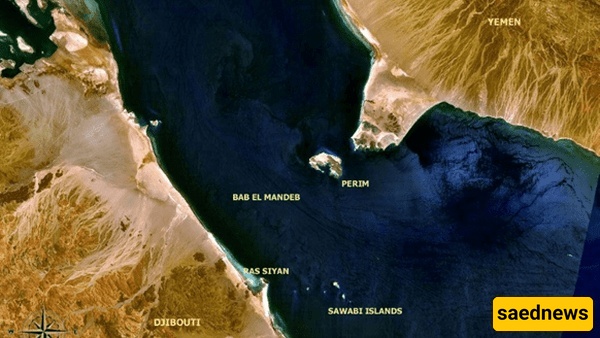
SAEDNEWS: The strategic waterways of the Red Sea and the Bab el‑Mandeb Strait have once again come under intense scrutiny by analysts following the deployment of the U.S. aircraft carrier Gerald R. Ford to the region.
According to SAEDNEWS, Tehran has warned that any facilities providing support to the U.S. carrier strike group could be considered potential targets by Iranian armed forces.
Analysts say it remains unclear whether Iran itself will take direct control of security dynamics in the Red Sea or whether Yemen’s Ansarallah movement — often described as the southern branch of the “Axis of Resistance” — will assume a leading role. In recent years, particularly during the Gaza war, shipping traffic through the waterway has already declined significantly due to threats and disruptions attributed to Yemeni forces.
On March 5, Ansarallah announced that its “fingers are on the trigger” and that it is prepared to respond immediately if circumstances change. Even this warning alone has contributed to disruptions in Red Sea trade routes.
According to the International Energy Agency, global oil and shipping markets have been thrown into turmoil after Iran reportedly responded to U.S. and Israeli actions by closing the Strait of Hormuz.
Regional powers have been scrambling to mitigate the potential damage. Saudi Arabia has increased the capacity of its East‑West pipeline, which connects oil fields in the Persian Gulf to ports on the Red Sea. Meanwhile, the United Arab Emirates has boosted flows through the Habshan–Fujairah pipeline that bypasses the Strait of Hormuz and reaches the Gulf of Oman.
However, energy analysts say these alternatives can only partially offset the disruption. David Butter, an associate fellow at the London‑based think tank Chatham House, wrote in a recent analysis that even at full capacity these routes could carry only about one‑quarter of the oil that normally passes through the Strait of Hormuz.
Butter also warned that these alternative pipelines remain vulnerable to potential attacks by Iran or Yemen’s Ansarallah movement. While the Yemeni group has not yet fully entered the conflict, he said its involvement could severely disrupt Saudi Arabia’s oil exports.
Approximately one‑tenth of the world’s seaborne oil shipments pass through the Bab el‑Mandeb Strait. Maritime intelligence firm Windward reported that although Ansarallah has not resumed its missile campaign, the threat alone has already led to a sharp decline in shipping traffic through the area.
Ahmed Suleiman, a senior researcher at Chatham House specializing in the Horn of Africa, said the Red Sea corridor is a strategic crossroads where African, Gulf, Middle Eastern, Asian, and global powers converge. As a result, any escalation in this region could have deeply destabilizing consequences for global shipping and trade.