SAEDNEWS: Decades of dependence on outdated technology and inadequate investment have made the US aviation system increasingly vulnerable, as a failed infrastructure upgrade led to thousands of flight cancellations and disrupted travel for more than one million passengers.
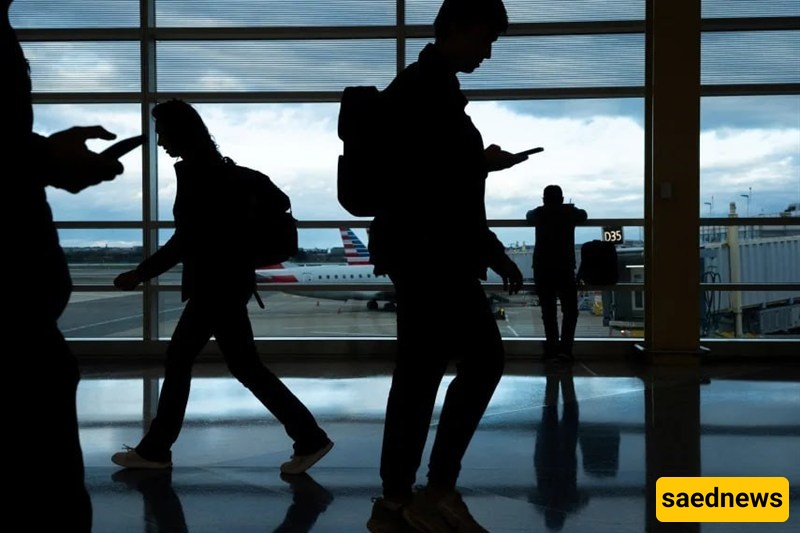
According to Saednews, The cancellation of thousands of flights across the United States has highlighted serious weaknesses in the country’s aging aviation infrastructure. Outdated technology, years of insufficient investment and unsuccessful modernization projects have disrupted air travel, affecting more than one million passengers.
The Federal Aviation Administration (FAA), which oversees more than 45,000 flights every day across the country’s vast airspace, continues to depend on outdated air traffic control systems. Some of its operations still rely on decades-old equipment, including paper flight strips, floppy disks and copper-wire communication networks.
The most recent disruption occurred on Friday after a contractor attempted to upgrade part of the existing copper-wire network by introducing fiber-optic technology. The transition placed excessive pressure on the outdated infrastructure, forcing the FAA to implement an unusual nationwide ground stop.
Homeland Security Secretary Markwayne Mullin explained that the newly installed technology overwhelmed the older systems, highlighting the problems created by an infrastructure that combines incompatible generations of equipment. He emphasized that the current patchwork approach is no longer effective.
The outage affected critical systems used to track and communicate with aircraft flying at cruising altitudes, preventing the FAA from ensuring that normal flight operations could continue safely. FlightAware reported that airlines canceled approximately 9,200 flights following the nationwide grounding order.
Although the FAA lifted the restriction shortly after 8 p.m. Eastern Time on Friday, the consequences continued into the following day. Staff shortages and aircraft left in locations where they were not needed created further operational difficulties, leading to another 6,200 cancellations on Saturday.
Transportation Secretary Sean Duffy acknowledged the seriousness of the situation, pointing to the difficulty of replacing outdated infrastructure while keeping existing systems functioning. He noted that the country's aviation network still depends on technology from several decades ago, including 1980s-era equipment, software developed in the 1990s and radar systems dating back to the 1970s, for which replacement parts are no longer manufactured.
This latest incident is not an isolated case. It reflects a wider history of technological problems affecting the American aviation sector.
In May 2025, communication failures involving air traffic control systems near Newark Liberty International Airport forced the FAA to introduce flight restrictions. The incident also placed considerable pressure on air traffic controllers, with some employees experiencing significant psychological stress and taking trauma-related leave.
Another nationwide aviation disruption occurred in January 2023, when a malfunction in the system responsible for warning pilots about potential hazards along their flight routes resulted in widespread flight cancellations and delays.
Airlines themselves have also faced serious technological failures. In July 2024, a defective automatic software update released by cybersecurity company CrowdStrike caused widespread computer disruptions around the world. Delta Air Lines was particularly affected, experiencing major difficulties restoring its crew-tracking systems and bringing its operations back to normal.
Southwest Airlines encountered another major operational crisis during the 2022 holiday travel season. Problems with its crew-scheduling software contributed to approximately 16,700 flight cancellations, leaving millions of passengers stranded and causing the airline financial losses estimated at more than $1 billion.
Behind many of these incidents lies a persistent problem: insufficient investment in essential technology and operational infrastructure.
Airlines have frequently directed their spending toward improvements that are more visible to customers, such as faster onboard Wi-Fi, modern aircraft and renovated airport lounges. Meanwhile, investments in internal software, communication networks and operational systems have often received less attention.
Travel industry analyst Henry Harteveldt argues that relatively low profit margins and airlines' unwillingness to commit significant funding to long-term technology projects have helped maintain their dependence on outdated infrastructure.
Modernizing the FAA's systems has also been difficult because the process relies heavily on financial support from Congress. Last year, lawmakers approved $12.5 billion for air traffic control improvements. Transportation Secretary Duffy had previously sought an additional $30 billion, but following Friday's disruption, he indicated that the agency now requires $50 billion.
The growing financial requirements demonstrate the enormous scale of the challenge facing the US aviation system. Decades of inadequate technological investment have left critical transportation infrastructure vulnerable to failures capable of affecting millions of travelers.
While the latest wave of flight cancellations may encourage Congress to approve additional modernization funding, the incident has also demonstrated the dangers associated with upgrading an outdated system without adequately protecting the infrastructure already in operation.
The unsuccessful transition to fiber-optic technology illustrates how even necessary improvements can create widespread disruption when older equipment cannot properly support new systems.
Duffy acknowledged that similar incidents could happen again, although he said he could not predict whether the same failure would be repeated. He argued that the current crisis provides a compelling reason for Congress to release the necessary funding and allow the modernization program to move forward.
Ultimately, the latest aviation disruption has exposed a fundamental problem within the United States' air travel network: modernizing critical infrastructure is no longer simply a matter of improving efficiency, but an urgent requirement for maintaining the safety, reliability and stability of the country's aviation system.
Tighten repetitive passagesMake the paraphrase more distinctStrengthen the article’s structure