Saed News: Remnants of radioactive stardust from stellar explosions have been trapped in the ice of Antarctica. Researchers in a new study found that these cosmic remnants act as clues that help uncover the history of our solar system.
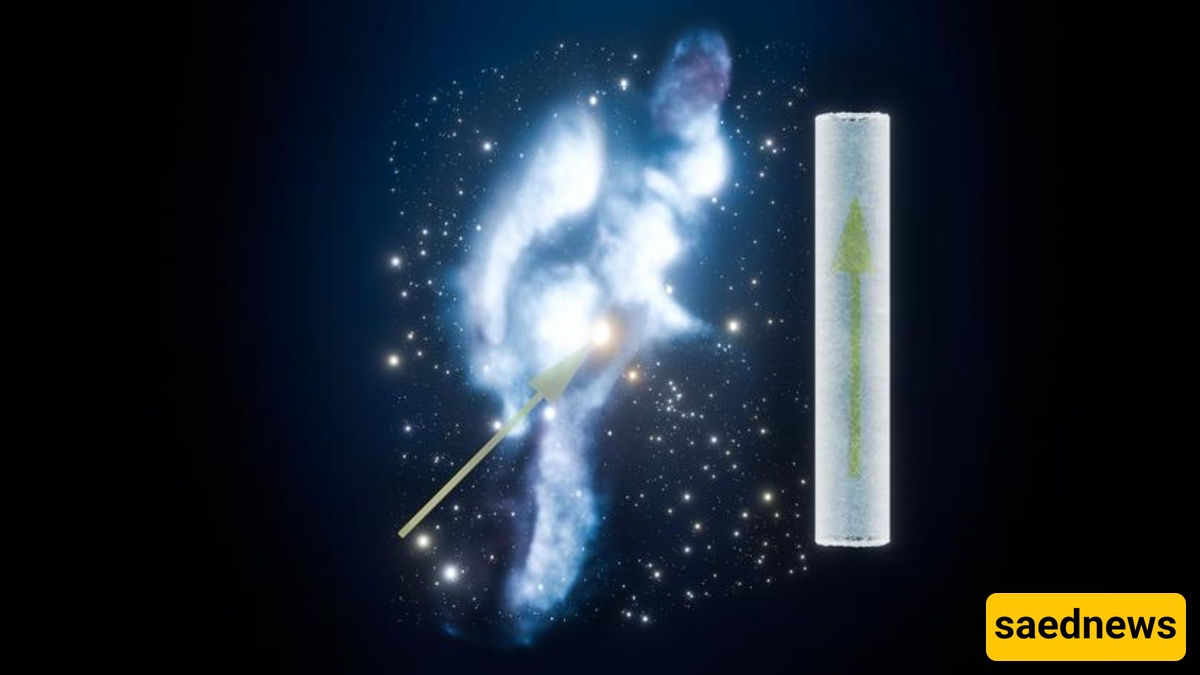
According to SAEDNEWS, scientists have discovered stardust trapped in Antarctic ice, but what can this dust tell us about the solar system?
Remnants of radioactive stardust from stellar explosions have been trapped in Antarctic ice. Researchers in a new study found that these cosmic remnants act as clues that help uncover the history of our solar system.
According to Space, throughout the universe we find vast interstellar clouds of gas, dust, and plasma that exist between stars. Our solar system is currently passing through such a cloud, known as the Local Interstellar Cloud.
These clouds can collect material while drifting through space, and this material can sometimes reach Earth as our planet passes through the interstellar cloud. In a new study of some of this material, researchers have found a byproduct of ancient supernovae, a radioactive iron isotope known as iron-60, trapped in the cloud and embedded in Antarctic ice.
But how did researchers know that this iron isotope found in Antarctic ice came from an ancient stellar explosion carried by an interstellar cloud?
A group of researchers analyzed more than 300 kilograms of ice samples from Antarctica dating back 40,000 to 80,000 years. This is the time period during which scientists believe a supernova occurred, ejecting material into space and into the cloud. After melting and chemically purifying the ice, and using a method called accelerator mass spectrometry, which essentially accelerates ions and allows researchers to separate isotopes, they were able to examine and count individual atoms of the isotope in their samples.
They were looking for individual atoms of the radioactive isotope Fe-60. This isotope is a signature of exploding stars. Their hypothesis was that iron-60, if originating from stellar explosions, could be present in the Local Interstellar Cloud.
The group compared the amount of iron isotope in newly fallen snow with the amount found in ancient ice. They found less iron-60 in older samples, suggesting that less of it reached Earth between 40,000 and 80,000 years ago than in more recent times.
Researchers believe the source of this dust is most likely a stellar explosion that occurred in the region of the Local Interstellar Cloud. This means that the clouds around our solar system are linked to a stellar explosion, and for the first time, this gives us a chance to investigate the origin of these clouds.
Scientists have said that our solar system has been traveling through the Local Interstellar Cloud for about 40,000 to 124,000 years, although only a few thousand years remain before it exits the cloud.
The team plans to conduct further research by studying ice samples from much older periods, before the solar system began passing through this cloud, in order to confirm and expand their findings.