SAEDNEWS: Abdolali Dastgheib believes many scholars have misunderstood Rumi. He argues that the focus should be on how Rumi expresses his ideas, not just what he says. According to Dastgheib, Rumi’s deep relationship with Shams was central to his transformation and is key to understanding his work.
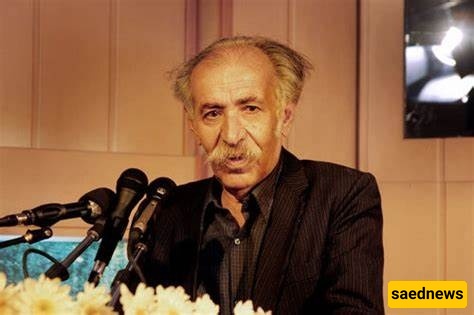
According to the social affairs service of Saed News Agency, in the spring of 2021, Abdulali Dastgheib, a prominent literary researcher and critic, revisited the life and works of Rumi in depth and revealed previously unspoken mysteries about his relationship with Shams of Tabriz. In an interview, he emphasized that Rumi scholars, including Badi al-Zaman Forouzanfar and Jalal al-Din Homai, had taken a wrong approach in analyzing Rumi’s works. In Dastgheib’s view, instead of asking “what did Rumi say?”, one should ask “how did Rumi say it?”. This perspective opened a new window for understanding the deep connection between Shams and Rumi, a connection that, according to him, came at the cost of Shams’s life.
Citing sources such as Manaqib al-Arifin by Aflaki and the Sipehsalar Treatise, Dastgheib stated that the killing of Shams of Tabriz in Konya by jealous associates of Rumi and Seljuk courtiers was certain. He dismissed theories attributing Shams’s disappearance to travel or voluntary absence, and explained from a psychological perspective that Rumi, unable to believe in this crime, repeatedly searched for Shams in cities such as Damascus, but found no trace of him.
The critic considered the relationship between Shams and Rumi to be beyond a normal friendship, stating that in their long private gatherings they sought to establish a new spiritual path based on sama (whirling dance), poetry, and music in order to draw closer to God. However, these ideas faced opposition from those around them and ultimately led to the killing of Shams. Dastgheib added that although Shams had limited academic knowledge, his strong psychological influence left a lasting impact on Rumi that continued until the end of his life.
Dastgheib also discussed Rumi’s poetic style, stating that unlike the refined poetry of Hafez and Saadi, his ghazals had an epic tone and were closely aligned with instruments such as the daf and ney. Referring to repetition in Rumi’s poetry and its thematic diversity, he suggested compiling a selection of his best ghazals for modern audiences.
In conclusion, Dastgheib referred to the grand funeral ceremony of Rumi, in which figures ranging from Sultan Ala al-Din Kayqubad to the Jews and Christians of Konya participated with music and whirling dance. This event demonstrated Rumi’s unparalleled status in history. Dastgheib’s reinterpretation not only shed light on the mystery of Shams’s death after 800 years, but also invited readers to re-examine Rumi’s works from a new perspective, focusing on his style and method.