SAEDNEWS: Silk and Light Trigger a Hydrogen Peroxide–Like Chemical Reaction
According to Saed News and quoted from Net Nevesht:
Silk is one of the materials that has consistently attracted human attention throughout history, with its high value repeatedly emphasized. In recent years, scientists have also focused extensively on it because silk is extremely strong. As a result, it can be used in bulletproof vests and protective armor. However, silk’s potential goes beyond external applications; it can also be used inside the human body as part of biological structures, to help heal wounds and even support bone stability.
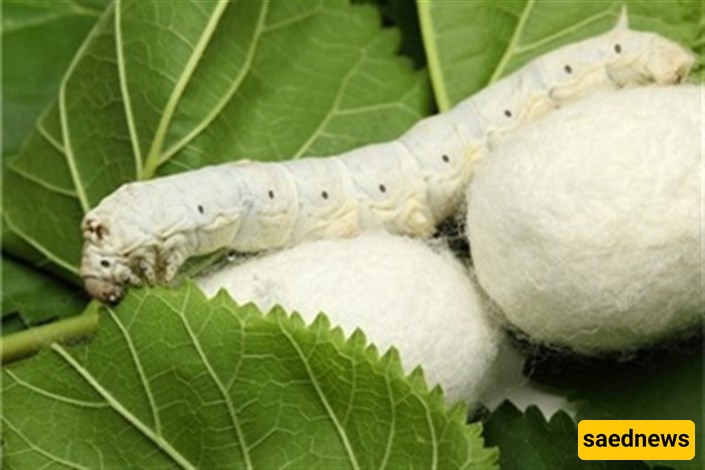
It is worth noting that silk comes in two types: one produced by silkworms to form cocoons, and another produced by spiders for their webs. These two types differ from each other and also have distinct properties. For example, silkworm silk is slightly weaker compared to spider silk. However, both are highly strong and can potentially be used for various medical applications inside the human body.
According to Young Kim, researchers first identified all natural proteins that can be activated by a specific type of light in order to create a chemical reaction capable of killing pathogens. They then genetically engineered a silkworm by inserting these proteins into its DNA, enabling it to produce a bright red silk that becomes activated by green light.
Interestingly, when scientists placed E. coli bacteria on this silk and exposed it to green light for one hour, they observed a 45% reduction in bacterial survival. According to Young Kim, this process is similar to how hydrogen peroxide works in disinfecting a wound or cut. In fact, silk combined with light exposure can generate a chemical reaction similar to that of hydrogen peroxide.
Although this engineered silk cannot distinguish between harmful and harmless pathogens, hydrogen peroxide also lacks this ability. The minimum exposure time required for the light to be effective is still unknown. Nevertheless, this discovery is highly promising and could potentially be used for purifying various materials, including air and water, which are important for human health.
In another study published by Kim and colleagues, it was shown that certain physical properties cause silk to cool down significantly, which may help reduce inflammation. This finding, combined with previous research, suggests that silk could be used in advanced bandages that both eliminate bacteria and reduce inflammation risk.
It has also been found that silk can be used to maintain the health of certain body structures, such as bones. When a bone is fractured, doctors typically use a metal implant, such as titanium or stainless steel, to keep the bone stable during healing. However, according to Mei Wei, a materials scientist at the University of Connecticut, these metals can sometimes harden and cause further fractures. In addition, once the bone heals, a second surgery is required to remove the metal.
Wei and her team have developed a type of silk that could offer a better alternative to metal implants. This silk is strong yet flexible, and it naturally dissolves after about one year, eliminating the need for a second surgery.
The team combined a protein found in spider silk called fibroin with a type of plastic and calcium similar to that found in human bones. The result was a material stronger than human bone itself. In fact, it is considered one of the strongest materials ever created that can also be absorbed by the body. The researchers are continuing to refine the material before testing it in animals.
One major challenge with this type of silk is its high cost. In addition, silkworms are relatively rare, and using spiders is not a practical solution. However, plant-based materials such as wood nanocellulose are both strong and inexpensive. A promising approach is to combine nanocellulose with silk to create a more affordable material.
Daniel Söderberg has noted that when nature creates a tree, it must have a strong mechanical structure to avoid collapse.
His team combined nanocellulose for strength with silk for stiffness and elasticity.
This composite material could be used in bulletproof vests. In the future, it may even be used as part of the human body. It degrades outside the body, but inside the body it remains stable because the body cannot break down nanocellulose. However, it is considered safe, and cells can grow on and around it. Its elasticity makes it a promising candidate for tendon replacement, a procedure that is currently difficult and often requires using tissue from other parts of the body.
Söderberg and his team are continuing to improve the material and are also working to reduce production costs so that it can be more widely used in medical applications.