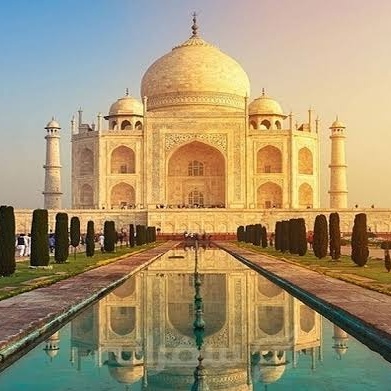
SAEDNEWS: The Taj Mahal: One of the New Seven Wonders of the World – India’s Iconic Monument, Mughal Architecture, and the Eternal Love Story of Shah Jahan and Mumtaz Mahal
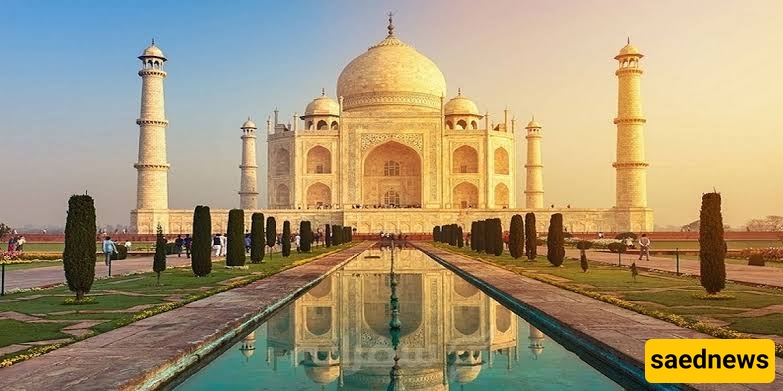
According to Saednews, The Taj Mahal (Hindi: ताज महल; Urdu: تاج محل) is one of the most famous monuments in the world. This magnificent mausoleum is located near the city of Agra, approximately 200 kilometres south of New Delhi, the capital of India. It is recognised as one of the New Seven Wonders of the World.
Commissioned by Emperor Shah Jahan, the fifth Mughal ruler of India, the Taj Mahal was built in memory of his Persian-born wife, Arjumand Banu Begum, better known as Mumtaz Mahal. She died in 1631 during childbirth while accompanying the emperor on a military campaign. Shah Jahan was eventually buried beside her in the same mausoleum.
The name Taj Mahal has Persian origins. The monument combines elements of Persian, Indian and Islamic architecture. Approximately 20,000 artisans, craftsmen and architects from different parts of Asia participated in its construction, particularly from Persia, the Indian subcontinent, Central Asia and Anatolia.
Construction of the Taj Mahal began in 1632 and was completed in 1647.
Ahmad Lahori and his brother, Master Hamid Lahori, were among the Persian architects traditionally associated with the construction of the Taj Mahal in India. Historical accounts also mention Isa Khan Shirazi and Amanat Khan Shirazi, a Persian calligrapher responsible for much of the exquisite calligraphy decorating the monument's walls and entrances.
Shah Jahan and Mumtaz Mahal married in 1612 and shared 18 years of married life. Their union produced 14 children, seven of whom survived into adulthood. Mumtaz Mahal was Shah Jahan's second wife. She died on 17 June 1631 while giving birth to their fourteenth child.
During one of his military campaigns, Shah Jahan had taken Mumtaz Mahal, whom he deeply loved, with him. She was pregnant and approaching the final months of her pregnancy. Their fourteenth child was a daughter named Gauharara Begum. Unfortunately, Mumtaz Mahal died shortly after giving birth.
Mumtaz Mahal was only 39 years old when she passed away. According to historical accounts, she asked her husband not to marry another woman after her death and to build a magnificent tomb in her memory so that her name would live forever.
Her sudden death plunged the emperor into profound grief. Following a period of reflection, Shah Jahan decided to fulfil her wishes by constructing an extraordinary mausoleum over her grave, creating a lasting symbol of his love. He summoned the finest architects, engineers, designers and craftsmen from across the world to create what would become one of the greatest achievements of Mughal architecture.
According to historians, following the death of his beloved wife, Shah Jahan replaced his royal garments with white mourning clothes and grieved for an entire year. The emperor, who had previously shed considerable blood in expanding his empire, withdrew from public life. For a period, his daughter Jahanara Begum took responsibility for many affairs of state. Historical accounts also claim that Shah Jahan's black hair turned white within one or two months of mourning.
Eventually, after recovering from his deep sorrow, Shah Jahan began fulfilling Mumtaz Mahal's wishes. He invited the finest architects and calligraphers from across India and beyond to construct a memorial for his beloved wife in Agra, the capital of the Mughal Empire.
Historians of that period referred to the monument as the Rauza-i-Mumtaz Mahal, meaning the Mausoleum of Mumtaz Mahal. Some accounts suggest that the name Taj Mahal is an abbreviated form of Mumtaz Mahal. Peter Mundy, a European traveller of the seventeenth century, also referred to the Taj Mahal in his writings as the tomb of the Mughal court's queen.
Years later, Shah Jahan was defeated by his son Aurangzeb and placed under confinement in the Red Fort (Lal Qila). Following his death, he was laid to rest beside Mumtaz Mahal beneath the magnificent dome of the Taj Mahal.
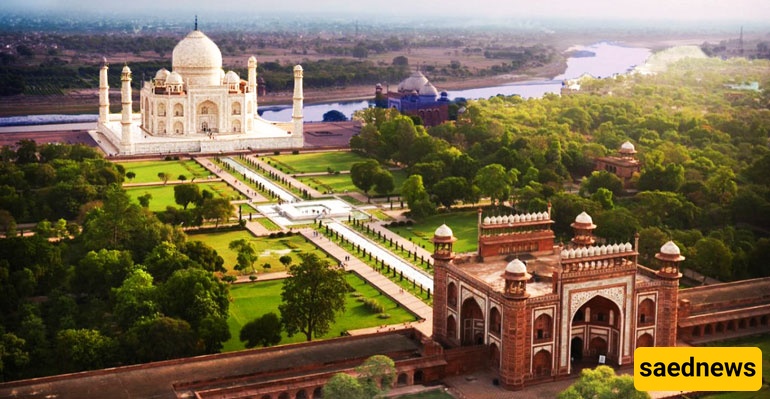
Shah Jahan selected a site beside the Yamuna River for the construction of this magnificent monument.
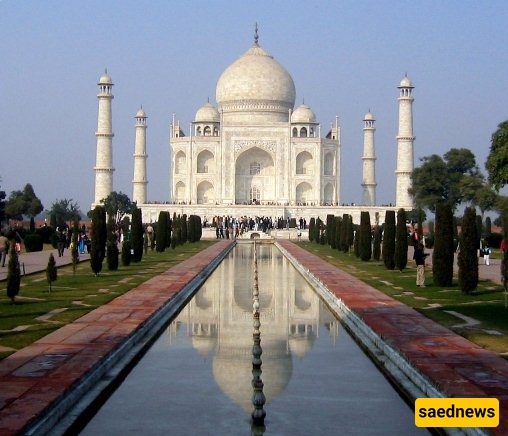
The Taj Mahal is approximately 58 metres high and 56 metres wide. Located near Agra in the Indian state of Uttar Pradesh, it stands on an enormous marble platform measuring approximately 100 by 100 metres.
The monument is surrounded by an extensive garden covering approximately 18 hectares. At the centre of the garden runs a long reflecting water channel, designed in the traditional style of Persian gardens.
Shah Jahan originally intended to build a second mausoleum for himself on the opposite bank of the Yamuna River, directly facing the Taj Mahal. He planned to connect the two monuments with a bridge, symbolising the eternal bond between himself and his wife, transcending the passage of time.
Unlike the Taj Mahal, which is predominantly constructed of white marble, his own mausoleum was intended to be made of black marble. However, these plans were never realised, and Shah Jahan was ultimately buried beside his wife.
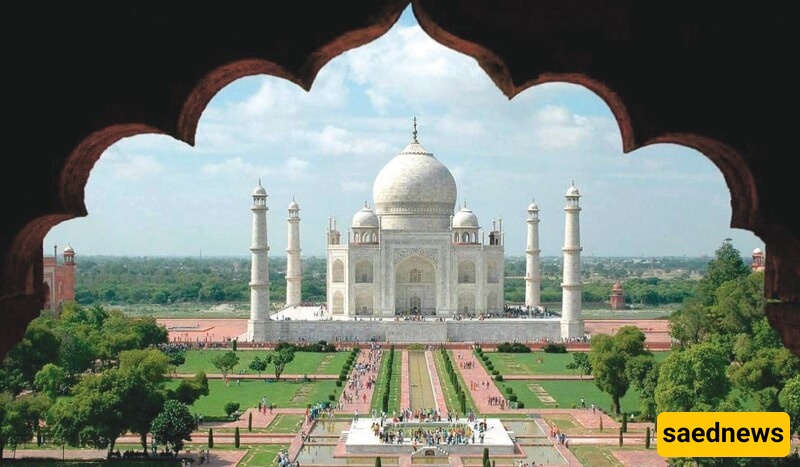
The Taj Mahal became a UNESCO World Heritage Site in 1983. Later, following a worldwide public vote whose results were announced on 8 July 2007, it was officially recognised as one of the New Seven Wonders of the World.
On either side of the main mausoleum stand two smaller, symmetrical structures. To the west is a mosque featuring three domes, constructed from reddish-brown sandstone. On the eastern side stands an identical building, traditionally believed to have served as a guesthouse.
The Taj Mahal remains one of the world's most celebrated architectural masterpieces, representing the artistic achievements of the Mughal Empire and an enduring symbol of love, devotion and remembrance.