SAEDNEWS: Elon Musk says the value of a single hour of his time could reach $100 million—not as direct hourly income, but as the potential financial impact of making a better decision at the center of a massive company.
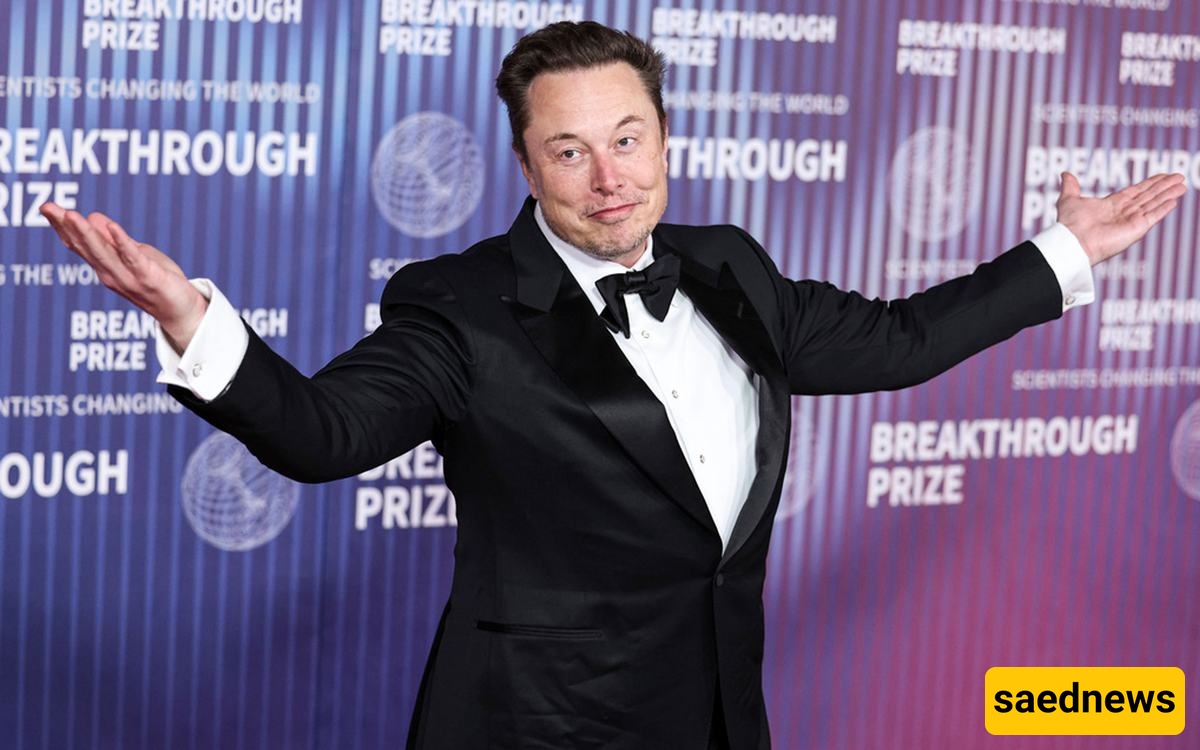
According to SaedNews: Elon Musk has offered a striking way to think about executive time: under the right circumstances, one hour of his time could be worth as much as $100 million.
The figure sounds extraordinary at first. But Musk’s argument is not that he personally earns $100 million every hour. Instead, he is describing the potential value created when a senior executive makes a decision that improves the performance of a company operating on an enormous financial scale.
In a recent interview, Musk explained his reasoning by pointing to Tesla’s expected revenue this year. He said the company will generate more than $100 billion in revenue, a figure that translates into roughly $2 billion a week.
That weekly figure is at the heart of his calculation.
When a company is moving money at that scale, even relatively small improvements in decision-making can have very large consequences. Musk’s argument is that if a decision can improve the outcome by a modest amount, the resulting financial difference can potentially reach hundreds of millions of dollars—and, in some cases, around $1 billion.
That changes the way an executive’s working hour can be viewed.
For an ordinary employee, an hour is generally measured by the work completed during that period. For the chief executive sitting at the center of a huge organization, however, an hour can be connected to decisions that influence multiple parts of the business simultaneously.
A choice involving production, supply chains, investment, product launches or engineering priorities may appear to be a single decision. But its consequences can spread across an enormous operation.
That is why Musk believes the ultimate value of a better decision could reach $100 million within an hour.
The important distinction is that the $100 million figure should not be interpreted as an hourly salary or direct revenue generated by Musk. It is better understood as an estimate of potential added value—the difference between what might happen following an ordinary decision and what could happen after a significantly better one.
This distinction matters because the claim is fundamentally about leverage.
A senior executive's influence can extend far beyond the number of tasks that person personally completes. When a decision affects a company generating tens of billions of dollars, a relatively small improvement can be magnified by the scale of the organization.
Musk’s comments therefore offer a glimpse into how he views his own role at Tesla. His time, in this framework, is valuable because it is concentrated at a point where decisions can affect production, engineering, investment and other major areas of the company.
The argument also highlights why decision-making becomes increasingly important as businesses grow. A small company may be able to absorb a poor decision with limited financial consequences. At a company operating on a vastly larger scale, the same type of mistake—or the same improvement—can produce a much bigger outcome.
Musk’s example is built around Tesla, but the broader idea is easy to understand: the financial value of an executive's time is not necessarily determined by the number of hours worked. It can be determined by what happens because of the decisions made during those hours.
That is what makes the $100 million figure so eye-catching.
It is not a claim that every meeting, phone call or hour on Musk’s calendar automatically generates that amount of money. Nor does it mean that Tesla receives $100 million in additional revenue every time Musk makes a decision.
Instead, Musk is describing the potential economic impact of making better choices when the underlying business is already operating at enormous scale.
His calculation starts with more than $100 billion in annual revenue and roughly $2 billion in weekly revenue. From there, the argument is that even a relatively small improvement in outcomes can become financially significant.
In that sense, the most revealing part of Musk’s statement may not be the $100 million number itself. It is the idea that, inside a company as large as Tesla, a single decision can carry consequences far beyond the time required to make it.
The claim also raises a broader question about leadership: when the decisions of a small group of people can influence billions of dollars in business activity, how should the value of their time actually be measured?
For Musk, the answer is clear. At the highest level of corporate decision-making, time can become an unusually scarce and valuable asset—and a better decision can potentially be worth far more than the hour it took to make it.
Whether every decision can truly be assigned such a price is another question. But Musk’s calculation offers a striking reminder of how dramatically the stakes change when one person’s choices are connected to a company operating at extraordinary financial scale.
And that may be the real story behind the $100 million hour: not the price of Musk’s time itself, but the enormous financial leverage that can sit behind a single decision.