Saed News: According to many linguists, the hardest language in the world is not Mandarin, Basque, Hungarian, or Xhosa (spoken in South Africa), but rather “Navajo,” the language of one of the Native American tribes.
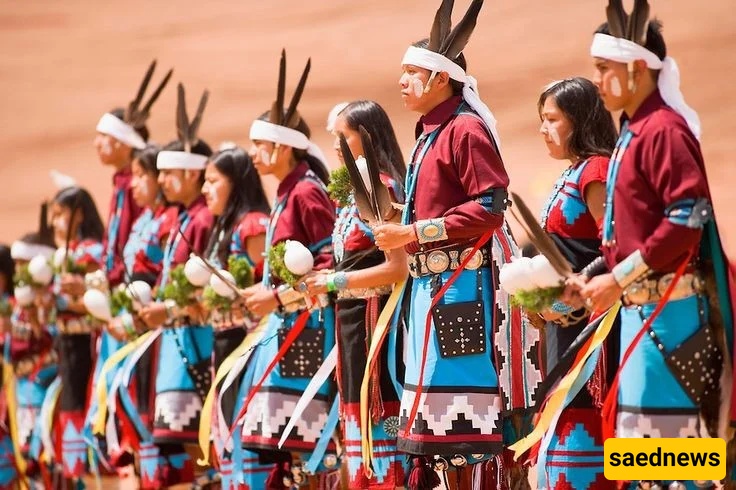
According to SAEDNEWS, quoting Faradid, the Navajo people, concentrated in Arizona and New Mexico, are one of the largest Native American groups in the United States. This tribe, which currently consists of 400,000 members, originated from northwestern Canada and was relocated to its present location in the 1860s through forced exile by the US federal government. Traditional Navajo families live in circular homes made of earth and wood called hogans, create complex ceremonial sand paintings, and hold four-day “running” ceremonies (a ceremony called Kinaaldá) to celebrate the coming of age of girls.
However, arguably the most important aspect of Navajo culture is their language. The Navajo language, also known as Diné Bizaad (the people’s language), is similar to Apache, from which it split between 1300 and 1525 AD. The Navajo and Apache languages belong to a language family called Athabaskan, also spoken by indigenous tribes in Yukon, Alaska, and British Columbia. Like other Native American languages, globalization and discrimination threaten the survival of Navajo. In 2017, the number of fluent Navajo speakers was estimated at 170,000, less than half of the tribe’s population.

Learning Navajo is not easy at all. Compared to other complex but more common languages such as Korean or Arabic, there are very limited resources available for learning it. Mastering Navajo also requires familiarity with Navajo customs, something that even some native people no longer fully have access to.
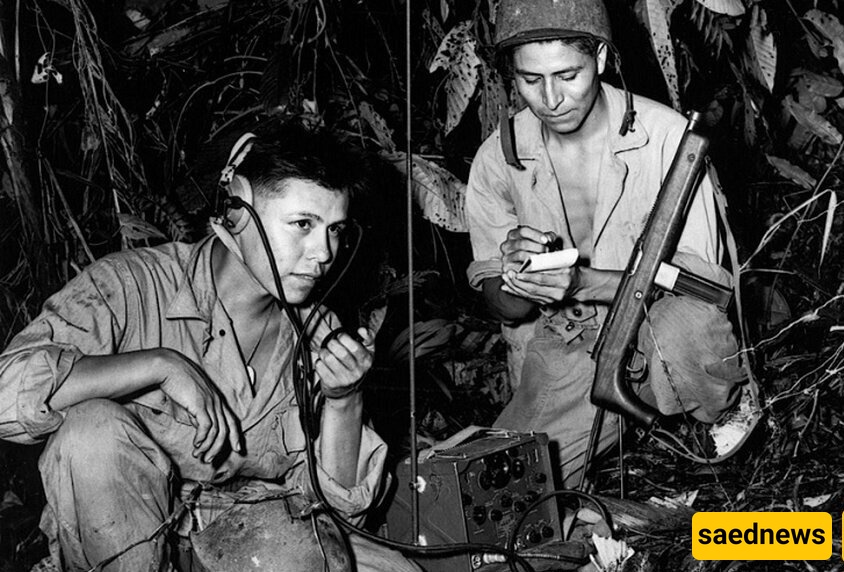
But the most daunting aspect of learning Navajo is the language itself. Two linguists, Robert W. Young and William Morgan, described it as a “hopeless tangle of disorder”; its grammar, syntax, and unique pronunciation are so difficult for outsiders that during World War II, the US military used Navajo as a type of code language.
Not only speaking but even listening comprehension of Navajo can be nightmarish. Like other Athabaskan languages, Navajo is a tonal language, meaning words with exactly the same spelling can have different meanings depending on pronunciation. Navajo not only distinguishes between long and short vowels (for example, bita means “in the middle” while bitaa means “father”), but also distinguishes between four different pitch levels. Athabaskan is the only Native American language family that relies so heavily on tone, meaning Navajo can be as confusing for a Cherokee speaker as for a white New Yorker.
Navajo also has sounds that do not exist in many other languages. It has 33 consonants and 12 vowels (compared to English, which has 21 consonants and 5 vowels). It includes vowels pronounced partly through the nose, and consonants produced by placing the tongue against the roof of the mouth and exhaling from both sides.
One Native student from Arizona State University said: “Teaching our language is difficult because of the different sounds and symbols. You have to interact with others to know if you are saying it correctly.”
The next stage is grammar. Like Spanish, Navajo is a verb-centered language in which a single verb can carry as much information as an entire English sentence. Verbs in Navajo change depending on how an action is performed. For example, “nash’aah” means touching something once, while “yish’aah” means repeatedly handling something. Verbs also change depending on the nature of the object involved. For instance, the verb “to give” changes depending on whether you are giving a compact object, a long flexible object, a rigid object, a flat object, or a container. So if you want to ask someone for a glass of water, you must first check whether the glass is empty, full, or half full.