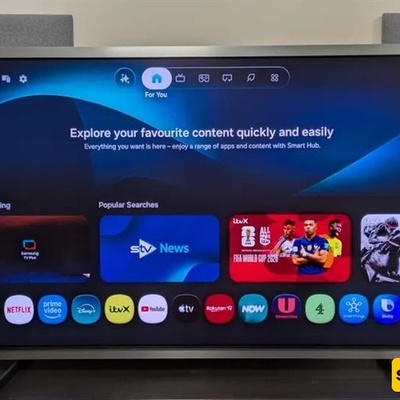
SAEDNEWS: Samsung is facing renewed privacy concerns after a security researcher reportedly discovered software markers linked to detecting baby cries and dog barking, raising questions about how household data is collected and processed.

According to Saednews, A security researcher’s analysis of Samsung TV software has raised concerns about household sound detection and targeted advertising after reportedly uncovering references to dog barking, baby crying, camera activity and nearby microphones. However, the findings do not prove that Samsung secretly accessed microphones or used the collected data for advertising.
The claims were shared by an X user known as log4j and discussed in a Reddit thread. The investigation began after the researcher examined the television’s data usage in response to increasingly personalised on-screen advertisements.
According to the researcher, the software contained markers associated with detecting dog barking and baby crying, information about camera streaming duration, and a feature designed to identify microphones in nearby devices.
The findings have renewed concerns about the amount of data collected by smart TVs and how manufacturers use information about household activities. These concerns follow earlier allegations involving data collection by LG televisions.
However, some of the reported capabilities appear to be connected to features Samsung had previously advertised rather than undisclosed surveillance systems.
Samsung’s Family Care feature, for example, was designed to detect a baby’s cries and send alerts to connected mobile devices. Its Pet Care feature offered similar functionality for detecting dog barking. Both features were designed to operate while the television was in standby mode.
Samsung has announced that it is discontinuing Family Care approximately 18 months after its launch, citing low usage and persistent false positives. In some reported cases, the system mistakenly interpreted crying sounds from television programmes as real events.
Although these features help explain why the software contains references to household sounds, questions remain about whether Samsung adequately informs users when such events are reported to its servers and why collecting this information is necessary.
Companies commonly gather usage data to understand how customers interact with their products and evaluate feature performance. However, the extent of Samsung’s data collection and retention practices remains unclear based on the reported findings.
The researcher’s discovery concerning the detection of microphones in nearby devices has also raised questions about potential access to household equipment.
Nevertheless, identifying a nearby device equipped with a microphone does not, by itself, demonstrate that the television accesses or records audio through it. Such detection could support functions such as karaoke and video calling by helping the television identify available microphones when those applications are launched.
Further technical findings may clarify whether the software performs monitoring beyond the functions associated with Family Care and Pet Care.
The researcher has also reportedly identified a region-specific neural network that monitors the use of applications such as YouTube. A more detailed technical analysis is expected to provide additional information about its purpose and operation.
Until further evidence becomes available, the findings do not establish that Samsung is secretly recording household conversations or collecting audio specifically to deliver targeted advertisements.
Nevertheless, the case highlights broader concerns about transparency, consent and the amount of information smart TV manufacturers collect from their users.
These issues are particularly relevant in markets where data protection regulations provide different levels of safeguards. Consumers need to understand what information their devices collect, how that information is processed and whether it is shared with third parties.