SAEDNEWS: Unraveling a Mysterious Enigma That May Preoccupy Many People Around the World
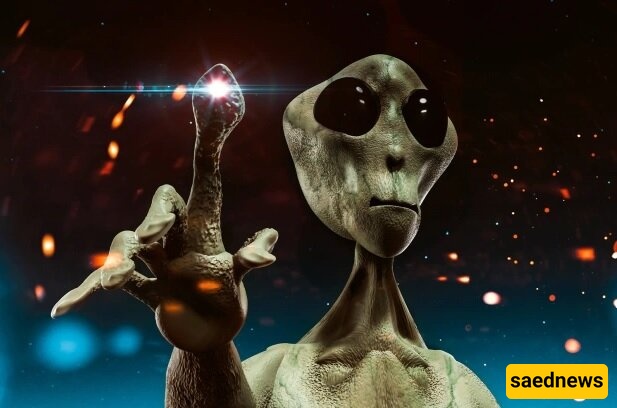
According to Saed News, quoting Javan News Agency, there are between 100 and 200 billion galaxies in the universe. Every star has at least one planet, and out of every six planets, one is similar to Earth. Despite all this, the only known living beings in the universe so far are those on Earth.
However, this fact has not changed public beliefs about the existence of extraterrestrials among us. Around 40% of Americans believe that aliens or space beings exist somewhere in the universe, and 35% of them think that at some point in history, aliens have been present among humans.
About 11% of people participating in various surveys believe that aliens are currently living among us and that many of them hold high-ranking positions or jobs. Meanwhile, some people also believe in time travel and suggest that a different type of “earth-based alien” may be living normal daily lives among humans.
If we imagine extraterrestrials as something like a gorilla, it would be nearly impossible for such a large, unusual being to pass through a crowd unnoticed. The same idea could apply to aliens. We assume that, with our current abilities, we would be able to recognize an alien if we saw one. In our minds, aliens have a fixed and recognizable form.
In the famous “invisible gorilla” experiment, participants are asked to count basketball passes between people. During the activity, a person in a gorilla suit walks through the scene, yet only about half of the participants notice it. The mind becomes so focused on a specific task that it completely ignores even obvious changes in the environment.
With such a mind—capable of ignoring obvious and familiar visuals—how can we expect humans to easily detect life forms that differ drastically from our expectations? An alien could be far more intelligent than us, too small to notice, or even something we do not recognize as “life” at all.
Perhaps aliens are made of dark matter, or perhaps they do not have a physical form at all. These ideas remain speculative hypotheses that we do not fully understand. As a result, many strange events in daily life become easier to imagine, even if they lack scientific, ethical, or religious explanations.
We might also consider alien communication systems. Humans rely on sound, light, and touch as basic communication methods. But what if aliens communicate through entirely different senses—like cats using smell? There could be millions of communication methods in the universe that we are unaware of, while we still search using our limited assumptions.
Let us explore another idea. Imagine a planet where intelligent beings like humans exist. Over time, they develop artificial intelligence and live alongside advanced robots.
Eventually, these robots—frustrated by inequality or conflict—eliminate biological life on that planet and take control. In such a world, traditional biological life might be replaced by digital existence.
We usually imagine robots as slow-moving metal machines, but a robot could instead be a complex computer program living in a virtual world. A different form of life that is conscious, capable of feeling, and able to make decisions. It might even be reading this text right now.
Such beings could easily travel between planets, adapt to different technologies, and spread like computer viruses across systems.
Taking this idea further, it is possible that a form of life—traditional or digital—could exist inside human bodies. Many known and unknown viruses may represent a different kind of life that has entered biological systems.
These could range from a simple cold virus to an unknown entity influencing human behavior. If humans are considered intelligent animals, then it is possible that what we call “life” is itself the result of another entity’s survival strategy on Earth. This perspective has even led some scientists to speculate that humans themselves might be a kind of alien life on Earth.
Another theory suggests that if extraterrestrials had visited Earth in prehistoric times—or even in recent centuries—human reactions might not have been welcoming. Fear of difference still exists today, and humans often reject those who appear too different.
So what guarantees that we did not eliminate alien visitors in the past? What if some aliens were captured and studied in secret facilities today? Given global political competition and secrecy, such ideas are not entirely dismissed by some thinkers.
Even well-known figures like Elon Musk have been jokingly associated with alien theories. Some internet users claim he is an alien with extraordinary intelligence. Musk himself has responded humorously:
“I think this is one of the most important questions in physics and philosophy. Are aliens among us? Some people think I am an alien. But I must clarify: I am not an alien. Even if I were, my answer would still be a simple no.”
Regardless of such jokes, the idea of aliens among humans raises deeper questions. If an advanced civilization existed, would they even need to physically visit Earth? Or could they simply collect information remotely?
Another hypothesis is the “space farming” theory. It suggests that Earth is a kind of experimental laboratory where advanced beings periodically introduce new forms of life.
In 2015, British scientists reportedly discovered a seed-like structure with genetic material unlike anything known on Earth, placed on a metallic surface. Some interpretations suggested it could be evidence of extraterrestrial “seeding” of life on Earth.
If this theory were true, it would imply that Earth is being observed or managed by a higher intelligence, possibly for experimental purposes.
A concern raised by this idea is that such interventions could involve genetic manipulation or even extinction-level risks through unknown viruses or biological changes.
If intelligent extraterrestrials exist, it is also possible they have already visited Earth and left. Such beings might consider Earth too primitive or uninteresting compared to the vast universe and move on quickly.
Reports of unidentified flying objects and mysterious sightings exist, but none can be definitively verified.
Similarly, many historical structures—such as the pyramids of Egypt—have fueled speculation. How ancient civilizations built such massive structures remains partially unexplained, though modern archaeology continues to study them.
Despite all theories and mysterious signs, there is still no concrete evidence of extraterrestrial life. Water, a key ingredient for life on Earth, exists in some form on about one-sixth of known planets.
One major challenge in identifying life elsewhere is that we still do not fully understand how life originated on Earth itself. If we could create a living single-celled organism from non-living materials, it might help answer this question. So far, however, no such creation has been achieved.
Mathematics allows us to estimate the probability of life elsewhere in the universe. Given billions of planets, the existence of life elsewhere seems statistically plausible. Yet it is also possible that we are completely alone—like rolling dice millions of times and only once getting double sixes.