SAEDNEWS: Recent archaeological studies indicate that tattoos—one of the oldest forms of human cultural expression—have a history stretching back 5,200 years in both the world and Europe.
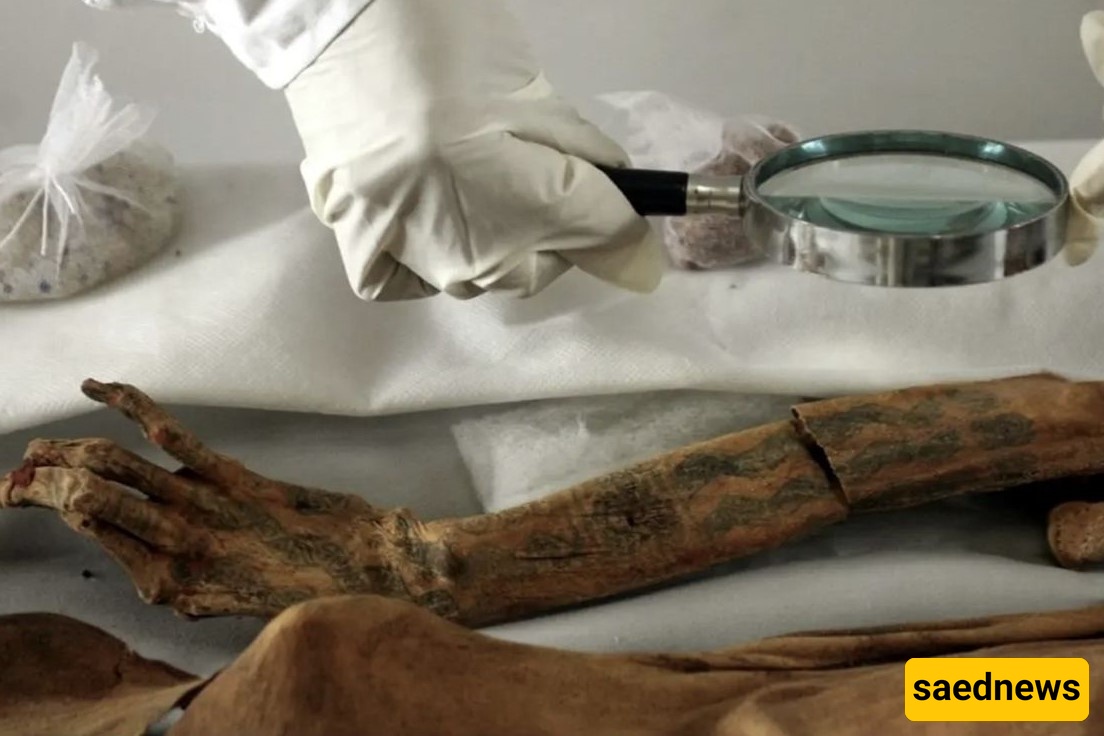
According to Saednews Social Affairs Desk, Archaeological findings indicate that early humans, thousands of years ago, had already turned their bodies into canvases for conveying meaning. Studies of ancient tattooed mummies in Europe and other parts of the world suggest that this practice has deep roots in human civilization, dating back to the Neolithic period.
According to the report, the most significant and oldest historical evidence of tattoo culture is the famous mummy known as “Ötzi,” a man discovered in 1991 in the ice of the Alps on the modern border between Austria and Italy. Analyses show that he lived more than 5,200 years ago, and his body was naturally preserved in ice.
Ötzi is not only one of the oldest naturally preserved human mummies in the world, but his body also bears 61 tattoos—a series of simple lines and markings found on various parts of his body, including the knees, ankles, back, and torso. These tattoos are considered the oldest known examples of tattoos in Western Europe.
Based on archaeological research, National Geographic reports that Ötzi’s tattoos were created using a primitive yet effective technique similar to modern hand-poking methods. The skin was punctured with a sharp tool, and soot or charcoal was then rubbed into the wounds to form the patterns. This suggests that prehistoric humans possessed both the tools and the practical knowledge required for tattooing.
One of the key questions among archaeologists studying ancient tattoos concerns their meaning. The placement of many markings—particularly on joints such as the knees and ankles—has drawn scientific attention, as these areas are often associated with chronic pain and physical strain. This has led some researchers to propose that ancient tattoos may have had therapeutic functions.
According to this hypothesis, tattoos may have been used as a form of pain relief or treatment for musculoskeletal disorders, showing similarities to traditional acupuncture. This suggests that early humans had an experiential understanding of the body and pain management.
Alongside the medical interpretation, other researchers argue that tattoos may have served ritualistic or symbolic purposes. The use of geometric patterns on parts of the body such as the chest has been interpreted as a possible reflection of religious beliefs, group identity, or social status. In prehistoric societies, the human body may have functioned as a medium for expressing meaning, belonging, and symbolic power, with tattoos helping to define an individual’s role within the community.
Although Ötzi provides the oldest known example of tattoos in Europe, evidence shows that tattooing was not limited to this region.
In ancient Egypt, infrared imaging of mummies has revealed symbolic tattoos on some individuals. These markings, dating back to approximately 3300–3000 BCE, often include animal figures and geometric designs.
Similarly, in the Americas and other regions, tattoo traces discovered on human remains indicate widespread use of body art as a means of expressing magical beliefs, ritual practices, or social identity across ancient cultures.
Despite scientific advances and detailed analyses, researchers have not yet reached a definitive conclusion regarding the exact meaning of ancient tattoos. The purpose of these markings—some of which are more than 5,200 years old—remains uncertain. Scholars still cannot say with certainty whether they were primarily therapeutic tools or expressions of spiritual and social identity. However, it is widely accepted that tattooing in prehistoric humans was far more than simple decoration—it was a complex cultural practice embedded in meaning and belief.