SAEDNEWS: Iran says the Strait of Hormuz is fully open, while Donald Trump states the U.S. naval blockade will remain in force until a long-term deal is reached.
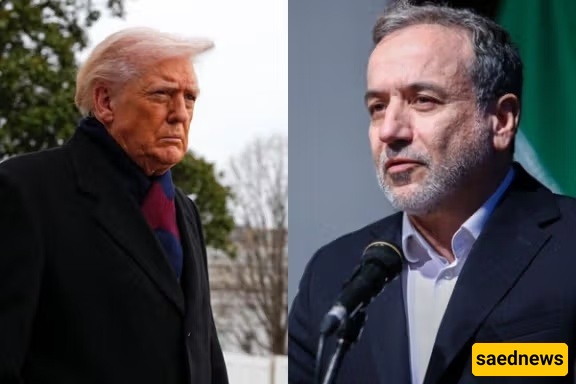
According to Saed News’ political desk, citing The Hill, Iran has announced that the strategic Strait of Hormuz—one of the world’s most vital shipping routes—is now “fully” open after being largely closed since the outbreak of conflict between the United States and Iran earlier this year.
Iran’s Foreign Minister, Abbas Araghchi, wrote in a post on X on Friday: “In line with the ceasefire in Lebanon, the passage of all commercial vessels through the Strait of Hormuz is fully open for the remainder of the ceasefire period, via the coordinated route previously announced by the Ports and Maritime Organization of the Islamic Republic of Iran.”
U.S. President Donald Trump reacted enthusiastically to Iran’s announcement but emphasized that the American blockade remains in place. Writing on Truth Social, he said: “Iran has just stated that the Strait is fully open and ready for complete passage. Thank you.”
In a subsequent post, Trump added that the U.S. naval blockade of the strait would continue “with full force” until a long-term agreement is reached between Tehran and Washington. He wrote: “The Strait of Hormuz is fully open and operational, but the naval blockade—applying only to Iran—will remain in full effect until our agreement with Iran is 100 percent complete. This process must move very quickly, as most elements have already been agreed upon.”
The announcement coincided with the implementation of a 10-day ceasefire between Israel and Lebanon, a development that could remove a major obstacle to a broader peace agreement involving Iran.
Following the news, U.S. financial markets showed upward momentum, with the Dow Jones, S&P 500, and Nasdaq indices all posting gains.
The earlier closure of the strait had driven a surge in global fuel prices. On Friday, Brent crude—the global benchmark—fell to $89 per barrel, while West Texas Intermediate (WTI), the U.S. benchmark, reached $81.
In another Truth Social post, Trump claimed that Iran had agreed to hand over its “nuclear dust,” a phrase that appears to refer to enriched uranium. He also stated that Israel would cease bombing Lebanon.
“The United States will receive all the ‘nuclear dust’ produced by our magnificent B-2 bombers. No money will be exchanged in any form. This agreement is not contingent on Lebanon, but the U.S. will separately work with Lebanon and address the Hezbollah situation appropriately. Israel will no longer bomb Lebanon,” he wrote.
These developments follow Trump’s earlier announcement that Israel and Lebanon had agreed to a 10-day ceasefire after talks in Washington—an outcome that could ease tensions in U.S.-Iran negotiations.
Since the onset of the conflict involving the United States and Israel against Iran, Israel has carried out heavy strikes in Lebanon targeting Iran-backed Lebanese militants, namely Hezbollah. While Iran and Pakistan had stated that Lebanon was included in the initial ceasefire framework, the United States and Israel disputed that claim.
According to Vice President Vance, who led the U.S. delegation, the first round of talks held last week in Islamabad made little progress toward an agreement.
Pakistan’s Foreign Ministry said on Thursday that Washington and Tehran are in contact via Pakistan to coordinate a second round of negotiations, though no date has yet been set.
Trump told reporters on Thursday that he might travel to Islamabad to finalize a deal if an agreement is reached.
On Friday morning, Trump also stated on Truth Social that he had received a phone call from NATO, asking whether the United States needed assistance following Iran’s announcement about the Strait of Hormuz. He responded: “I told them to stay out—unless they just want to fill their ships with oil. When they were needed, they were ineffective—a paper tiger!”
In another message, the president praised U.S. allies in the Persian Gulf, thanking Saudi Arabia, the United Arab Emirates, and Qatar for their “courage and support.”