SAEDNEWS: With Iran and the U.S. entering a fragile ceasefire, The Guardian’s report reveals a strategic failure for Israel—where, despite months of pressure and threats, Benjamin Netanyahu’s government not only fell short of its stated objectives but also faced widespread domestic criticism and weakened political and international standing.
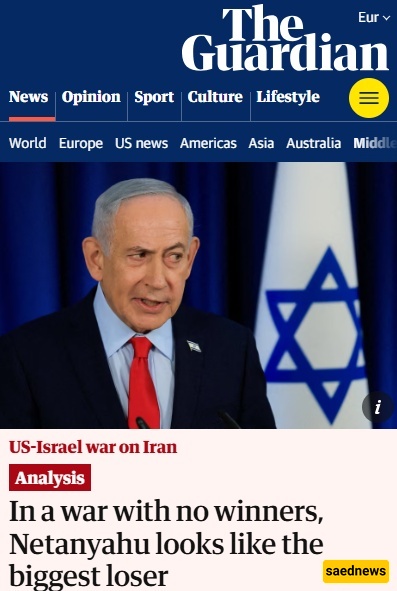
According to Saed News political service, The Guardian reported that in a war where the U.S.-Israel front failed, Israel’s Prime Minister appears to be the biggest loser, entering a fragile and uncertain ceasefire with Iran.
After years of Benjamin Netanyahu’s threats against Iran, his high-profile appearances at the UN General Assembly, suspicious dossiers presented continuously before global media cameras, and diplomatic pressure on successive U.S. presidents to approve a war against Iran, Israel’s confrontation ultimately ended in a comprehensive defeat.
The U.S. intelligence community’s conclusion that Israel’s predictions of regime change and revolution in Iran were “absurd” proved accurate in practice. Israel’s assumption that the conflict would last a few days at best, or a few weeks at worst, was clearly far from reality.
Even two days ago, according to Israel’s Channel 12, Netanyahu pressured Donald Trump not to agree to a ceasefire. Trump warned Tehran severely for a day before stepping back, and according to some accounts, sidelined Israel in the decision-making process.
Yair Lapid, Israel’s main opposition leader, wrote on X: “In all our history, there has never been a political disaster of this magnitude. Israel was not even at the table when decisions were made about the core of its national security.”
He added: “The army did everything it was asked, and the people showed remarkable resilience, but Netanyahu failed politically, failed strategically, and achieved none of the goals he set. Repairing the political and strategic damage he imposed through pride, neglect, and lack of strategic planning will take years.”
Yair Golan, leader of the leftist Democratic Party, called the ceasefire a “strategic failure” for Netanyahu. On X, he wrote: “He promised a historic and security victory for generations, but in reality, we suffered one of the most severe strategic defeats Israel has ever experienced. This is a total failure that will threaten Israel’s security for years to come.”
In reality, Netanyahu gambled everything on war. Unable to bring down Iran’s religious regime, seize Tehran’s high-enriched uranium reserves, or meaningfully weaken the Iranian government’s structure, Israel’s global standing—already damaged by actions in Gaza, where it has been accused of genocide—has been further eroded.
Contrary to Trump’s claims, the Islamic Revolutionary Guard Corps has emerged stronger; Tehran, at least for now, achieved its main objective: survival against a month-long assault by two of the world’s major military powers.
These attacks left behind a wounded but intact regime, one that still possesses significant military capacity and is likely to rebuild its armament capabilities quickly, seeking opportunities for retaliation.
Netanyahu’s insistence on continuing attacks in southern Lebanon seems to reflect political pride. Israel’s declaration of a new security zone confronts its forces with Hezbollah fighters on the ground, a group repeatedly proven highly effective in land battles.
In this context, Israel’s brutal, unannounced strikes on Lebanon appear more punitive and reactive than strategic, carried out after Israel failed to achieve its objectives in Iran.
The war’s consequences for public opinion and diplomacy are likely to be severe for Netanyahu and Israel. In the U.S., political consensus that had existed since the 1960s is clearly eroding. Israel’s role in pushing Trump toward war with Iran has faced criticism from both progressives and the far-right, and support for Israel has fallen to historically low levels—even among Jewish voters.
Yair Golan noted: “We experienced one of the most severe strategic defeats Israel has ever faced.”
Domestically, Netanyahu faces political repercussions in an election year. Instead of transforming Israel’s security, he emerges from a war in which none of his key promises materialized.
Despite Netanyahu’s well-known tendency to exaggerate temporary achievements, Israelis are realizing that he neither neutralized the so-called existential threat he claimed for years nor materially changed the situation.
Meanwhile, Iran’s Supreme Leader may be gone, but his determined successor appears in charge. Rather than closing the nuclear file, Tehran’s ten-point plan—once described by Trump as a feasible negotiation framework—seems to allow Iran’s right to enrich uranium, though Trump did not consider this part of an official agreement.
For now, the U.S.-Iran dialogue framework resembles the international nuclear deal under Barack Obama—a deal Netanyahu tried to destroy and from which Trump withdrew—rather than a new reality.
Some, including Haaretz military correspondent Amos Harel, argue that Netanyahu’s defeat was inherent from the start. Harel wrote: “Many weaknesses shared by the current U.S. administration and Israel’s political system under Netanyahu became clearly visible: gambling on baseless hopes, superficial and incomplete plans, disregard for experts, and aggressive pressure to force experts to align with political leadership.”
For Israelis, it is also clear that the recent month-long conflict was a rare opportunity to conduct such a large-scale campaign with full U.S. support. Other flare-ups may occur, but the chance for another prolonged confrontation seems unlikely.
Trump retreated at the most dangerous escalation stage, including ground troop deployment—a highly unpopular move with American voters due to its cost and global economic impact.
Netanyahu’s years-long reliance on war as a political tool now raises a question: what remains for him? Amos Harel concluded: “This is the fourth consecutive time—Gaza once, Lebanon once, Iran twice—that his promises of total victory and eliminating existential threats have been exposed as empty.”