SAEDNEWS: When does ritual bathing (Ghusl Janabah) become obligatory for men and women? Is it required when a person becomes wet due to sexual play? Learn about the Islamic rulings regarding Ghusl Janabah and when it must be performed.

According to Saednews, Apart from sexual intercourse and penetration, a woman becomes junub (in a state of major ritual impurity) if sexual stimulation causes her to reach the peak of sexual pleasure and arousal, and fluid is discharged at that moment.
If she does not reach the peak of sexual pleasure and fluid is discharged, or if she reaches the peak but no fluid is discharged, or if she is unsure whether any fluid was discharged, she does not become junub and Ghusl Janabah is not required.
If a woman is certain that semen has been discharged, she becomes junub. If she is not certain, she does not become junub. Therefore, when a woman experiences some pleasure due to sexual stimulation and fluid comes out, but she does not reach the peak of sexual pleasure, she does not become junub. The discharged fluid is also considered pure and does not invalidate Wudu (ablution) or require Ghusl.
The peak of sexual pleasure refers to a state in which a person typically becomes overwhelmed by pleasure and experiences intense sexual satisfaction. Semen is discharged, and afterward, the person feels relieved and satisfied. Sexual arousal subsides, and the body becomes relaxed or weak. The person no longer experiences the same level of stimulation as before release.
There are two causes of major ritual impurity:
Sexual intercourse.
The discharge of semen, whether during sleep or while awake, in a small or large amount, with or without sexual pleasure, and voluntarily or involuntarily.
If fluid comes out of a man and he does not know whether it is semen, urine, or something else, it is treated as semen if it is discharged with sexual pleasure and force and the body becomes weak afterward. If none of these three signs, or only some of them, are present, it is not treated as semen. However, for a sick person, forceful discharge and subsequent bodily weakness are not necessary; fluid discharged with sexual pleasure is treated as semen.

The moisture that women feel in their private parts during sexual play or sexually arousing thoughts is considered pure if it is not abundant enough to spread to other parts of the body or clothing. It does not require Ghusl and does not invalidate Wudu.
However, if the fluid is abundant enough to qualify as ejaculation and stain clothing, it is considered impure and causes major ritual impurity if accompanied by the woman reaching the peak of sexual pleasure and complete satisfaction (orgasm).
Even if it is not accompanied by orgasm, according to obligatory precaution, such fluid is considered impure and causes major ritual impurity. If a woman is unsure whether the fluid was sufficiently abundant or doubts whether any fluid was discharged at all, Ghusl is not obligatory, and neither Wudu nor Ghusl is invalidated.
If fluid comes out of a healthy man and has one of the three signs mentioned above, but he is unsure whether the other signs were present, he may rely on his existing Wudu if he had performed it before the discharge. If he had not performed Wudu, performing Wudu alone is sufficient, and Ghusl is not required.
It is recommended that a person urinate after the discharge of semen. If he does not urinate and, after performing Ghusl, fluid comes out that he cannot identify as semen or something else, it is treated as semen.
If a man has sexual intercourse with a woman and penetration reaches the extent of the circumcised portion or more, whether vaginally or anally, both become junub, whether they are adults or minors, even if no semen is discharged.
If a person doubts whether penetration reached the required extent, Ghusl is not obligatory.
If a person engages in sexual intercourse with an animal and semen is discharged, Ghusl alone is sufficient. If no semen is discharged and the person had Wudu before intercourse, Ghusl alone is still sufficient. If he did not have Wudu, obligatory precaution requires him to perform both Ghusl and Wudu. The same ruling applies to sexual intercourse with a male or a boy.
If semen moves from its place but does not come out, or a person doubts whether semen has been discharged, Ghusl is not obligatory.
A person who cannot perform Ghusl but can perform Tayammum (dry ablution) may engage in sexual intercourse with their spouse even after the time for prayer has begun.
If a person finds semen on their clothing, knows that it is theirs, and has not performed Ghusl for it, they must perform Ghusl and make up any prayers they are certain they performed after the semen was discharged. They do not need to make up prayers that they suspect may have been performed before the discharge.
Five things are forbidden for a person who is junub:
Touching the written text of the Quran or the name of God, in any language, with any part of the body. As a precaution, it is also better to avoid touching the names of the Prophets, the Imams, and Lady Fatimah (peace be upon them).
Entering the Grand Mosque in Mecca or the Prophet's Mosque in Medina, even if entering through one door and leaving through another.
Staying in other mosques and, according to obligatory precaution, the shrines of the Imams. Passing through a mosque from one entrance to another is permitted.
Entering a mosque to take something out or, according to obligatory precaution, placing something inside it, even without personally entering the mosque.
Reciting any verse of the Quran that requires obligatory prostration. These verses are found in Surah As-Sajdah (verse 15), Surah Fussilat (verse 37), Surah An-Najm (verse 62), and Surah Al-Alaq (verse 19).
Nine things are considered disliked for a person who is junub:
Eating and drinking. However, this is no longer disliked if the person washes their face and hands and rinses their mouth. Washing only the hands reduces the degree of dislike.
According to the commonly held view, reciting more than seven verses of the Quran that do not require obligatory prostration.
Touching the cover, margins, or spaces between the lines of the Quran with any part of the body.
Carrying a copy of the Quran.
Sleeping, unless the person performs Wudu or, if water is unavailable, Tayammum in place of Ghusl.
Applying henna or similar substances to the body.
Applying oil to the body.
Having sexual intercourse after experiencing a wet dream, meaning semen was discharged during sleep.
Other acts listed as disliked in the relevant religious rulings.
Ghusl Janabah is obligatory for performing prayers and similar acts of worship that require ritual purity. However, it is not required for the funeral prayer, the prostration of forgetfulness (Sujud al-Sahw), the prostration of gratitude (Sujud ash-Shukr), or the obligatory prostrations required when reciting certain Quranic verses.
It is not necessary to explicitly intend that the Ghusl is obligatory. Performing it with the intention of seeking closeness to God is sufficient.
If a person believes that the time for prayer has begun and performs Ghusl with the intention of fulfilling an obligation, but later discovers that the prayer time had not yet begun, the Ghusl is still valid.
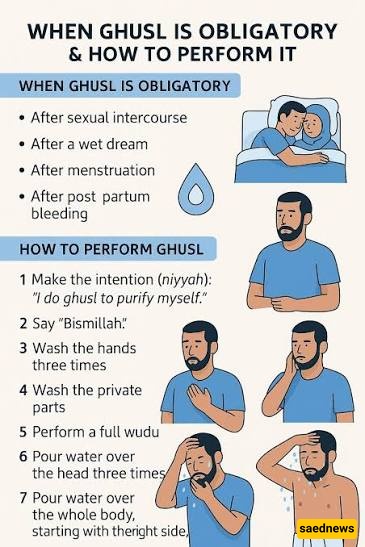
Ghusl Janabah can be performed in two ways: sequentially (Ghusl Tartibi) or by immersion (Ghusl Irtimasi).
In sequential Ghusl, according to obligatory precaution, the person must first wash the entire head and neck, then wash the entire body with the intention of performing Ghusl. It is preferable to wash the right side of the body before the left.
If a person deliberately, or through negligence in learning the relevant rulings, fails to wash the entire head and neck before washing the body, the Ghusl is invalid according to obligatory precaution.
According to obligatory precaution, it is not sufficient to intend to perform Ghusl simply by moving the head, neck, or body while it is underwater. The part being washed must first be taken out of the water and then washed with the intention of Ghusl.
If the body is washed before the head, there is no need to repeat the entire Ghusl. Washing the body again will make the Ghusl valid.
If a person is not certain that both the head and neck and the body have been washed completely, they should wash a portion of the adjoining area whenever washing each section to ensure that everything has been washed.
If, after completing Ghusl, a person realizes that some part of the body was not washed but does not know which part, there is no need to wash the head again. They need only wash the parts of the body they suspect were missed.
If a person discovers that part of the body was not washed:
If the missed area is on the left side, washing that area alone is sufficient.
If the missed area is on the right side, it is recommended, as a precaution, to wash the left side again after washing the missed area.
If the missed area is on the head or neck, according to obligatory precaution, the entire body must be washed again after washing that area.
If a person doubts whether they have washed part of the right or left side before completing Ghusl, they must wash that part. If they doubt whether part of the head or neck has been washed, then, according to obligatory precaution, they must wash the body again after washing the missed area.
Immersion Ghusl can be performed in two ways: instantaneous immersion and gradual immersion.
In instantaneous immersion, the entire body must be covered by water at one moment. However, the whole body does not need to be outside the water before beginning. If part of the body is outside the water and the person submerges themselves with the intention of performing Ghusl, it is sufficient.
In gradual immersion, the body must be submerged progressively in a manner that is conventionally regarded as one continuous act. In this method, each part of the body must be outside the water before it is immersed.
If a person discovers after completing immersion Ghusl that water did not reach some part of the body, they must perform Ghusl again, whether or not they know which part was missed.
If there is insufficient time to perform sequential Ghusl but enough time for immersion Ghusl, the person must perform immersion Ghusl.
A person who has entered the state of Ihram for Hajj or Umrah must not perform immersion Ghusl. However, if they do so out of forgetfulness, the Ghusl is valid.
Ghusl Janabah becomes obligatory following sexual intercourse involving the required degree of penetration or the discharge of semen. For women, ordinary moisture during sexual play or arousal does not automatically require Ghusl. According to the rulings described above, the amount and nature of the fluid, whether orgasm occurs, and whether the discharge is certain all affect the ruling.