SAEDNEWS: Many of today’s most colorful festivals began with rituals meant to honor gods, ancestors, spirits, nature or the changing seasons. From Nowruz and Holi to Halloween and Japan’s Gion Matsuri, their modern celebrations preserve fragments of remarkably old traditions.
According to SaedNews, some of the world's best-known festivals have histories that reach far beyond modern calendars, tourism and popular culture. Long before colorful powders were thrown into the air or enormous floats moved through city streets, communities gathered for rituals tied to religion, harvests, ancestors, seasonal change, disease and the supernatural.
But there is an important distinction: ancient origins do not necessarily mean that today's festival is unchanged from antiquity. Many celebrations evolved over centuries, absorbed new religious traditions or were revived after periods of decline. Their histories are therefore less like straight lines and more like layers of cultural memory.
Here are seven festivals whose modern forms preserve connections to ancient sacred practices.
Every spring, millions of people celebrate Nowruz, the Persian New Year, as the northern hemisphere approaches the vernal equinox. The festival is now shared by communities across Iran, Central Asia, the Caucasus, South Asia and elsewhere.
Its history reaches back more than two millennia, with some of its earliest roots connected to the religious world of ancient Zoroastrianism. UNESCO describes Nowruz as a rite dating to at least the 6th century BCE, while the United Nations notes that its roots extend back more than 3,000 years.
In the ancient Zoroastrian calendar, Nowruz was among the most important sacred occasions. Encyclopaedia Iranica describes it as one of the seven major Zoroastrian feasts and the holiest of them.
Modern Nowruz is much broader than a religious observance. Families clean their homes, prepare festive foods, visit relatives and arrange symbolic objects such as the Haft-Sin table. In Azerbaijan and other regions, fire rituals, music, dancing and public celebrations have become important parts of the festivities.
The central idea, however, remains remarkably old: renewal. Spring represents the return of life, while the new year offers a symbolic opportunity to leave the previous cycle behind.
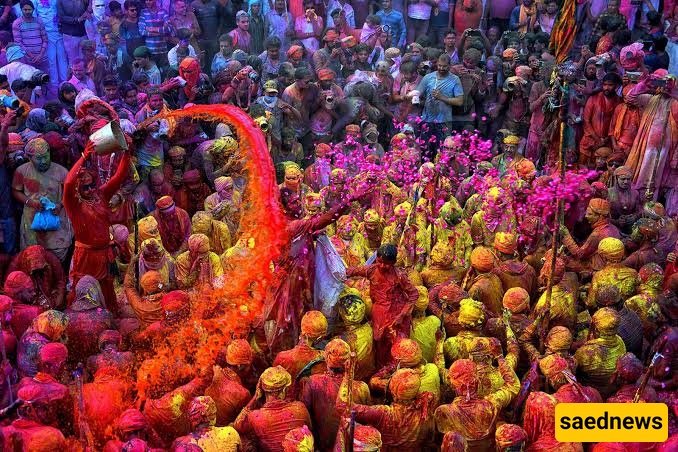
Today, Holi is famous around the world for clouds of brightly colored powder, water fights, music and enormous public gatherings. Yet its religious meaning is much deeper than the modern image of a giant color festival.
Holi is an ancient Hindu celebration associated with the arrival of spring, the triumph of good over evil and several religious traditions and legends. Its date is determined by the Hindu lunar calendar and generally falls around February or March.
One of the best-known stories associated with the festival concerns Prahlada and Holika. According to Hindu tradition, the demon king Hiranyakashipu wanted his son Prahlada to abandon his devotion to Vishnu. Holika, who was believed to possess protection from fire, attempted to burn the boy. Instead, Prahlada survived while Holika perished.
That story lies behind Holika Dahan, the ritual bonfire held before the color celebrations.
Holi also carries associations with Krishna and Radha, and its spring timing gives the festival a strong seasonal dimension. UNESCO records Holi among the living cultural traditions connected with India's music, dance and ritual life.
The result is a festival where theology, mythology, seasonal renewal and social celebration have become intertwined.
Few festival images are as recognizable as rows of small lamps glowing during Diwali, the Festival of Lights.
Diwali is celebrated by Hindus and is also important in Jain and Sikh traditions, although the religious meaning differs among communities. Its history extends back more than 2,500 years, but historians caution against reducing its origins to a single event or story. Different regions and religious communities connect Diwali with different traditions.
For many Hindus, one major story links the festival to Rama's return to Ayodhya after defeating Ravana. Lamps are traditionally associated with illuminating his return.
Other traditions connect Diwali with Lakshmi, the goddess of prosperity, while Jain communities associate the festival with Mahavira's liberation. Sikhs commemorate Bandi Chhor Divas around the same period, giving the season another important religious meaning.
This diversity is one of the reasons Diwali cannot be described as having one universally agreed ancient starting point.
What has endured is the symbolism of light. Lamps, candles and other lights turn homes and public spaces into glowing landscapes, transforming an ancient religious symbol into one of the world's most recognizable celebrations.
Modern Halloween is associated with pumpkins, candy, costumes and horror imagery. Its older history is considerably more ritualistic.
Halloween's deepest commonly cited predecessor is Samhain, an ancient Celtic festival marking the end of the harvest and the beginning of the darker half of the year. Historical accounts describe bonfires, costumes and beliefs about a temporary weakening of the boundary between the living and the dead.
Samhain was not simply an ancient version of trick-or-treating. It was a religious and seasonal observance involving communal fires, offerings and rituals associated with the supernatural world.
Over the centuries, Christian observances became intertwined with older Celtic customs. November 1 became associated with All Saints' Day, while November 2 became All Souls' Day. The evening before All Saints' Day eventually became known as All Hallows' Eve, which developed into the word Halloween.
Some modern Halloween customs have much more complicated histories than the popular story suggests. Trick-or-treating, for example, developed through a mixture of Celtic, Christian and medieval customs rather than simply being a direct survival of Samhain.
So the Halloween party of today is several historical layers removed from the ancient ritual—but traces of the old seasonal and supernatural symbolism remain.
Every summer, families across Japan observe Obon, a period dedicated to remembering and honoring ancestors.
Obon is strongly associated with Buddhism, particularly the Ullambana tradition, while its Japanese form also incorporates older beliefs about ancestral spirits. Japan's official cultural resources describe it as a fusion of ancient Japanese beliefs and Buddhist practices.
The religious story behind Obon centers on Mokuren, one of the Buddha's disciples. According to the Buddhist tradition, Mokuren discovered that his deceased mother was suffering among hungry spirits. The Buddha instructed him to make offerings to monks, an act that ultimately helped free her from suffering.
The festival developed into a period when families remember the dead, visit graves and make offerings. Mukaebi, or welcoming fires, are traditionally used to guide ancestral spirits home, while okuribi, or sending-off fires, mark their departure.
Bon dances, lanterns and family gatherings have turned Obon into one of Japan's most recognizable seasonal traditions.
It is a particularly vivid example of how a religious ceremony can evolve into a broader cultural festival without losing its connection to the dead and to family memory.
Kyoto's Gion Matsuri looks today like a spectacular celebration of Japanese craftsmanship, with enormous decorated floats, processions and elaborate rituals. Its origin, however, was much more solemn.
The festival began in 869 CE, when an epidemic was devastating Kyoto. People at the time attributed disease to angry or vengeful spirits. A ritual known as Gion Goryo-e was organized to appease these spirits and pray for an end to the epidemic.
The ritual reportedly involved 66 halberds representing the provinces of Japan, along with a procession carrying a sacred portable shrine.
By 970, the ritual had become an annual event. Over the centuries, religious ceremonies, artistic traditions, processions and elaborate floats transformed it into the month-long Gion Matsuri known today.
Its history offers a striking reminder that festivals were not always created simply for entertainment. In medieval Japan, a major public festival could be an attempt to confront fear, disease and the invisible forces people believed controlled their fate.
In Cusco, Peru, Inti Raymi is now one of the country's most famous cultural celebrations. Its roots lie in the religious world of the Inca Empire.
The name means "Festival of the Sun," and the ancient ceremony honored Inti, the Inca sun deity. Peruvian government sources describe it as a major religious celebration associated with the winter solstice in the Southern Hemisphere and the agricultural cycle.
The festival is traditionally associated with the reign of Inca Pachacuti in the 15th century. Historical accounts describe ceremonies intended to honor the sun and seek prosperity for the coming agricultural cycle.
Spanish colonial authorities eventually prohibited the ceremony because of its non-Christian religious character.
Its modern revival is itself a fascinating part of the story. In the 1940s, Peruvian intellectuals and cultural leaders reconstructed a public performance of the festival, turning it into a major expression of Cusco's Indigenous heritage. The modern event is therefore not an uninterrupted ritual surviving unchanged from the Inca period; it is a cultural reconstruction rooted in a much older religious tradition.
Today, the spectacle brings together history, performance, tourism and cultural identity—but its central symbol remains the same: the sun and its importance to life.
The most fascinating thing about these festivals may not be their age. It is their ability to change without completely losing their identity.
Nowruz turned an ancient sacred celebration of renewal into a festival shared across religious and national boundaries. Holi combined mythology, spring and communal play. Halloween absorbed Christian and later popular traditions while retaining echoes of an older seasonal festival. Obon blended Buddhism with Japanese ancestral beliefs. Gion Matsuri transformed an ancient response to epidemic disease into one of Kyoto's greatest cultural spectacles.
Inti Raymi demonstrates another path: a festival can disappear as a religious practice and later return as a carefully reconstructed cultural tradition.
These histories also show why claims about "ancient origins" should be treated carefully. A modern festival is rarely a perfect time capsule. Traditions are borrowed, adapted, renamed, suppressed, revived and reinvented.
That may be precisely why they survive.
A festival can begin with a prayer, a sacrifice, a seasonal rite or an attempt to protect a community from disaster—and centuries later become a family gathering, a public spectacle or a cultural symbol. The ritual changes, but the human need behind it often remains: to mark time, remember the past, welcome renewal and bring a community together.