SAEDNEWS: Clashes broke out in Paris and several other French cities on Saturday as hundreds of thousands of people took part in protests for the third consecutive weekend, expressing anger over the rising cost of living.
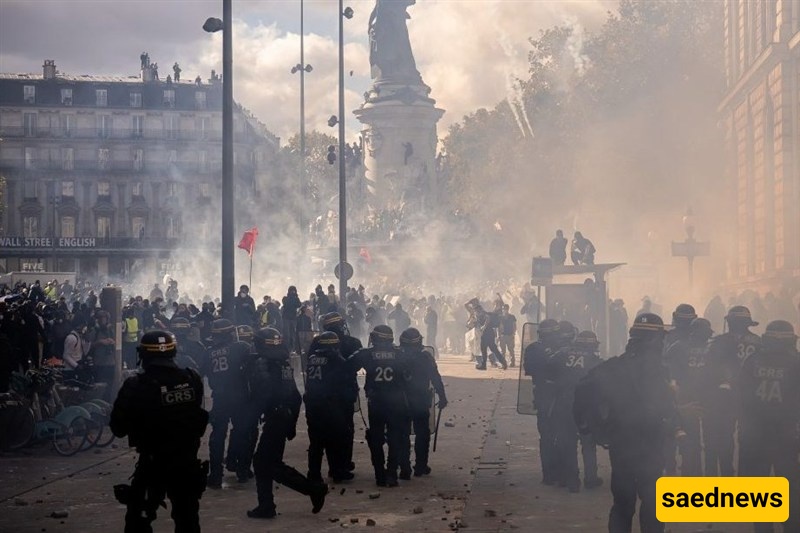
According to Saednews, Hundreds of people were arrested as police deployed water cannon and tear gas to disperse rioters on the sidelines of demonstrations, where ordinary protesters marched wearing Halloween costumes.
While Interior Minister Laurent Nunez said the marches had been largely peaceful, he condemned the violence, including an incident in Paris in which a police officer was hit by a Molotov cocktail.
Following a march on the outskirts of Paris under bright sunshine, clashes erupted between police and some demonstrators as the procession reached its final destination.
Dozens of masked individuals dressed in black used hammers to loosen paving stones and throw them at police officers, AFP journalists witnessed. Police responded with tear gas and several baton charges.
The Paris police prefecture said several hundred rioters had attacked security forces with projectiles.
Nunez described the level of violence displayed by some protesters as “extraordinary”, blaming far-left extremist groups for attacks on security forces.
He called the throwing of a Molotov cocktail at a riot police officer in Paris an “attempted murder”, adding that the officer had escaped with minor injuries.
“We are fully prepared for those looking for confrontation tonight,” he warned.
Far-right leader Marine Le Pen said those responsible for the firebomb attack must be “punished with the utmost severity”. In a post on X, she described images of the officer engulfed in flames as “unbearable”.
A nighttime curfew was scheduled to take effect in the central Paris districts of République and Châtelet–Les Halles from 11:00 pm to 6:00 am on Saturday and Sunday.
Nunez said police had arrested 520 people nationwide by 1900 GMT.
The Interior Ministry reported that “radical elements” in cities including Bordeaux, Toulouse and Marseille had attempted to enter city centres “with the aim of carrying out vandalism and looting”.
In Lyon, France’s third-largest city, demonstrators threw projectiles at police, prompting officers to respond with tear gas.
In the southern city of Toulouse, police deployed water cannon against an unauthorized demonstration attended by several thousand people.
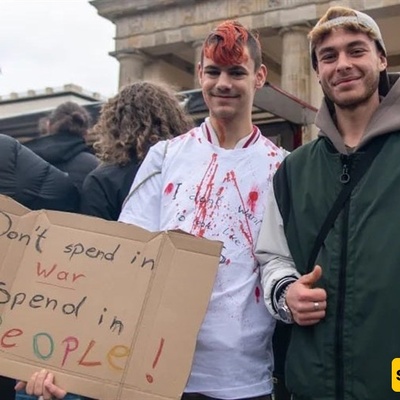
Earlier on Saturday, thousands of people marched through eastern Paris, some dressed in costumes ranging from Spider-Man to Frankenstein, while a helicopter circled overhead.
Their placards carried messages such as: “No need for tear gas to make our future look bleak” and “Dressed up as an angry citizen for Halloween.”
“The fact that demonstrations are being pushed outside city centres, and that so many protests are being banned, is really an attack on freedom,” said Alice Hien, a video game developer who took part in the demonstration.
Authorities estimated that around 320,000 people had taken part in rallies across France, including 70,000 in Paris.
Youth organizations, however, put the nationwide turnout at nearly 500,000, including 200,000 in the capital.
Jean-Luc Mélenchon, leader of the far-left France Unbowed party, joined the Paris march and praised the massive turnout.
The demonstrations are taking place amid heightened political tensions, with presidential elections less than six months away and Le Pen leading in opinion polls.
The protest movement, which brings together Yellow Vest activists, trade unions, high school students and university students, initially centred on the rising cost of living, social inequality and worsening educational conditions.
Following a security crackdown and serious injuries sustained by some demonstrators, the movement expanded its demands to include stronger protection of civil liberties and the right to protest.
In Lille, a city in northern France, 47-year-old Aurelie Herrmann danced during the demonstration.
“I dance because on television they only show damage and destruction, whereas you can perfectly well demonstrate in good spirits,” she said.
Student demonstrators complained that police had refused to authorize a march through central Paris. They vowed to organize fresh blockades of high schools and universities the following week, including on November 5, when trade unions had called for another demonstration.
With the Eurozone's second-largest economy on the verge of recession and facing mounting pressure to reduce public debt, the government has limited room to ease public discontent through additional spending.