SAEDNEWS: Serbia’s longtime leader Aleksandar Vucic acknowledged defeat in the snap parliamentary election, as a student-led opposition movement is poised to win a majority of seats.
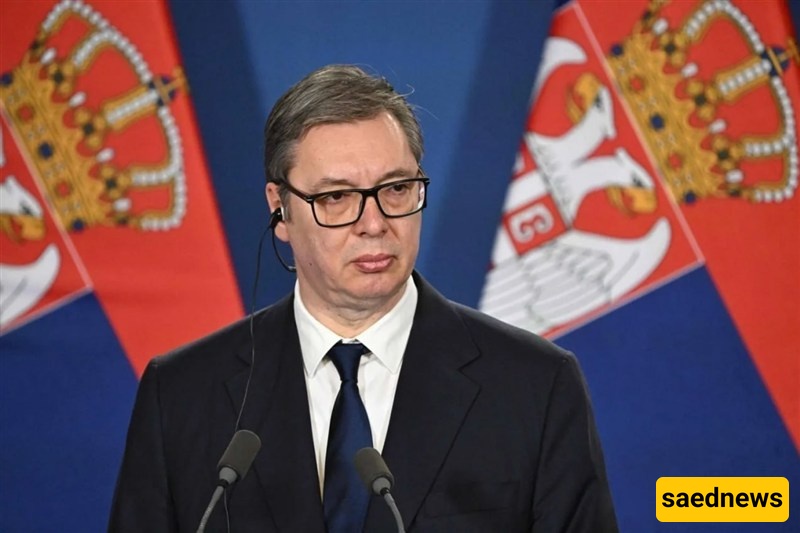
According to Saednews, Vucic said on Sunday that, based on a sample of votes, the Student List was expected to win between 135 and 140 seats in the 250-member parliament, compared with 105 seats for his electoral list.
While acknowledging that the final results were not yet available, the populist leader said, “It is clear that we have lost these elections.”
His announcement was met with cheers, euphoria and tears at the Student List headquarters, according to the Belgrade-based FoNet news agency.
“Preliminary results show that students are convincingly leading in almost all polling stations,” Radomir Saicic, a parliamentary candidate for the Student List, said in a speech at the movement’s election headquarters.
“Students won, and with them also a hope that Serbia can be a country of justice, freedom and dignity,” he added. “Let this night be the beginning of a new chapter.”
Voting to determine whether Vucic’s Serbian Progressive Party (SNS), which has governed since 2012, could retain power against a movement born out of nationwide anti-corruption protests, ended at 8pm local time (19:00 GMT) on Sunday.
The State Election Commission reported that voter turnout had reached 64.9 percent by 6pm (17:00 GMT), the highest level since the breakup of Yugoslavia in 1992.
Jelena Vasiljevic, a researcher at the University of Belgrade, told Al Jazeera in an interview published on Friday that the SNS had a dependable voter base, while the students needed to attract people who typically did not participate in elections.
Sunday’s vote was also overshadowed by reports of intimidation and procedural irregularities.
The Centre for Research, Transparency and Accountability (CRTA), an independent election-monitoring organisation, said its observers had documented pressure on voters or election workers at nearly one-third of the 500 polling stations they monitored.
The organisation also reported failures to safeguard ballot secrecy.
By 5pm (16:00 GMT), the Centre for Free Elections and Democracy (CeSID), an election-monitoring group, had received approximately 260 reports of possible irregularities, including ballot photography, group voting and problems with identity verification.
Celebrations broke out across Serbia, with fireworks illuminating the sky almost immediately after Vucic announced his defeat. Tens of thousands of people filled Belgrade’s main roads as Student List supporters drove through the streets, honking their horns.
Serbians chanted, “Aleksandar is gone,” and sang songs associated with the student movement. Crowds dismantled tents in a park in central Belgrade where Vucic’s supporters had been camping for more than a year.
“It means freedom from a dictatorship that has lasted for 12 years, that I cannot remember a time before,” voter Jana Vasic told Al Jazeera. “I’m not completely sure what our candidates will do first, but I think first for tonight, we’ll celebrate. And then tomorrow, the real hard work starts.”
Belgrade resident Dragana Kovecevic told the Associated Press that she was delighted that “everyone greets with smiles”. She added, “We are all too happy; finally, we are becoming one normal and free country.”
European Commission President Ursula von der Leyen congratulated the Student List on its electoral victory, writing on X: “We stand ready to support reforms on the rule of law, media freedom, the fight against corruption and strong democratic institutions, and to work together to advance Serbia’s future in the European Union.”
As voting took place in Belgrade, police wearing riot helmets and carrying shields were deployed near the election commission’s headquarters. Roads were closed and barricades were erected in the surrounding area.
City prosecutors appealed on Sunday to all those involved in the election to refrain from violence.
The election followed nearly two years of student-led protests that began after a railway station canopy collapsed in Novi Sad in November 2024, killing 16 people.
Calls for accountability gradually expanded into a broader movement opposing alleged government corruption and repression. Vucic and the SNS have denied the allegations.
The Student List – Students Win emerged from the demonstrations and fielded candidates from professions including medicine and education. Many of the candidates had no previous political experience.
The movement campaigned for stronger institutions and an end to corruption.
Several established opposition parties chose to support the students rather than put forward their own candidates.
Vucic resigned as president in September to run for prime minister, pledging increases in pensions and public-sector salaries, alongside further investment.
His supporters credit his leadership with modernising Serbia’s economy.
Approximately 6.5 million people were eligible to vote for the 250 parliamentary seats, with 18 electoral lists competing in the election. A minimum of 126 seats is required to secure a parliamentary majority and form a government.