Saed News: The results show that high nominal salaries do not always mean higher welfare. In some countries, high housing costs and consumer goods expenses reduce the real purchasing power of income.

According to SAEDNEWS, quoting Khabaronline, Switzerland, despite very high nominal wages, falls below Canada and Spain after taking living costs into account.
This chart ranks countries based on average monthly income adjusted for Purchasing Power Parity (PPP), using data from the International Labour Organization. Unlike a simple comparison of wages, this ranking shows how much real purchasing power people actually have after considering the prices of goods and services in each country.
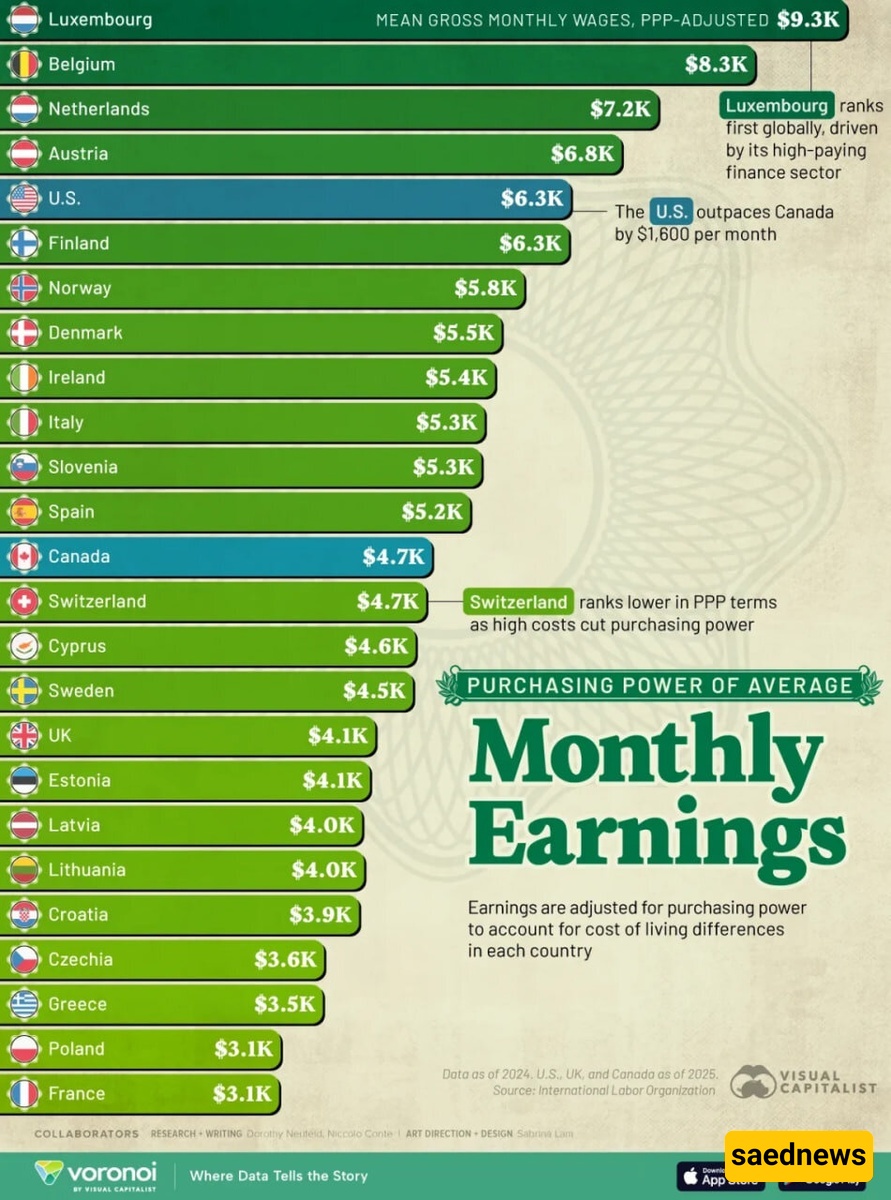
The results show that high nominal wages do not always mean higher welfare. In some countries, high housing and consumer costs reduce real purchasing power, while other countries, with a combination of adequate wages and lower costs, provide better conditions for citizens.
Luxembourg ranks first in the world in terms of purchasing power of income, with an adjusted monthly income exceeding 9,300 dollars—a figure about 50 percent higher than the average purchasing power in the United States.
After that, Belgium with 8,297 dollars and the Netherlands with 7,234 dollars follow; countries that, due to a combination of high income and controlled costs, create strong purchasing power for their citizens.
This ranking is based on average gross monthly wages adjusted for cost of living in 2024. Data for the United States, United Kingdom, and Canada correspond to 2025.
1 Luxembourg — 9,307 USD
2 Belgium — 8,297 USD
3 Netherlands — 7,234 USD
4 Austria — 6,832 USD
5 United States — 6,273 USD
6 Finland — 6,253 USD
7 Norway — 5,760 USD
8 Denmark — 5,512 USD
9 Ireland — 5,441 USD
10 Italy — 5,326 USD
11 Slovenia — 5,291 USD
12 Spain — 5,166 USD
13 Canada — 4,747 USD
14 Switzerland — 4,683 USD
15 Cyprus — 4,566 USD
16 Sweden — 4,538 USD
17 United Kingdom — 4,124 USD
18 Estonia — 4,065 USD
19 Latvia — 4,011 USD
20 Lithuania — 4,001 USD
21 Croatia — 3,945 USD
22 Czech Republic — 3,561 USD
23 Greece — 3,546 USD
24 Poland — 3,082 USD
25 France — 3,064 USD
The United States, with an adjusted income of about 6,300 dollars per month, ranks fifth in the world and even stands above Northern European countries such as Finland and Norway.
One of the most surprising cases in this list is Switzerland. Although it has one of the highest nominal wages in the world, very high costs of housing, services, and goods have reduced its real purchasing power below that of Canada and Spain.
Countries with similar purchasing power may have completely different economic conditions. For example, Canada and Switzerland end up with similar figures, but in Canada this results from relatively balanced wages and costs, while in Switzerland very high wages are offset by high expenses.
Even after considering living costs, there is a large gap between living standards in developed countries.
Workers in top-ranked countries have almost three times more monthly purchasing power than those in lower-ranked countries such as Greece and France. This difference reflects variations in productivity, economic structure, and industrial composition across countries.
In practice, two people with similar incomes may have completely different living experiences depending on the country they live in. Ultimately, where you live can be as important as how much you earn.