SAEDNEWS: In an armed terrorist attack on the Imam Sajjad (AS) Clinic, Marzieh Nabavi-Nia, a nurse at the center, was martyred—an account that highlights the scale of terrorism against ordinary civilians and points to the role of what is described as a Zionist–American-led enemy strategy.
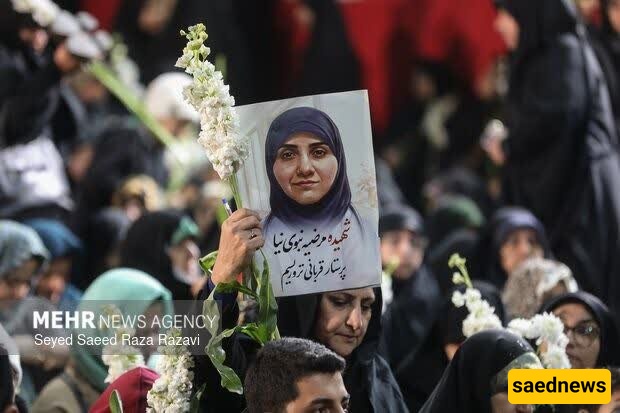
According to SAEDNEWS, Qouting mehrnews, A devoted nurse who stood against the enemies with her life—today her name shines beside the martyrs of history, carrying a flag as high as the homeland itself. As a reminder that one of Iran’s red lines is the Islamic Republic system—on the very land that Martyr Haj Qasem once called “the sanctuary”—Martyr Marzieh Nabavi-Nia is far more than a name. She represents faith, resilience, and sacrifice.
Her life was a story of standing up against hardships and making relentless efforts to serve her people. In the midst of war and unrest, with a heart full of certainty and a bag filled with the Qur’an, she stepped into the battlefield.
Endless Worry—and Unlimited Pride
Maryam Mirzaei, the martyr’s mother, spoke to Mehr with a trembling voice while grieving her daughter:
“Marzieh was my fifth and last child. I am deeply proud of her. She was hardworking, kind, innocent, and well-mannered.”
She added that her daughter studied at Shahed School, and with great enthusiasm was accepted into the field of midwifery. She had a special bond with the Qur’an, always prayed on time, and eagerly attended religious gatherings and ceremonies.
Mirzaei continued:
“During the COVID era, she completed her service plan at Al-Zahra Hospital, and after that, she began working at the Imam Sajjad (AS) Clinic with love and passion.”
She said Marzieh performed everything wholeheartedly:
“She truly loved nursing—from injections to ECG tests. Everyone was satisfied with her work, and she had many friends.”
The martyr’s mother described the moment she heard about the incident:
“They told me her leg was injured. When we arrived there, it was already noon… (she no longer had the strength to speak).”
Her Last Days and Her Final Determination
Mirzaei recalled their last meeting:
“Her father and I had gotten influenza so badly that I was hospitalized. She came to the hospital to take care of me and also managed the house.”
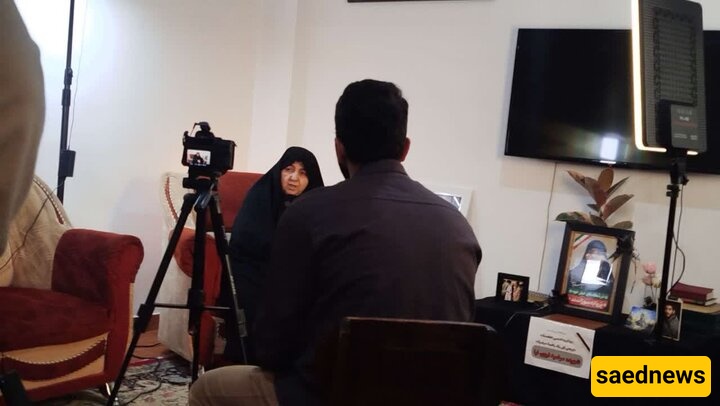
She added:
“Because of the situation in those days, I told her not to go to work. But she said she loved her job. When I told her about the events in Khoshkbijar, she still insisted on going to work and serving people.”
She also spoke about Marzieh’s family:
“Her husband visits the martyrs’ cemetery every day, and her child is deeply attached to her. My five-year-old granddaughter Zeynab had a dream that her mother drew a beautiful picture for her.”
Holding her daughter’s framed photo, with a broken heart but strong faith, she prayed:
“I ask God to place her in His mercy. And I ask Him to grant patience and strength to us—especially to her Zeynab—so we can endure this great sorrow.”
Marzieh: A Faithful Daughter Committed to Her Duty
Mohammad Nabavi-Nia, the martyr’s father, spoke calmly but with deep sadness:
“Marzieh was the youngest child of our family. She was only 31. During her studies she was a good student, and following her mother’s example, she was committed to hijab and prayer on time.”
He proudly said she was closely connected to the Qur’an:
“For several years she had started learning Qur’an memorization online. She attended different religious programs and all martyr-related gatherings, either with friends or with her husband.”
He said she was accepted into two fields, pharmacy and midwifery, and studied midwifery at the state university in Rasht. But due to not being employed in her specialized field, she chose to work in nursing and had been working at the clinic for about one year.
“She used to say: I love being present at this clinic.”
He continued:
“She considered serving people her duty. She always said she must go to work. During the 12-day war, she also said: Even though it’s dangerous, whatever God wills.”
The father called the enemy’s act “vile and sinister” and added:
“The enemy, by deceiving our youth, revealed its lowliness and evil.”
He also said:
“Betraying the homeland is betraying humanity. The young people who obeyed the enemy to destroy and attack fellow citizens—leading to martyrdom—must face punishment for their actions.”
Beyond Duty: Seeking God’s رضایت (Divine Approval)
Majid Nabavi-Nia, Marzieh’s brother, spoke to Mehr with a choked voice, describing how his sister was different:
“Among daily duties and obligations, Marzieh went beyond that. In her constant pursuit of God’s approval, she took steps beyond the minimum—devoting herself to recommended worship and good deeds.”
He said she was deeply faithful, always praying on time, attending Friday prayers, visiting holy sites, reading supplications, and fasting voluntarily.
“Even her recreation was a spiritual journey. In every trip, a religious pilgrimage would shine like a precious gem.”
Recalling how he learned of the attack, he said:
“The terrible news, along with the noise in Rasht, struck our hearts. We realized something horrible had happened, and the Imam Sajjad (AS) Clinic had been consumed by fire.”
After repeated attempts and unanswered calls to his brother-in-law, he finally heard the truth from the brother-in-law’s brother and informed the family.
He described the depth of the tragedy:
“When we arrived to say farewell, the painful scene shattered us—my sister’s small coffin showed us the full scale of the disaster.”
He said:
“Marzieh, you were an angel shining in the sky of faith. We did not realize your value, and we lost you.”
A Devoted, Compassionate Colleague With Strong Faith
Fatemeh Jafarpour, Marzieh’s friend and co-worker, said the clinic had invited Marzieh to work through a recruitment call due to staff shortages.
She explained:
“She texted me and asked me to schedule her shift from 4 PM to 6 PM—and I did.”
Speaking about the day of the incident, she said:
“At 4 PM I said goodbye and left. At 10 PM, a coworker called and said the clinic had been attacked. I called Marzieh and asked, ‘Where are you?!’ She said, ‘We’re on the 8th floor.’”
She contacted other coworkers to check on them, then called Marzieh again:
“She could barely speak. With a muffled voice and constant coughing, she told me: ‘Forgive me…’”
Jafarpour said she contacted the fire department for help:
“They said they knew about the incident, but the roads were blocked and they were trying to reach the clinic. Then at 3 AM, a coworker told me that Marzieh had been martyred.”
She described Marzieh as extremely committed and caring:
“She prayed on time, memorized the Qur’an, and followed Islamic morals and principles. She had a special devotion to حضرت زهرا (SA). Whenever she had a need, she would seek حضرت زهرا’s help.”
She added:
“She recited ‘40 days of Dua Ahd’ and said: ‘My presence in this clinic is because of the 40-day devotion to Lady Fatimah (SA).’ She was very happy to be here.”
A Special Place in Hearts—and the Journey Toward Martyrdom
Jafarpour said Marzieh held martyrs in a special place in her heart:
“She once told me that she and her husband visited the martyrs’ cemetery on their wedding day.”
The peak of the terrorists’ cruelty, she said, was not only creating unrest and attacking a medical center and setting it on fire—but also preventing rescue forces from arriving until hours after the incident.
The martyrdom of Marzieh Nabavi-Nia is not the end of the story—it is a turning point in the proud history of this land.
Her chador, like a shield of light, protected her, and in the end—on the path of defending divine values—she reached her Creator and received the reward of her struggle.
The martyrdom of this devoted woman should be a guiding light for all of us—an example of living on the right path and moving toward human perfection.
This martyrdom will show the enemies of this land that the Iranian nation is a nation that does not fear sacrifice or martyrdom for faith and homeland—a nation that has written its history in golden letters with the blood of its martyrs.