SAEDNEWS: Les Invalides, known in French as Les Invalides, is a historic complex in Paris that includes museums, monuments, and significant architectural sites. The complex is closely connected to the military history of France and was originally established as a hospital and retirement residence for wounded and retired war veterans.
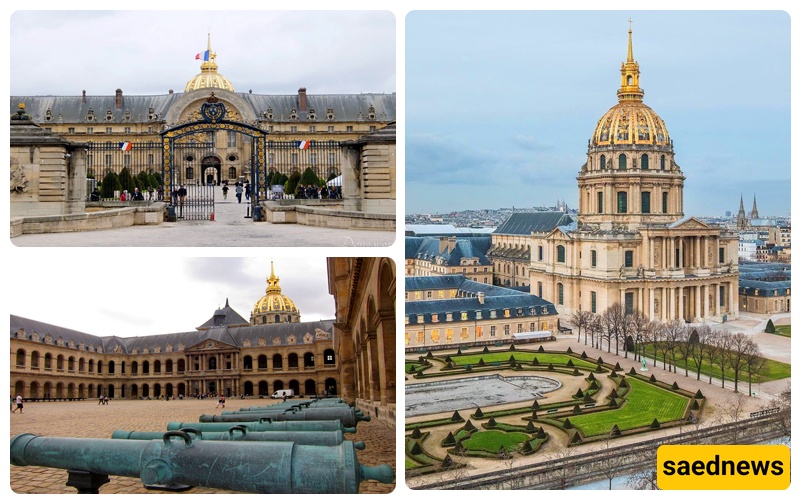
According to Saednews, Hôtel National des Invalides, commonly known as Les Invalides or the Army Museum, is a complex of buildings that houses several museums, historical monuments, and a church. The full name of this historic site, Hôtel National des Invalides, means “National Residence for Disabled War Veterans.” Above the main entrance is an inscription that honors King Louis XIV, who commissioned the complex in the 17th century.
Above the inscription stands a statue of Louis XIV, also known as Louis the Great. A sun can be seen above the statue, referring to his famous title, the Sun King, which he adopted during his reign.
At the northern gate of Les Invalides, visitors can see two large statues. The statue on the right represents Minerva, the Roman goddess of wisdom and war, accompanied by her owl. The statue on the left represents Mars, the Roman god of war, accompanied by his wolf.
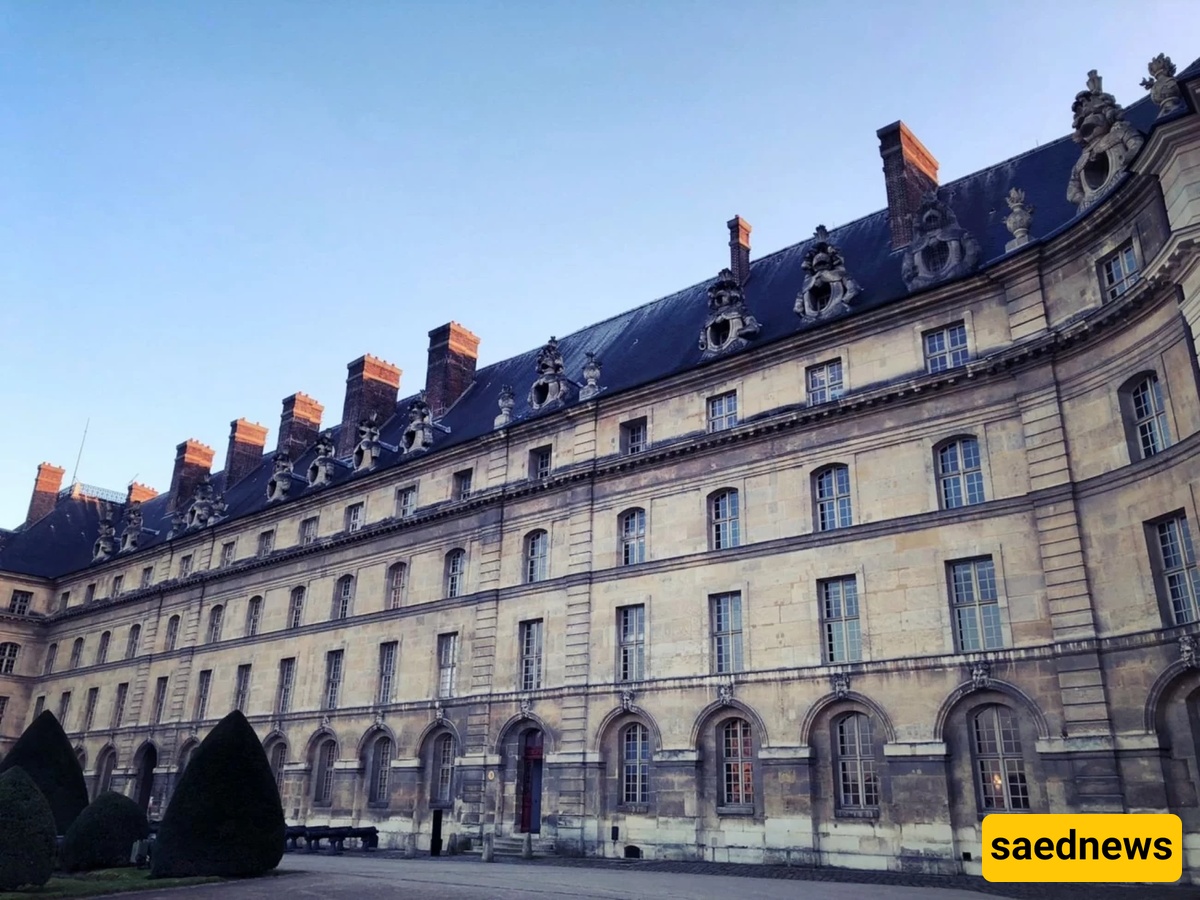
The complex originally served as a military residence and hospital. The soldiers living there wore military uniforms and, alongside their military training, worked in workshops where items such as shoes and uniforms were produced.
Construction began in 1671 and was completed in 1676. Louis XIV ordered the complex to be built as a residence for wounded, disabled, and impoverished war veterans. The original design consisted mainly of barracks and a hospital. However, Louis XIV approved the plan proposed by Libéral Bruant, which also included a church and a royal courtyard.
Geographically, Les Invalides is located east of the École Militaire, or Military School. The complex also overlooks the Seine, one of Europe's major rivers.
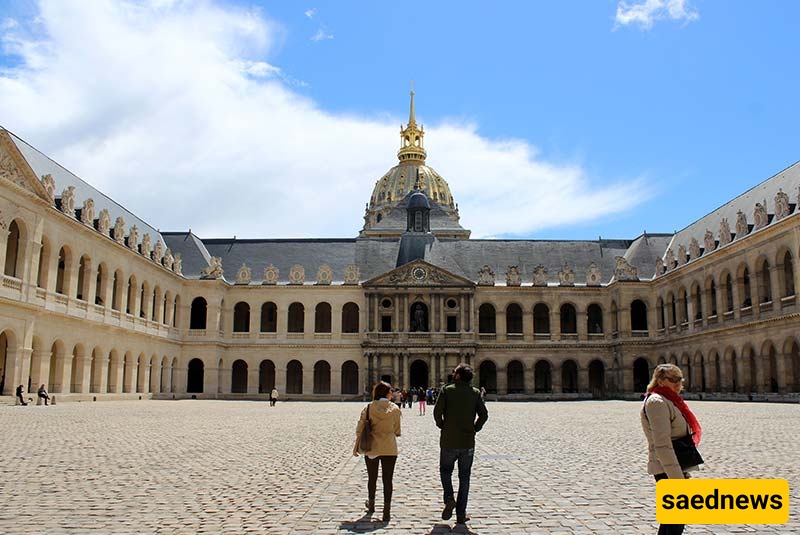
Les Invalides contains around 15 courtyards, the largest of which is known as the Cour d'Honneur, or Court of Honor. Its distinctive architecture is one of the reasons for its fame. In the past, the courtyard was used for military parades.
The complex also played a role in important events during the French Revolution. Its strategic importance led revolutionaries to seize weapons and cannons from Les Invalides, which were later used during the attack on the Bastille.

As mentioned above, the church was added to the complex at the request of Louis XIV's Minister of War. It was intended to strengthen the religious commitment of the soldiers, who were required to attend services there every day. For this reason, the church became known as the Soldiers' Church.
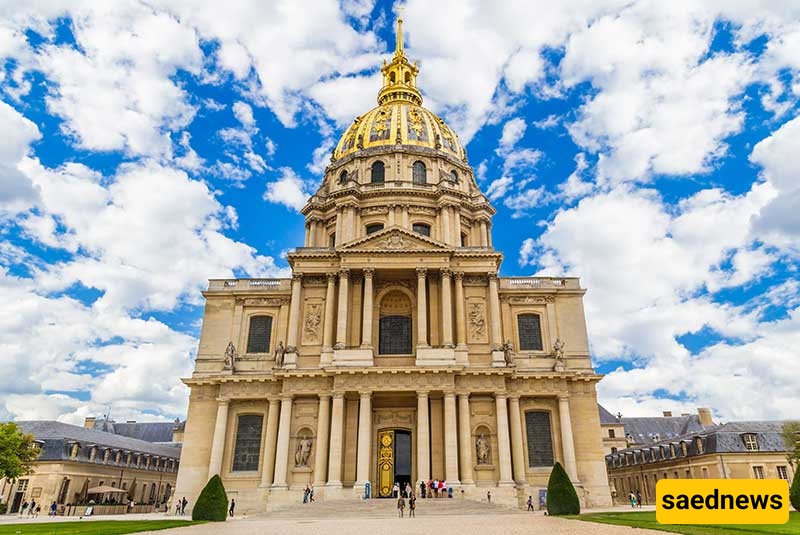
The Dôme des Invalides is a small royal church directly connected to Saint-Louis des Invalides. It was originally designed as a burial place for members of the royal family and was inspired by the Baroque architecture of Rome.
After the death of Louis XIV, however, this plan was abandoned. Later, Louis Philippe I arranged for the remains of Napoleon Bonaparte to be transferred from the island of Saint Helena to Les Invalides in Paris. The complex subsequently became a burial place for Napoleon and several other prominent military commanders, including Ferdinand Foch, Vauban, and Turenne.
Today, visitors enter the tomb area by a staircase that leads to a large and ornate bronze door decorated with two statues.
Napoleon's tomb rests on a green granite pedestal and consists of six coffins: one made of iron, one of mahogany, two of lead, one of ebony, and one of oak.
A stone statue of Napoleon, one of the most influential figures in French history, depicts him wearing a military uniform. On the floor surrounding his tomb is a colorful mosaic representing the principal battles of the French Empire. Twelve monumental statues symbolizing military victories stand opposite the columns of the chamber.
The ten periods of Napoleon's reign are represented in a circular gallery through reliefs carved in white marble. The tomb of the King of Rome, Napoleon's son, is also located beneath a marble slab. The tombs of Joseph Bonaparte and Jérôme Bonaparte can also be found within the complex. Gilded bees decorate Jérôme's tomb, adding to its elaborate appearance.
The Army Museum at Les Invalides was created through the merger of the Artillery Museum and the Military History Museum. It is one of the world's largest military museums and one of France's most important institutions dedicated to military history.
The former soldiers' dining hall occupies part of the ground floor. Exhibits from different periods of history include flags, military trophies, weapons, armor, and works of art.
Among the museum's notable pieces is Jean-Auguste-Dominique Ingres's “Napoleon I on His Imperial Throne,” painted in 1806, as well as the flag of the 1st Regiment of the Imperial Guard, which Napoleon famously kissed during his farewell ceremony at Fontainebleau.
The second-floor galleries are arranged chronologically and thematically. The Army Museum is the best-known of the museums within the Les Invalides complex. Its collections trace the military history of France from the Middle Ages through the period following World War I.
The weapons collection extends beyond Western arms and includes military artifacts from countries such as Turkey, China, India, and Japan.
The Musée des Plans-Reliefs contains highly detailed scale models of French fortresses and fortified cities dating mainly from the 17th century. These models provide a fascinating insight into the defensive architecture and military planning of France during that period.