SAEDNEWS: Gonbad-E Qabus Tower is a historical monument dating back to the 4th century AH, located in the city of Gonbad Kavus in northern Iran, Golestan Province. The architectural style of the structure is Razi architecture.
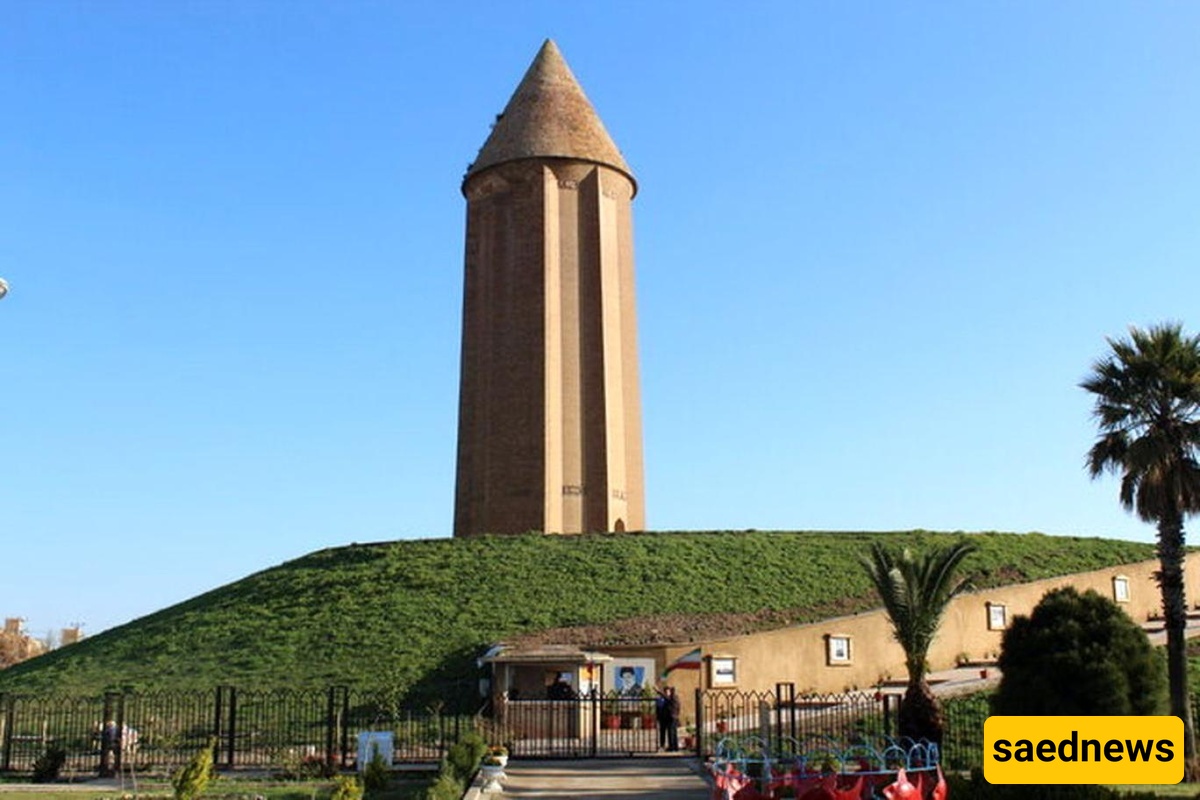
According to the Saed News Tourism Service, this structure—recognized as the tallest fully brick-built tower in the world—is located atop an earthen hill approximately fifteen meters higher than the surrounding ground. The total height of the monument, including its foundation, is 72 meters. It was constructed in 375 AH (Islamic calendar) during the reign of Kavus ibn Voshmgir in the city of Gonbad-e Kavus, which served as the capital of the Ziyarid dynasty.
Professor Arthur Upham Pope described this monument as follows:
“Below the eastern slopes of the Alborz Mountains and facing the vast deserts of Asia, one of the greatest masterpieces of Iranian architecture rises in all its grandeur. This structure is the Gonbad-e Kavus, the mausoleum of Kavus ibn Voshmgir, a tower free of any ornamentation. A warrior driven by the power of faith in direct confrontation, a poet king in battle with eternity—can there be a mausoleum so immense and powerful?”
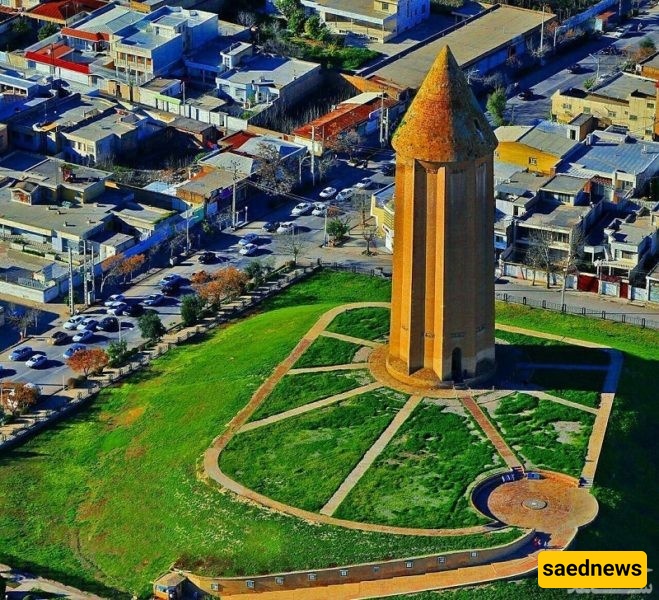
Gonbad-e Kavus Tower is located in the city of Gonbad-e Kavus in northern Iran, within Golestan Province.
Will Durant also wrote about it:
“Gorgan, in the 10th century CE (Ziyarid period), was one of the major provinces of Iran and was ruled by enlightened princes such as Kavus Voshmgir, who invited Avicenna to his court. This city possessed a 52-meter tower.”
The structure consists of two main parts:
The foundation and body of the structure
The conical dome
The foundation was built from bedrock and extends up to a height of 15 meters, constructed with brick and materials similar to those used in the upper structure. Inside the base, there was once a crypt, the remains of which have largely been lost due to repeated excavations by treasure hunters.
The cylindrical body of the tower features 15 fluted ribs (similar to a ten-pointed star), evenly spaced around the structure. These ribs extend from the base up to the start of the dome. The spaces between them are filled with brick masonry. Above these ribs (except at the entrance), the spacing reaches approximately 1.34 meters.
The internal diameter of the tower is 9.70 meters. Measured at the base of the ribs, the diameter is 14.66 meters, and at the upper section it reaches 17.06 meters. The thickness of the structure gradually decreases toward the top. At a height of 37 meters, the conical brick dome completes the tower’s form.
The monument is built using special elongated bricks known as “dandaneh-kafshaki” and features a double-shell dome system. The inner dome is semi-ovoid in shape, similar to earth-based domes and made of standard bricks, while the outer shell is constructed with the specialized brick type.
The conical dome rises to a height of 18 meters. On the eastern side, there is an opening measuring 1.90 meters in height, with varying widths of 73 cm at the top, 75 cm in the middle, and 80 cm at the bottom. In the southern corner, there is an entrance approximately 1.5 meters wide and 5.5 meters high. Above the semicircular arch of the entrance, early forms of muqarnas (stalactite vaulting) can be observed, representing one of the earliest stages in the development of this architectural ornamentation in Islamic architecture.
According to American scholar Dr. Wilson of the University of Pennsylvania, this muqarnas decoration above the entrance represents an early and simple stage of architectural ornamentation, later developed in Islamic architectural traditions.
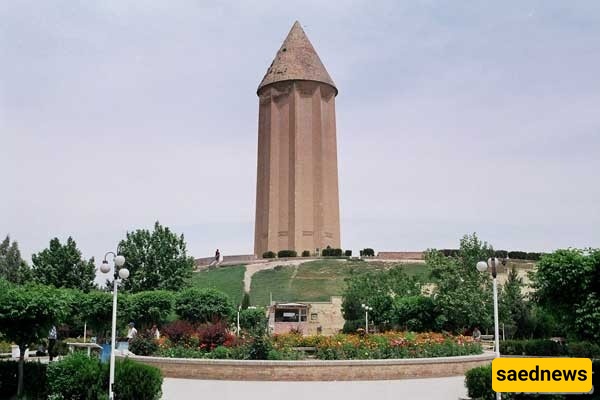
Kufic inscriptions encircle the structure in a belt-like arrangement, one at approximately 8 meters above the base and another below the conical dome. These inscriptions are simple, brick-made, and unadorned, yet clear and legible, framed within rectangular brick panels surrounding the tower.