Saed News: The Stanford Prison Experiment is one of the most famous and dangerous psychological experiments ever conducted. In this experiment, several psychologically healthy students were experimentally assigned the roles of prisoners and prison guards, but what ultimately happened to them?

According to SAEDNEWS, quoting Khabar Online, the Stanford Prison Experiment is one of the most well-known psychological studies ever conducted. This experiment, conducted under the supervision of Dr. Philip Zimbardo at Stanford University in 1971, aimed to investigate whether the personality traits of prisoners and prison guards could explain the abusive behavior seen in real prisons in the United States.
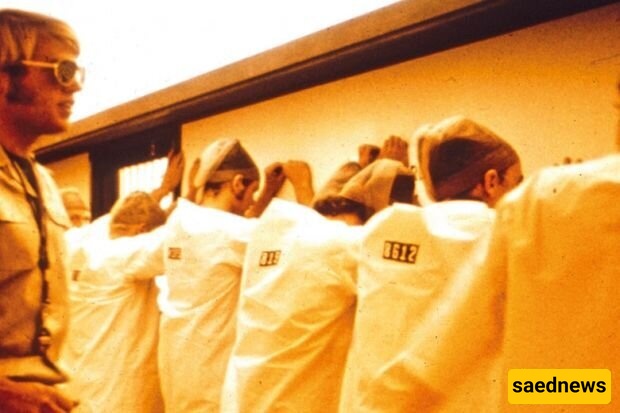
Zimbardo and his colleagues were interested in the psychological processes that occur when individuals take on the roles of prisoners and guards. Therefore, they built a simulated prison in the basement of the psychology department and placed an advertisement in a local newspaper seeking volunteers for a paid psychological study.
From 75 applicants, 24 individuals who were mentally and physically healthy and in normal condition were selected. The mock prison was set up in the basement of the psychology department. A graduate assistant acted as the “prison warden,” while Zimbardo himself served as the “superintendent” of the experiment. He established strict conditions and aimed to intensify confusion, loss of identity, and deindividuation among participants.
The volunteers were required to be students, white, middle-class, intellectually mature, emotionally stable, normal, and intelligent, and they came from the United States and Canada. None had a criminal record, and all appeared to share similar moral values. Through a random draw, 12 participants were assigned as prisoners and 12 as guards. Zimbardo coordinated with local police, who agreed to cooperate in the experiment.

The “prisoners” were at home when police officers unexpectedly arrived, arrested them, handcuffed them, blindfolded them, and transported them to the simulated prison. They were strip-searched and given loose uniforms and tight caps to create discomfort. Guards referred to prisoners only by numbers, which were sewn onto their clothing. Chains were placed around their ankles to constantly remind them of their status.
The guards were given khaki uniforms, batons, whistles, and mirrored sunglasses that prevented eye contact. They were told they could run the prison however they wished, but physical punishment was not allowed. The goal was to reinforce authority and role identity. The uniforms resembled military prison guard clothing purchased from army surplus stores. The mirrored glasses prevented emotional connection through eye contact.

The results were shocking. Within a few days, most guards began showing strong sadistic behavior, and the situation escalated so quickly that the experiment was stopped after just six days due to concerns that it had gotten out of control.
However, contrary to popular belief, later analyses—including those discussed in the book Human: A Hopeful History—showed another side. Many guards were hesitant to engage in harsh behavior. Two-thirds refused to participate in abusive actions, and one-third treated prisoners kindly. One guard even quit before the experiment began, saying he could not follow the instructions. It can be assumed that many participants continued partly because Zimbardo was paying them.
The Stanford Prison Experiment demonstrated the powerful influence of situation and environment on human behavior, as well as the strength of institutional norms in settings such as prisons. Since participants were randomly assigned roles, nothing in their personalities or backgrounds explained their behavior. Even though participants were free to act as they wished, interactions quickly became negative, hostile, and dehumanizing—similar to what is often seen in real prisons. The study showed that the prison environment itself can be so powerful that it can distort normal human behavior.