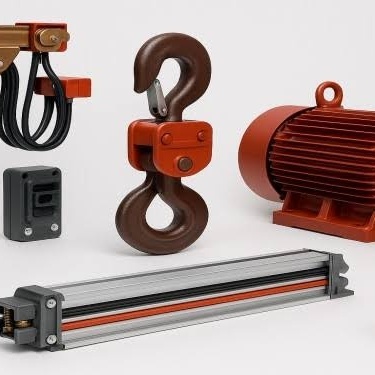
SAEDNEWS: Mechanical components of wire rope hoists consist of belts and winches, while chain hoists comprise chain catchers, crescent-shaped hooks, and rocker mechanisms.
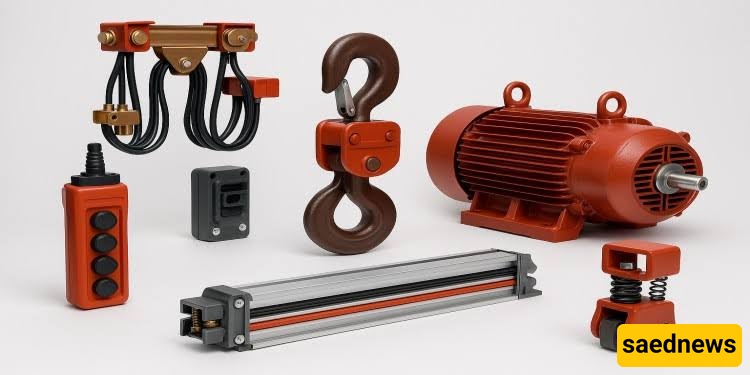
According to Saednews, Overhead crane components play an essential role in lifting and moving loads horizontally, transversely, and vertically. These cranes are available with lifting capacities ranging from 500 kg to 50 tons and are widely used in enclosed and open industrial facilities. The main components include hoists, winches, transverse and longitudinal rails, each of which consists of several individual parts.
Overhead cranes are commonly equipped with components from well-known brands such as Demag (Germany), Podem (Bulgaria), Stahl (Germany), Kito (Japan), and Konecranes (Finland). Crane components are generally divided into electrical and mechanical parts. Mechanical components are used in single-phase, three-phase, wire rope, and chain hoists. Chain hoists are typically used for lighter loads, while wire rope hoists are preferred for heavier loads. The mechanical components of wire rope hoists differ from those of chain hoists, with the latter incorporating parts such as chain guides, sprockets, and related mechanisms.
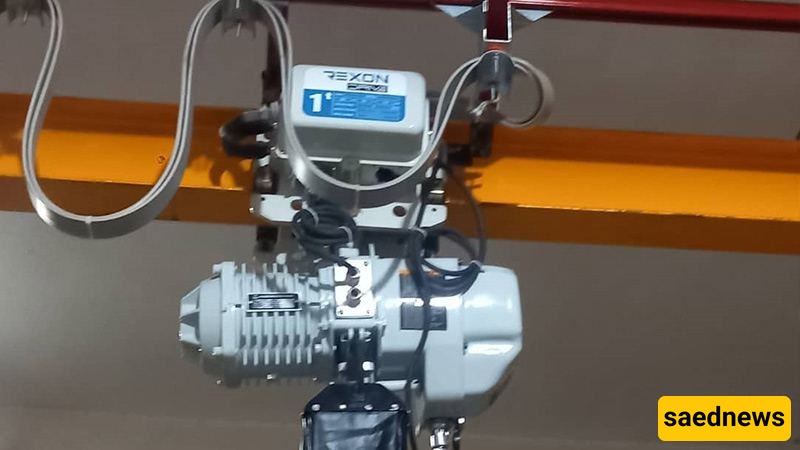
Chain or wire rope hoists are installed beneath the bridge girder on single-girder overhead cranes, while they are mounted on top of the bridge girders on double-girder cranes. The bridge girder, often made from an H-shaped steel beam, is designed according to engineering calculations, considering the hoist weight and the width of the industrial building.
The hoist uses an electric motor and gearbox to raise and lower loads, with a hook serving as the primary lifting attachment. Hooks are used in both chain and wire rope hoists. Wire rope models generally use one or two circular cast-iron sheaves over which the wire rope runs.
The wire rope must be connected to a drum to wind around the hook pulley system. The drum is a grooved steel cylinder manufactured with specific dimensions, including length, diameter, and groove pitch. Generally, the drum length increases with the crane's lifting capacity.
The electrical control panel is another essential component of an overhead crane. It supplies and controls the electrical power required for lifting operations and contains components such as contactors, miniature circuit breakers, relays, and inverters. It is typically powered by a three-phase electrical supply and installed on the bridge girder.
The crane brake is responsible for stopping the hoist and motor-gearbox assembly. When the operator presses the emergency stop button, the braking mechanism engages to bring the crane to a halt. A brake rectifier converts the electrical current supplied to the brake system and supports proper braking operation.
A trolley or transverse travel system enables the hoist to move from left to right across the crane bridge. A typical trolley uses four wheels, which may be smooth or geared, along with a motor rated at approximately 0.37 or 0.55 kW to move the hoist.
Double-girder overhead cranes generally use a larger carriage assembly instead of a standard trolley. These carriages are often custom-built to suit the crane's dimensions and operating requirements.
The bridge moves along the length of the crane runway using two end carriages and two powerful geared motors, allowing forward and backward movement.
Each end carriage typically contains two wheels, with outside diameters ranging from 200 to 400 mm. The wheels travel along the runway rails through their mounting assemblies, enabling smooth longitudinal movement.
The crane motor is connected to the gearbox through a coupling, providing the mechanical power required for vertical hoisting, transverse trolley movement, and longitudinal bridge travel.
Motors consist of components such as rotors, gears, shafts, bearings, and oil seals. Well-known manufacturers include SEW and Siemens of Germany, as well as Demag.
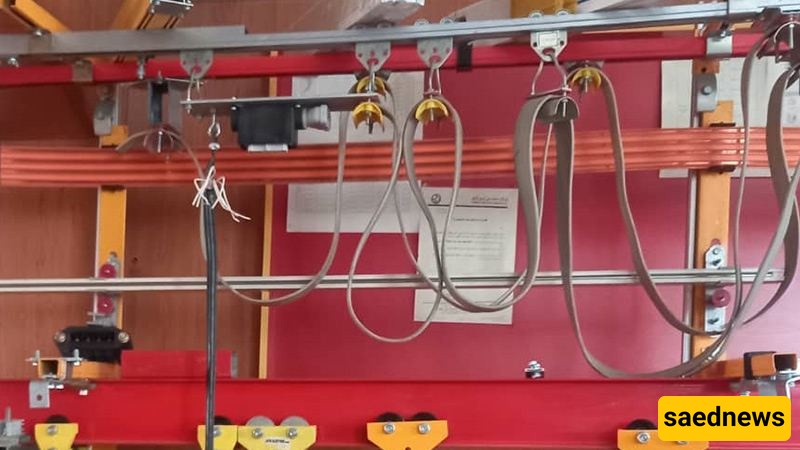
The main electrical components include the control panel, power supply system, radio remote control, and limit switches.
A transverse power supply system distributes electricity across the horizontal travel path of the crane. It may use galvanized C-rails, wire ropes, electrical cables, and metal or plastic cable-supporting trolleys and pulleys.
These systems are suitable for travel distances of up to approximately 40 meters. Connecting brackets are used to join the components together and secure them to the ceiling or supporting structure.
The longitudinal power supply line is generally longer than the transverse system. It commonly uses four-meter aluminum or PVC-insulated conductor rails containing copper conductors to transmit electrical power.
Overhead crane conductor rails are available in open and enclosed designs and operate with current collectors that maintain electrical contact as the crane moves.
The current collector transfers electrical power from the conductor rail to the moving crane through carbon brushes. Its plastic wheels guide it along the rail as the crane travels.
Enclosed conductor rail systems may be designed for currents of around 40 A, while open conductor rail systems are available in ratings such as 100 A, 200 A, 400 A, and 800 A, depending on the installation.
A limit switch is an electrical safety device that stops or restricts crane movement when a predefined travel limit is reached. It can be used to control vertical lifting, transverse trolley movement, and longitudinal bridge travel.
Common designs include cross-shaped and adjustable lever-operated switches. Without properly functioning limit switches, excessive movement may damage the hoist, motor, bridge, or other crane components.
A wireless overhead crane remote control uses radio communication between a transmitter operated by the user and a receiver connected to the crane's control system. It allows the operator to control crane movements from a suitable location.
If the control unit is connected to the crane by a cable, it is commonly known as a pendant control. Saga and Telecrane are among the brands available in the Iranian market.
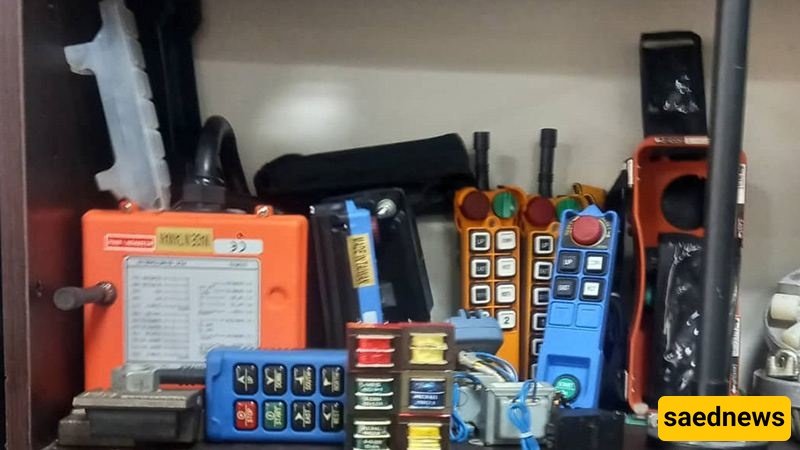
These replacement parts are used throughout the crane's moving assemblies, including motors, gearboxes, and wheels. They support mechanical power transmission and ensure proper movement of the crane and its components.
Crane buffers are durable rubber shock absorbers installed at the ends of the bridge or other moving assemblies. They help reduce impact when moving components approach their travel limits or come into contact with structural stops.
Buffers are available in sizes such as 60, 80, 100, 130, and 180 mm, depending on the crane design and application.
Routine maintenance: Crane components should be inspected and serviced regularly, especially in demanding industrial environments with high duty cycles.
Electrical safety: Before installing or repairing equipment such as remote controls, isolate the incoming power supply at the control panel to reduce the risk of electric shock, injury, or equipment damage.
Motor speed: Overhead crane motors may operate at single or dual speeds. Dual-speed systems generally require more complex electrical controls and may cost more.
Hoist power supply: Hoists are available in single-phase and three-phase configurations. Single-phase hoists are generally less expensive and are frequently used in construction applications. Some models can lift loads of up to 1,200 kg.
The correct components should be selected according to the technical specifications on the hoist and motor-gearbox nameplates. Important details include lifting capacity, motor power, voltage, operating speed, and component model.
Common causes include incorrect installation, unsuitable component selection, counterfeit or poor-quality parts, inadequate maintenance, and prolonged use. Defective components should be inspected and replaced promptly when necessary.
Repair may be appropriate when replacement parts are unavailable or when repair is significantly more economical than replacement, provided that the component can be restored to a safe and reliable operating condition.
When purchasing an overhead crane or its replacement parts, consider the crane type, manufacturer, hoist capacity, electric motor power, warranty, and authenticity of the electrical and mechanical components. Consulting a reputable supplier or manufacturer, such as Novin Crane for power supply rails and conductor systems, can help ensure that the selected equipment meets the technical requirements of the installation.