SAEDNEWS: NASA is preparing a controlled fire experiment on the Moon to discover how everyday materials burn in lunar gravity and a low-oxygen environment. The results could help engineers improve fire-safety standards for future human missions beyond Earth.
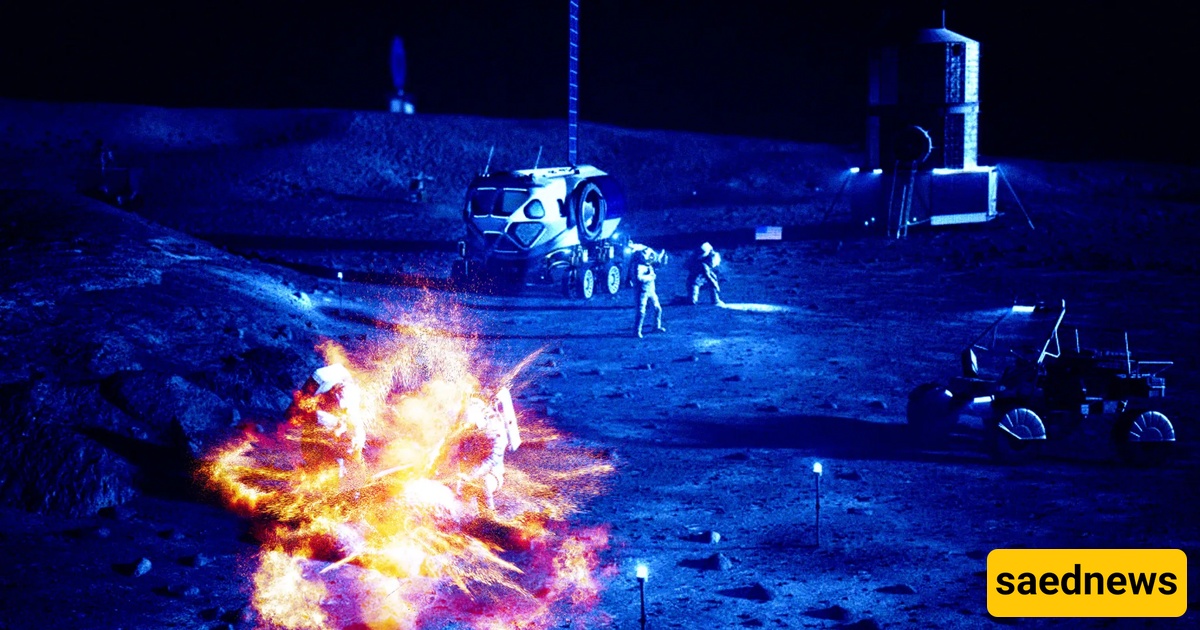
According to SaedNews: NASA is preparing to do something that sounds almost absurd at first: deliberately start a fire on the Moon.
There will be no giant lunar bonfire and no astronaut standing nearby with a match. Instead, NASA plans to send a compact robotic combustion chamber to the lunar surface, where carefully selected materials will be ignited under controlled conditions. The goal is much more serious than the unusual image suggests: researchers want to understand what happens when fire encounters an environment radically different from Earth.
The experiment, known as FM2, or “Flammability of Materials on the Moon,” is being developed with future human exploration in mind. As NASA looks toward later Artemis missions and eventually missions to Mars and beyond, understanding fire behavior away from Earth is becoming an increasingly important safety issue.
Fire is already dangerous in a spacecraft. In an isolated habitat, where astronauts depend on tightly controlled supplies of oxygen and where escape options are extremely limited, an unexpected fire could become catastrophic. NASA therefore wants better information about how different materials ignite, burn and spread flames under lunar conditions.
One of the biggest complications is that materials do not necessarily behave the same way in space as they do on Earth.
Something that is difficult to ignite under ordinary terrestrial conditions could potentially burn differently in the lower gravity of the Moon and in an environment with a different oxygen concentration. That uncertainty makes direct testing particularly valuable.
Emily Johnson, the project manager, has highlighted another unusual possibility. When certain materials burn, portions of the burning material can break away in small pieces resembling tiny droplets. Under microgravity or partial gravity, those pieces could behave very differently from what people see in an ordinary fire.
Instead of simply falling away, small burning particles could effectively become little moving fireballs, potentially igniting other materials.
That possibility explains why NASA is interested not only in whether something catches fire, but also in how the flame develops and spreads.
On Earth, gravity plays a major role in the familiar shape of a flame. Hot gases rise while cooler, denser air is drawn downward, creating the elongated flames people recognize from candles, campfires and other combustion sources.
The Moon is different.
Lunar gravity is only about one-sixth that of Earth. With weaker gravity, the normal movement of gases around a flame changes. NASA has previously noted that flames in low-gravity environments can become much rounder and, under some conditions, nearly spherical.
That means a flame on the Moon may not look or behave the way people expect.
The FM2 experiment is designed to capture those differences in detail. Rather than exposing the lunar environment to an uncontrolled fire, researchers have developed a cylindrical, robotic and self-contained metal combustion chamber. The equipment is expected to travel to the Moon as part of a commercial payload delivery mission.
Inside the chamber will be four test samples made from materials including cotton, fiberglass and acrylic rods. These samples will be deliberately ignited while instruments record what happens.
The chamber will contain an oxygen sensor, equipment for measuring electromagnetic radiation and cameras capable of documenting the fire. Researchers will use the footage and measurements to examine characteristics such as the speed at which flames spread under lunar gravity.
NASA has already conducted numerous fire experiments in microgravity on Earth over the past several decades. Those tests have provided valuable information, but researchers say they cannot completely replace direct access to the lunar environment.
The difference matters because the Moon combines several conditions that are difficult to reproduce simultaneously in terrestrial experiments. Its gravity is far weaker than Earth's, and future lunar habitats will also have their own controlled atmospheric conditions.
According to NASA's explanation of the project, comprehensive material qualification tests on the Moon would ideally be conducted once humans are present there on a much larger scale. Until that becomes practical, a contained robotic experiment can help address important gaps in knowledge without putting astronauts directly at risk.
The potential consequences extend beyond this single test.
The data gathered from FM2 could eventually contribute to updates in spacecraft material standards. If researchers discover that certain materials burn differently—or become more hazardous—in lunar conditions, those findings could influence how future spacecraft and habitats are designed and which materials are considered suitable for use around astronauts.
That makes the experiment far more significant than its headline-grabbing premise.
The image of a fire burning on the Moon may sound like a curiosity, but behind it is a practical question: if humans are going to spend longer periods away from Earth, can they predict what will happen when something catches fire?
NASA's answer, for now, is to test it before the problem becomes an emergency.
The mission is expected to take place later this year. Its results could help fill a critical gap in space-fire safety knowledge and provide engineers with information that cannot be obtained simply by studying flames on Earth.
As humanity prepares for longer missions and a greater presence beyond our planet, even something as familiar as a small flame can become an unknown. The experiment may therefore offer a simple but important lesson: before humans build a lasting presence on the Moon, they need to understand not only how to live there, but also how ordinary dangers change when Earth is no longer beneath their feet.