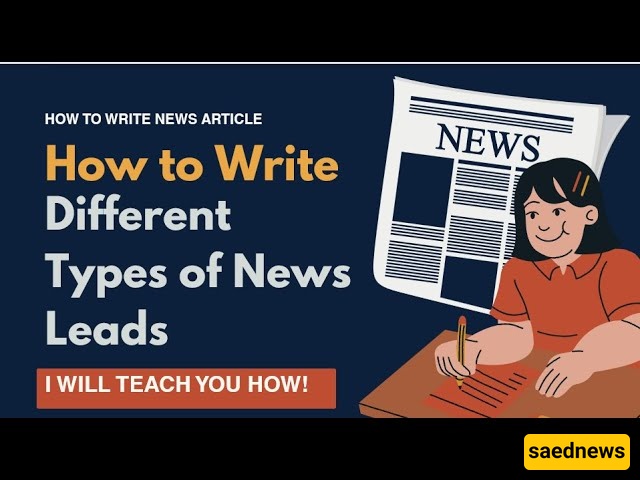
SAEDNEWS: In journalism, a lead is the opening part of a news story that comes after the headline. It highlights the most important information, summarizes the report, and quickly informs the reader of the main point in a clear and direct way

According to the Science and Technology Service of Saed News, the term lead is an English word meaning “leader” or “guide.” In journalism, it refers to the main or most important part of a news story that appears after the headline. Its purpose is to attract readers’ attention. A lead summarizes the report and allows readers to quickly understand its essence. It also presents the most important information in a clear, concise, and engaging way, while determining the tone and direction of the report.
The lead is also called the main paragraph of the text because it should not exceed 40 words or 300 characters. It must be written in a way that encourages the audience to continue reading. A good lead contains the most attractive part of the news. In lead writing, the most prominent news value or element should be highlighted, and the best angle for presenting the news should be chosen for the audience.
To write an effective lead, one must be familiar with different types of leads, news elements, and news values. In addition to technical writing skills, extensive reading is necessary to create simple yet meaningful and engaging leads.
One of the most important principles in news writing is simplicity. Although simple writing may seem easy, it actually requires a wide vocabulary and strong understanding to use words that are clear and understandable for the general public.

News elements include: What? Where? When? Why? How?
These elements help create a complete report and answer all audience questions about an event. In writing a report, one should address all these questions and identify which element is most important. The most prominent element can then be used in the lead.
News values are criteria used to select appropriate events for audiences. These values exist within events themselves, and each event may contain one or more news values. These values form the core reason an event becomes news.
News values include:
Prominence
Impact (relevance)
Conflict or tension
Surprise or unusualness
Magnitude or scale
Writers should use their understanding of these values to improve lead writing.
1. Simple (Direct) Lead
Directly presents the main news. Similar to an in-depth lead, but the in-depth version includes more detail.
2. Descriptive Lead
Uses descriptive language to create an image of the event, often including emotional or human elements.
3. Proverbial Lead
Uses well-known proverbs to make the news more understandable and concrete.
4. Quotation Lead
Includes direct or indirect quotations from important sources.
Direct quotation: exact words are written in quotation marks.
Indirect quotation: meaning is paraphrased without quotation marks.
5. Explanatory Lead
Common in economic and political news. Based on data and analysis, it provides a factual interpretation of events.
6. Question Lead
Presents a question to stimulate curiosity and encourage readers to continue reading.
7. Historical Lead
Refers to past events or background history to make the news more engaging.
To write an effective lead, consider:
What is the most important news value in this event?
Who is the audience and what matters to them?
What is the media platform and its editorial policy?
How can the maximum information be delivered in the fewest words?
The headline is written in bold and is not part of the news body; removing it does not damage the article. However, the lead is an essential part of the news, and without it, the report is incomplete. (Although the headline is often considered more important in attracting attention.)