SAEDNEWS: Who Was Xerxes I? His Wives, Biography, Family, and the Cause of Death of the Achaemenid Persian King
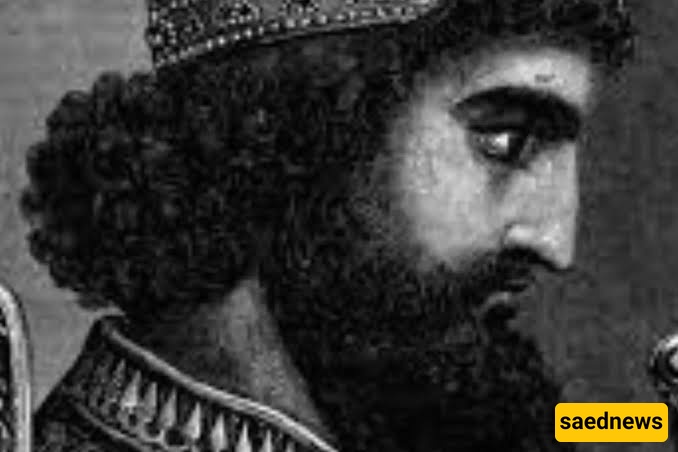
According to Saednews, The history of ancient Iran is filled with fascinating stories, powerful kings, and remarkable events that continue to captivate history enthusiasts centuries later. Among the prominent figures of the Achaemenid Empire, Xerxes I stands out as a king whose name is closely associated with major historical events and controversial accounts of the past.
If you would like to learn more about this Persian king and the lesser-known aspects of his life and reign, continue reading to explore his story.
Xerxes I was one of the best-known kings of the Achaemenid Empire and the son of Darius the Great. His name is most closely associated with the massive Persian military expedition against Greece and the construction projects at Persepolis.
He was born around 519 or 518 BC and ruled the Achaemenid Empire from 486 to 465 BC. His mother was the daughter of Cyrus the Great, and this family connection played a significant role in his selection as Darius’s successor.
Xerxes’s father was Darius the Great, also known as Darius I, the third major ruler of the Achaemenid dynasty after Cyrus and Cambyses. His mother was Atossa, the daughter of Cyrus the Great.
Although Xerxes was not Darius’s eldest son, he was the eldest son born to Atossa. He was eventually selected as his father’s successor and ascended the throne after Darius’s death.

The woman most reliably identified in historical sources as Xerxes I’s wife and queen was Amestris, the daughter of Otanes.
As for the question of how many wives Xerxes had, reliable historical sources do not provide a consistent or definitive account.
The biblical Book of Esther mentions a king named Ahasuerus, whom Esther marries. For centuries, many interpreters and researchers have identified this king with Xerxes I. Some encyclopedias have also presented this identification.
However, from a historical perspective, it cannot be stated with certainty that Esther was Xerxes’s wife. Greek sources, including accounts concerning the court of Xerxes, identify Amestris as his principal wife. No independent evidence concerning Esther has been found in the known Achaemenid records.
For this reason, the story of Xerxes and Esther is best regarded as an account drawn from the biblical tradition rather than an established historical fact.

According to historical accounts, Xerxes I and his wife Amestris had three sons—Darius, Hystaspes, and Artaxerxes I—and three daughters—Amytis, Rhodogune, and Ratasah.
Darius, his eldest son, was killed during the court power struggles that followed his father’s death, and Artaxerxes I subsequently became king. Hystaspes is also associated in some historical accounts with unrest in Bactria.
Among Xerxes’s daughters, Amytis married Megabyzus, an influential figure at the Achaemenid court. However, much of the information about Xerxes’s family comes from ancient Greek sources, and details of certain events remain disputed among scholars.
At the beginning of his reign, Xerxes faced unrest in several parts of the empire, including Egypt. After restoring stability, he pursued an extensive military campaign against Greece.
In 480 BC, the Persian army entered Greece from Asia Minor. The Battle of Thermopylae ended in a Persian victory, and Achaemenid forces subsequently entered Athens. However, the Persian fleet’s defeat at the naval Battle of Salamis changed the course of the war.
Xerxes then withdrew the main body of his army from Greece, leaving Mardonius behind with a contingent of troops. The defeat of Mardonius’s forces at the Battle of Plataea effectively brought the principal phase of the Persian invasion to an end.
In the following years, Xerxes’s reign was marked by extensive construction projects. Parts of the Persepolis complex, whose construction had begun under Darius, were completed or expanded during his rule.
Some historical accounts describe Xerxes as an educated and handsome prince with a refined temperament.
The prestige and grandeur established by Cyrus the Great and Darius I continued during his reign, helping preserve the status of the Achaemenid monarchy among the Persians and the peoples of the empire.
The historically established Persian form of the king’s name is Xerxes, or Xerxes I, corresponding to the Old Persian name Xšayāršā. It is commonly interpreted as meaning “ruler over heroes” or “ruling over men.”
The name is recorded in Old Persian as Xšayāršā and is known in Western sources through its Greek form, Xerxes. The Persian lexicographer Dehkhoda also lists the king under the name Khashayarsha (خشایارشا).
Some sources explain the name using elements associated with a king and a man, interpreting it as “king of men.” However, the ending of the name should not simply be treated as an abbreviated form of the Persian word for “king.”
From a historical and linguistic perspective, Khashayarsha (خشایارشا) is considered a more accurate Persian rendering than Khashayar Shah (خشایارشاه).
Xerxes I was killed in 465 BC, after ruling for approximately two decades. Historical accounts attribute his death to a palace conspiracy.
According to the best-known account, Artabanus, a high-ranking court official and commander of the royal guard, played a role in Xerxes’s assassination.
Following his death, a struggle over the succession began. Eventually, his son Artaxerxes I ascended the throne.

The tomb traditionally attributed to Xerxes I is located at Naqsh-e Rostam, near Persepolis in present-day Iran.
Naqsh-e Rostam is an important archaeological site containing monumental rock-cut tombs associated with several Achaemenid kings.
It is important to distinguish Xerxes II from the famous Xerxes I, the son of Darius the Great.
Xerxes II was born several decades later and was the son of Artaxerxes I. He became king following his father’s death, but according to the historical account of Ctesias, his reign was extremely short, lasting approximately 45 days.
He was killed during a dynastic power struggle by his half-brother Sogdianus.
It is also worth noting that Xerxes III does not appear in the generally accepted list of Achaemenid kings, despite the term sometimes being searched for or used in discussions of Persian royal history.