SAEDNEWS: A Washington Middle East Institute senior researcher says Iran is about three times larger than Venezuela in population and area, and Tehran lies hundreds of miles from U.S. troop locations, creating major geographic challenges.
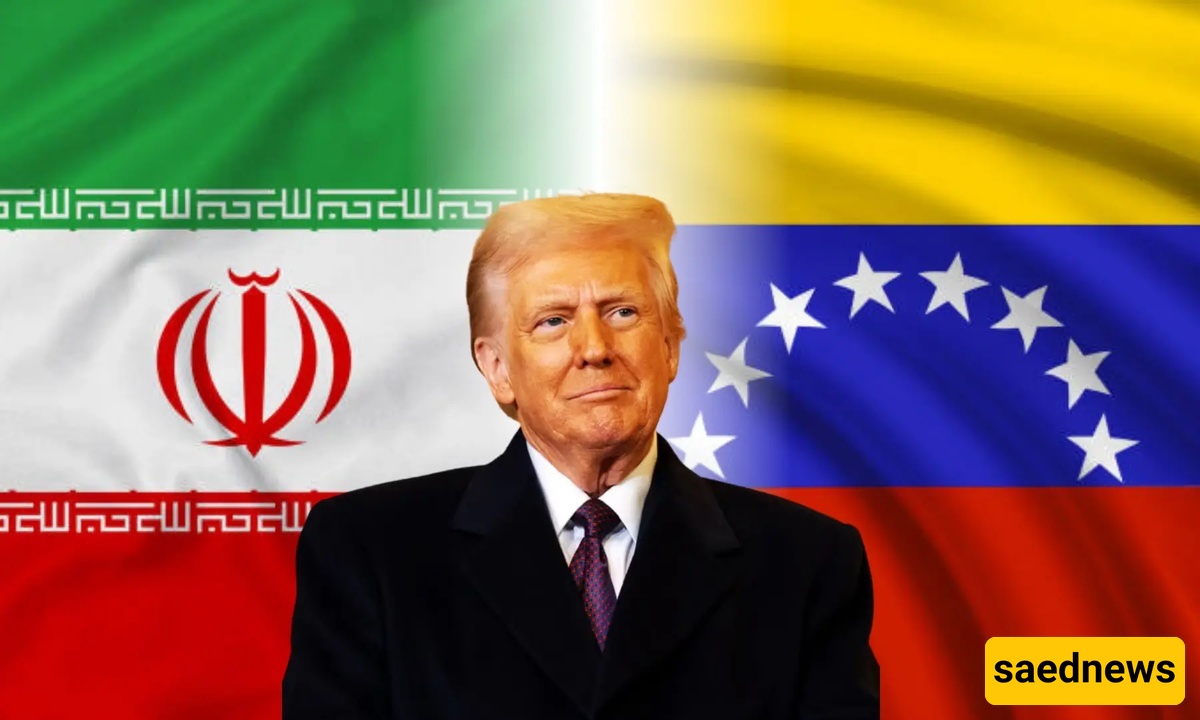
According to the political news service of SaedNews, the debate over whether the United States’ so-called rapid intervention model—previously associated with Venezuela—could be replicated against Iran has become a major focus of strategic analysis. Some experts argue that factors such as geography, time, and military deterrence create a fundamentally different equation compared to Caracas, making developments around Iran significantly more complex.
According to ISNA, citing Al Jazeera, the program “For the Rest of the Story” examined the fundamental differences between the Iran and Venezuela cases, as well as the cost-benefit calculations in such confrontations. It also highlighted signs of a possible inclination by former U.S. President Donald Trump to return to a diplomatic approach.
Jason H. Campbell, a senior researcher at the Middle East Institute in Washington, stated in an interview with the program that comparing Iran and Venezuela across multiple dimensions is both dangerous and misleading.
He noted that although the United States reportedly succeeded in a rapid operation—referred to as “Absolute Resolve”—on January 3, 2026, in which Venezuelan President Nicolás Maduro was detained in a 22-minute operation in Caracas, applying the same model to Iran was fundamentally a strategic error.
Campbell argued that the Trump administration’s assumptions clashed with geopolitical realities. Iran is roughly three times the size of Venezuela, with a much larger population, and its capital Tehran is located hundreds of miles from areas where U.S. forces are positioned. These factors create far greater geographical and logistical complexity.
He also emphasized that Iran’s security forces are more experienced and prepared, making any large-scale military action significantly more difficult.
Campbell further noted that the Middle East had previously ranked fourth in U.S. strategic priorities, but Washington is now increasingly engaged in a new conflict without fully assessing its long-term consequences, while also facing domestic political challenges ahead of elections within the Republican camp.
In another part of the discussion, Mashallah Shams al-Waezin, senior advisor at the West Asia Strategic Studies Center in Tehran, explained why the United States has failed to impose its will on Iran despite more than two and a half months of conflict since February 28, 2026, including U.S. and Israeli air operations.
He stated that Trump introduced what he described as a new and unusual principle in international relations centered on “kidnapping and assassination,” but miscalculated the outcomes. Venezuela, he argued, was isolated in America’s “backyard,” whereas Iran possesses three key advantages that have prevented the success of such scenarios.
Shams al-Waezin identified geography as the first factor, arguing that geography is more powerful than technology, and history has not shown any case where military power has fully overcome it.
The second factor is time. He said Iran has leveraged time to turn the confrontation into a war of attrition, sustained through attacks on U.S. bases and assets in the Persian Gulf and the Sea of Oman.
The third factor is social cohesion. According to him, after the onset of attacks, Iranian society became more unified around its political structure, undermining U.S. and Israeli assumptions that were based on expectations of internal unrest prior to the conflict.
Campbell further discussed the international dimension and the issue of the Strait of Hormuz, stating that Trump failed to secure the expected support during a meeting in Beijing involving the presidents of the United States and China.
He noted that China prioritizes Taiwan as its main strategic concern and that U.S. pressure regarding the Strait of Hormuz has had limited impact on Beijing, as Chinese oil tankers continue operations in coordination with Iran—thereby weakening Washington’s leverage over China.
Shams al-Waezin supported this assessment, arguing that Iran’s strategic alignment with major powers such as China and Russia has created significant geopolitical leverage for Tehran.
He also described claims about Trump’s success during his recent Beijing visit as part of a “psychological war,” emphasizing that major powers prefer to use mediators such as Pakistan, Qatar, and Oman to avoid direct pressure from China.
In another remark, he stated that Iranian attacks on U.S. bases in Gulf countries aim to push them toward neutrality, a situation that he believes could eventually be addressed through a shared security mechanism in the Strait of Hormuz.
Shams al-Waezin added that Trump’s recent statements about “hesitation and delay” in launching attacks—reportedly following requests from Qatar, Saudi Arabia, and the UAE—indicate a gradual return toward diplomacy.
He also identified Israel and Prime Minister Benjamin Netanyahu as major obstacles to a potential agreement between Washington and Tehran.
In contrast, Campbell argued that negotiations remain under strong pressure, as the U.S. president is concerned that any new political agreement would be perceived as weaker than the earlier nuclear deal signed under Barack Obama, which Trump has long criticized.