SAEDNEWS: An American publication reported on Monday that a power struggle has erupted within Donald Trump’s cabinet, involving his vice president and his secretary of defense.
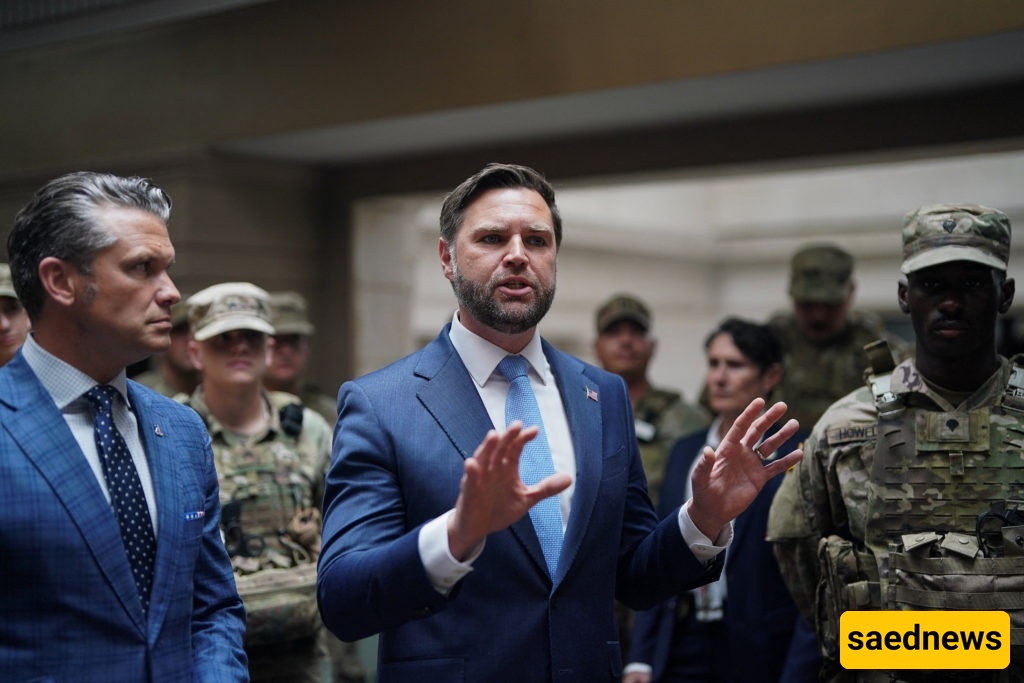
According to the political desk of Saed News, The Atlantic reported on Monday that as tensions between the United States and Iran reach a critical phase, confidential meetings in Washington reveal that Vice President J.D. Vance is deeply skeptical of the Pentagon’s account of the war’s progress and America’s weapons readiness.
The report states that Vance believes the Department of Defense may be concealing the true extent of the depletion of U.S. missile stockpiles.
These concerns come at a time when American military reserves are crucial not only for the current conflict but also for potential defense scenarios involving Taiwan against China, South Korea against North Korea, and Europe against Russia.
Citing informed sources, The Atlantic reports that while Defense Secretary Pete Hegseth and Chairman of the Joint Chiefs of Staff General Dan Caine have spoken optimistically about the extensive destruction of Iran’s military capabilities and described U.S. weapons supplies as “unlimited,” Vance has directly questioned the accuracy of these claims.
Some of Vance’s advisors argue that the positive image presented by Hegseth is “misleading.”
A former Trump administration official noted, “Pete Hegseth’s background in television, particularly at Fox News, has made him keenly aware of what Trump prefers to hear.”
Meanwhile, internal intelligence assessments present a different picture. For instance, previous reports suggest that Iran has retained roughly two-thirds of its air force.
Estimates of Iran’s missile capabilities also indicate that a significant portion of its launch capacity remains intact.
Furthermore, contrary to Donald Trump’s claims about the complete destruction of Iran’s navy, it appears that the country’s fast attack boats and its ability to lay mines in the Strait of Hormuz are still operational.
The Center for Strategic and International Studies (CSIS) recently warned that the United States has likely used more than half of its pre-war stockpiles of four key types of munitions, including Tomahawk missiles and defensive interceptors.
The Atlantic notes that this situation—combined with prior U.S. military support for Ukraine and Israel—could leave American forces in a vulnerable position in the event of a conflict with Russia or China.
Although both Vance and Hegseth served as junior officers in Iraq, The Atlantic writes that they drew very different lessons from their experiences.
Hegseth has taken a hawkish stance, claiming that in the first five days of the war with Iran, the U.S. unleashed twice the level of firepower used during the “shock and awe” phase of the 2003 Iraq War.
In contrast, Vance has consistently opposed what he calls “endless wars,” arguing that the United States has previously been “misled” about conflicts in the Middle East.
The report also indicates that tensions have spread across other layers of the administration. Dan Driscoll, Secretary of the Army and a close ally of Vance, has emerged on the opposite side of Hegseth.
Hegseth’s dismissal of senior army generals aligned with Driscoll has sparked criticism in Congress.
Additionally, Driscoll’s deployment to Kyiv for peace negotiations—instead of the Defense Secretary—signals an open rivalry between the two senior officials.
According to the American magazine, contrary to Hegseth’s predictions of a swift and decisive victory, the war has now turned into a “costly and complex entanglement.”
Last week, as Vance’s plane was preparing to depart for Pakistan for peace talks, former President Donald Trump canceled the trip and extended the ceasefire indefinitely due to Iran’s unwillingness to negotiate at that stage.
However, a recent move by Iran’s Islamic Revolutionary Guard Corps to seize commercial vessels in the Strait of Hormuz suggests that, contrary to Pentagon claims, Iran’s military capabilities remain intact. The strategy of achieving “full control” over Iran’s air and ground space appears, at least for now, closer to a diplomatic aspiration than a battlefield reality.