SAEDNEWS: The U.S. president, who has recently made repeated and contradictory remarks regarding the second round of negotiations with Iran and has effectively encountered a closed door, this time stated that his representatives would not travel to Islamabad due to the 18-hour distance.
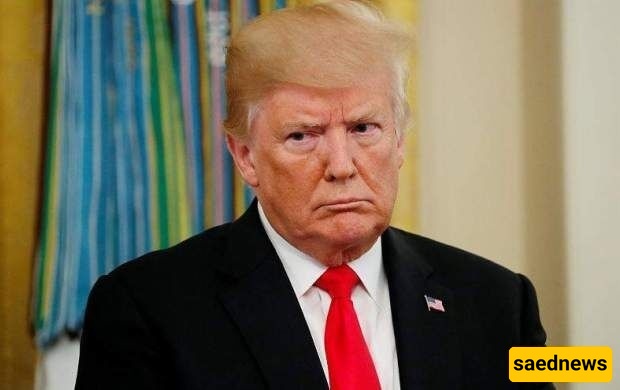
According to the political desk of Saed News, citing Fars News Agency, U.S. President Donald Trump stated in an interview with Fox News tonight: “Just moments ago, I told my people who were preparing for the trip, no—you would have to fly 18 hours to get there. We hold all the cards. They can call us whenever they want, but we are not going to take 18-hour flights just to sit there and talk about nothing.”
Trump, who had previously announced plans to send his representative Steve Witkoff and advisor Jared Kushner to Islamabad for talks with Iranian officials, effectively retreated from his earlier claim, using the long flight as a justification.
Over the past week, Trump had repeatedly mentioned the possibility of dispatching Witkoff, Kushner, and even Vice President J.D. Vance to Islamabad. He had also claimed that negotiations between Iran and the United States would take place on Wednesday, April 22. However, this claim proved unfounded as the Iranian negotiating team did not appear in Islamabad.
Earlier, on April 21, Foreign Ministry spokesperson Esmaeil Baghaei stated that no final decision had yet been made regarding participation in the Islamabad talks, emphasizing that this did not indicate indecision. He cited conflicting messages, contradictory behavior, and unacceptable actions from the U.S. side as the reason for the uncertainty.
On April 22, Baghaei also addressed the possibility of another round of negotiations, saying that diplomacy is a tool for securing national interests and security. He noted that Iran would engage in diplomacy whenever conditions are deemed appropriate for advancing national interests and consolidating achievements against adversaries.
On Friday, April 24, reports surfaced suggesting that Seyed Abbas Araghchi would travel to Islamabad, alongside renewed media speculation about Witkoff and Kushner visiting the city. However, Baghaei, who accompanied Araghchi, clarified on X (formerly Twitter) that no meeting between Iran and the United States had been planned, and that Iran’s views and considerations would instead be conveyed to the Pakistani side.
In this context, Araghchi met today in Islamabad with Pakistan’s Army Chief Asim Munir and Prime Minister Shehbaz Sharif, outlining Iran’s perspectives on a ceasefire and ending the conflict. Later, the foreign minister stated that during his visit, he had presented Iran’s position on a practical and implementable framework for a lasting end to the war, adding that it remains to be seen whether the United States has a genuine willingness to pursue diplomacy.
Despite participating in the first round of talks at the highest level, Iran has repeatedly emphasized that it will not yield to excessive demands or surrender. As Araghchi stated on April 21, Iran knows how to confront limitations, defend its interests, and stand firm against coercion.
According to Fars, Islamabad hosted the first round of indirect Iran–U.S. negotiations on April 11–12, mediated by Pakistan. The delegations were led by Iranian Parliament Speaker Mohammad Bagher Ghalibaf and U.S. Vice President J.D. Vance. The talks lasted 21 hours but ultimately failed to produce a result due to what was described as excessive demands from the U.S. side.