SAEDNEWS: A Democratic senator from the state of New Jersey, reacting to the end of Iran–U.S. negotiations in Islamabad, stated in a blunt and critical tone that the U.S. special envoy has, in practice, “caved in and retreated” in the face of Iran instead of resolving the crisis.

According to the political and analytical service of Saed News Agency, Democratic Senator from New Jersey, Andy Kim, published a sharp post on X (formerly Twitter) today (Sunday), criticizing the performance of JD Vance, the U.S. administration’s special envoy in recent negotiations with the Islamic Republic of Iran, stating that Washington achieved no gains in this round of talks.
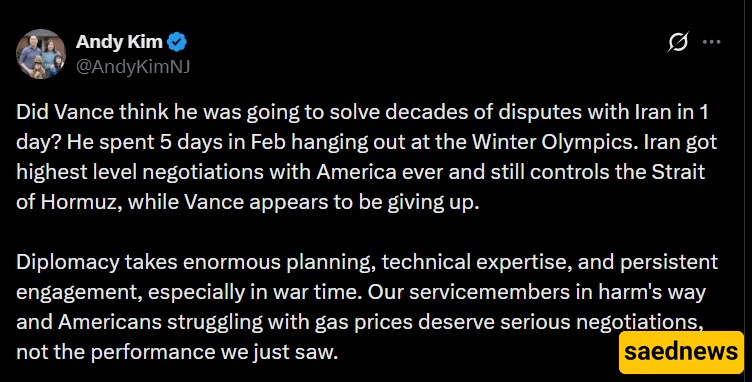
In his tweet, he wrote:
“Did Mr. Vance really think he could resolve decades-long disputes with Iran in a single day? He spent five full days in February touring the Winter Olympics. Iran experienced the highest level of negotiations with the United States in history, while still maintaining control over the Strait of Hormuz, whereas Vance appears to have backed down and retreated.”
The senior U.S. senator further described his country’s diplomacy as lacking proper planning and expertise, stressing:
“Diplomacy requires extensive planning, technical expertise, and continuous follow-up, especially during wartime. Our military personnel who are at risk, and American citizens burdened by skyrocketing fuel prices, deserve serious negotiations—not the kind of performance we just witnessed.”
These remarks, made by one of the prominent critics of White House foreign policy, came shortly after Pakistan’s foreign minister announced the conclusion of a new round of intensive talks between Iranian and American delegations.
Political observers interpret Andy Kim’s direct reference to Iran’s continued control over the Strait of Hormuz following the highest-level negotiations in the history of the two countries as an acknowledgment of the failure of the “maximum pressure” strategy and, at the same time, an implicit admission by a senior American official of the Islamic Republic of Iran’s bargaining power in international waterways.
In a related development, JD Vance stated at a press conference before leaving Pakistan for the United States: “The bad news is that we did not reach an agreement. So we are returning to the U.S. without a deal.”
Without addressing what Iran describes as excessive U.S. demands, he added: “They preferred not to accept our terms. The Iranian delegation did not provide anything substantial confirming that Iran is not seeking to acquire nuclear weapons.”
A source close to the negotiating team told Fars News Agency’s correspondent in Pakistan that the American team was looking for an excuse to leave the negotiation table.
It appears that, according to this source, the Americans entered the talks partly to repair their damaged international image and showed no willingness to lower their demands despite the deadlock and failure in their confrontation with Iran.