SAEDNEWS: The beautiful art of *Khous Doozi* is considered one of the traditional handicrafts of Hormozgan. Join Saed News in this article to explore this art.
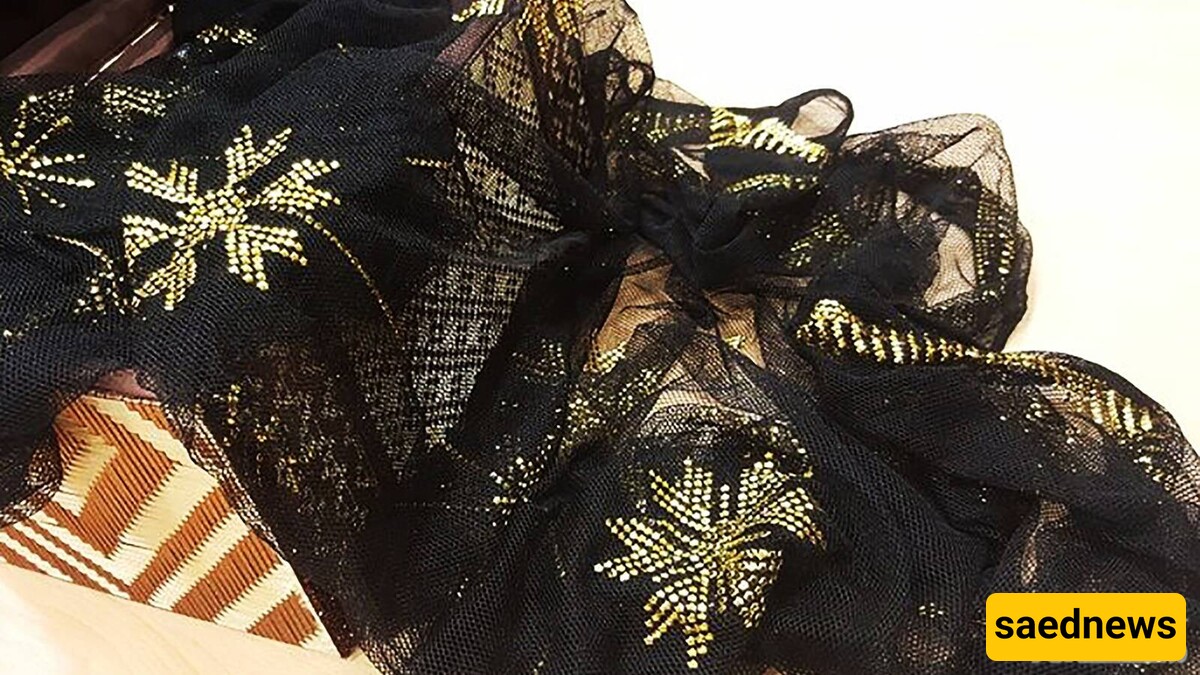
According to SAEDNEWS, The handicrafts of Hormozgan are primarily local in nature, and Khous Doozi is one of the types of embroidery from this region. This art involves sewing narrow strips of Khous (or Naghdeh) onto fine lace fabrics or fabrics with counted threads, creating geometric, curvy, dotted, Islamic, and tile-like designs with tall bases. This delicate craft requires a lot of patience and was historically executed using silver and gold threads instead of the current ones.
Khous Doozi
Khous Doozi is one of the traditional and ancient arts of Iran, which gained popularity during the Safavid period. In the past, silver metal was used as thread for Khous Doozi, but nowadays, thin plastic colored strips have replaced it. The colors available for Khous Doozi are varied, but gold and silver are the most popular choices. The patterns in Khous Doozi include geometric, curvy, dotted, tile-like, and Islamic designs. Khous Doozi has its place in the handicraft industry, and many beautiful pieces have been created by the tastes and skills of Iranian women. In addition to lace fabric, this art is also applied to velvet fabric using a special needle known as a Chenille needle.
The history of this beautiful art remains unclear. However, it is certain that during the Safavid period, Khous Doozi flourished in Bandar Abbas and Baluchistan. After the Safavid era, significant strides were made in advancing this embroidery technique, and it reached its most beautiful forms. The origin of this art is often attributed to India. The spread of this art to southern Iran is likely a result of the close relationship these cities had with India and other countries.
Khous Doozi is mainly done on black lace fabric, locally referred to as "glass fabric." Sometimes, it is also done on fabrics like Sormei and purple cloth. Green, red, or burgundy, and white fabrics are less commonly used. This art is mostly applied to decorate lace headscarves, locally called Jolbil or Jelwil. It is also used to embellish lace curtains and other local women's clothing in this province. The typical size of a Jolbil is about 150 cm in length and 45–80 cm in width. Sometimes, the headscarf is worn directly on the head with a cap placed over it, and the edges are brought from behind the ears to the chest and fastened with pins, wrapping it around the neck and shoulders.
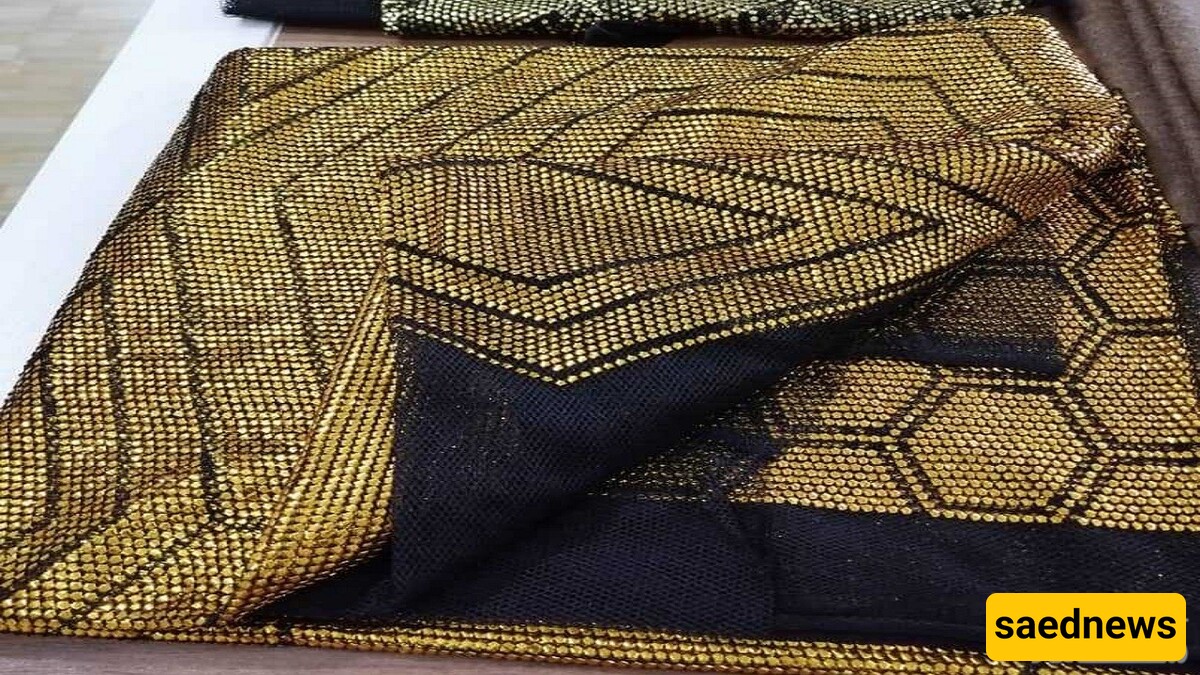
The motifs in Khous Doozi are widely recognized and include designs like honeycomb, six hearts, brick-in-brick, small star, small six-pointed star, scorpion, empty heart, Mekineh Tabuki (a type of motif), earrings, small bowls, peacock, fig leaf border, single stitch, feather stitch, flower designs, four-petal stars, windmill flowers, crab, butterfly, ball-shaped designs, six-pointed stars, missile-like shapes, heart borders, and the cow’s six-eyed border.
In this embroidery, due to the simplicity of the designs, there is no need for complex drawing or patterning on the fabric. To begin, the Naghdeh thread is threaded into a needle, and then the desired design is embroidered onto the lace fabric. Typically, the front and back of the fabric are uniform, with a special luster.
Required Materials
The materials and tools for Khous Doozi include the following: a type of lace fabric, gold or silver Khous, scissors, Sefleh or Segleh stone (a stone used for pressing the raised parts of the embroidery and smoothing out the work), and a Kam or Kaman, a thin walnut wood ring of various sizes, used to stretch the fabric for Khous Doozi and secure it tightly with a belt or cord. In the past, Khous Doozi was done manually with the help of hands and feet, but after the creation of the Kam or Kaman, the embroidery of headscarves became simpler, better, more beautiful, and more valuable, leading to increased popularity.
Khous Doozi can be combined with Golabetoon (gold thread embroidery) and sequin stitching to create stunning and unforgettable pieces. When visiting the provinces of Fars, Hormozgan, Kurdistan, and Baluchistan, be sure to visit centers that produce and sell this ancient art. We must continue to work on preserving traditional arts, and this can only be achieved if proper education is provided to those interested in this craft.