SAEDNEWS: This prehistoric animal had not yet been identified until 1840, but indigenous people of the Karoo Basin had drawn an image resembling it on a rock around 1835. If this claim is confirmed, it would suggest that indigenous peoples of southern Africa were already familiar with this prehistoric creature.

According to Saednews, In the Karoo region of South Africa, a strange tusked creature appears painted on a rock wall. Archaeologists once believed this artwork represented a mythical being from the imagination. However, new research suggests it may instead have been inspired by fossils of extinct animals that lived long before humans.
The painting was created by the San people of southern Africa between 1821 and 1835. Known as the “Horned Serpent Frame,” the image depicts a long-bodied animal with downward-pointing tusks—an anatomy that does not match any species living in the region today.
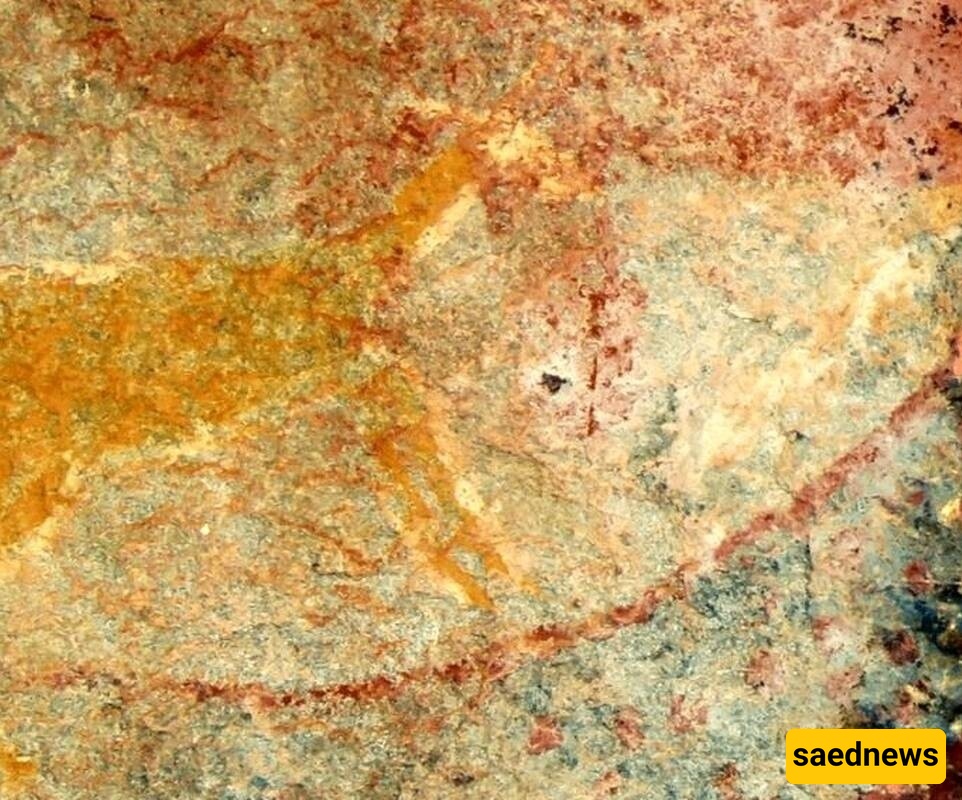
At first glance, it resembles a sea lion, but marine mammals of that kind live near the Arctic, far from southern Africa. Others have suggested it could be a purely spiritual San creature, yet San rock art is often grounded in observations of the natural world.
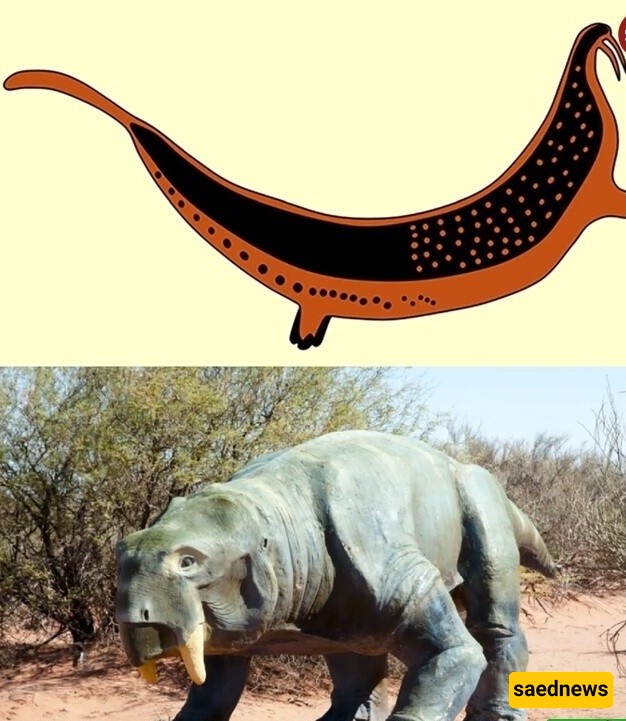
A recent study led by Julien Benoit of the Evolutionary Studies Institute at the University of the Witwatersrand proposes a different explanation: the tusked figure may be based on fossils of dicynodonts. These were giant herbivorous reptiles that lived around 200 million years ago in what is now southern Africa and also had distinctive downward-curving tusks.
There is growing evidence that San communities encountered and even transported prehistoric fossils over long distances. It is therefore plausible that fossil discoveries influenced human imagination and artistic expression, blurring the line between observation and mythology. In this view, extinct creatures may have found their way into San cultural narratives.
Benoit notes that San oral traditions include stories of enormous ancient animals that once roamed the region, far larger than elephants or hippos. A 1905 account also describes San stories of ancestors encountering monstrous creatures from a distant past.
Although dicynodonts died out long before humans appeared, these findings suggest that San communities may have had an awareness—at least culturally—of ancient life forms predating their own era.
Similar patterns are found elsewhere. Indigenous peoples in pre-colonial North America also discovered and interpreted fossils in various ways, sometimes recognizing them as remains of long-extinct animals. In southern Africa, San groups are known to have collected fossils as well, including a site where a dinosaur finger bone was reportedly found—potentially one of the earliest recorded encounters with dinosaur remains.
These discoveries highlight how ancient fossil finds may have influenced early human storytelling, blending natural history with myth and art.