SAEDNEWS: Earth’s rotation is so constant that we rarely notice it, yet the surface at the equator is moving at roughly 1,670 km/h.
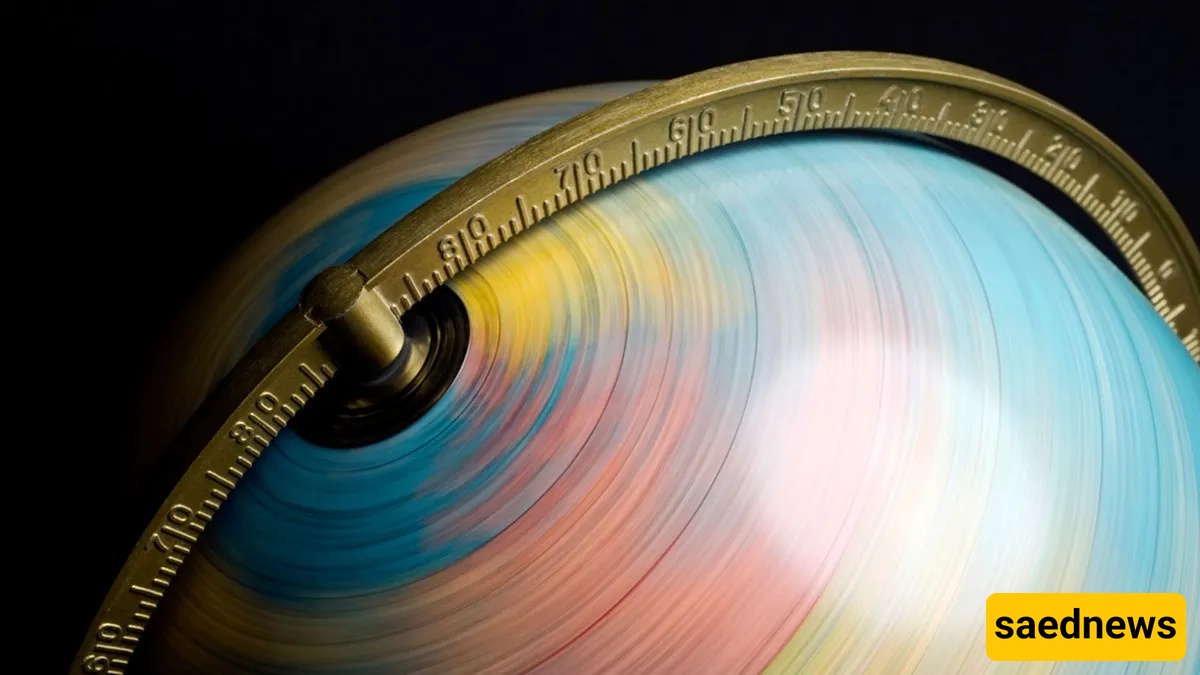
According to SaedNews, Earth’s rotation is one of those movements that is almost impossible to notice precisely because it never seems to change. The planet completes a rotation in about 23 hours, 56 minutes and 4 seconds relative to the distant stars, carrying a point on the equator around the planet at roughly 1,670 km/h.
That raises an extraordinary thought experiment: what if Earth suddenly stopped spinning?
The answer depends heavily on what “stopped” means. A sudden halt would be vastly more destructive than a rotation that gradually slowed over millions of years. In either case, however, Earth would become a very different planet.
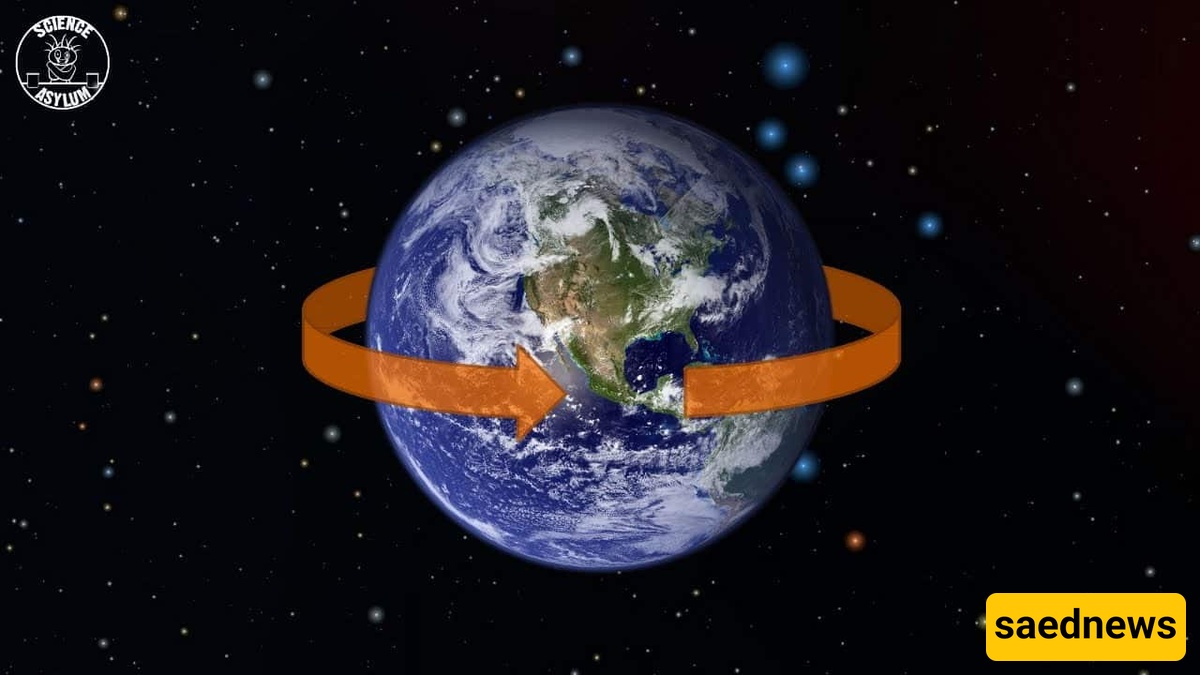
If the solid Earth suddenly stopped while the atmosphere, oceans and surface objects retained their existing motion, everything would effectively continue traveling eastward relative to the newly stationary ground.
At the equator, that relative motion would be around 1,670 km/h. The closer a location is to the poles, the lower its rotational speed; at the poles themselves, the linear rotational speed is essentially zero.
This is why the scenario is not comparable to simply turning off a motor.
Imagine standing inside a vehicle traveling at highway speed and having the vehicle stop almost instantaneously. Your body does not magically stop with it. Earth presents the same basic physics on a planetary scale.
The atmosphere would continue moving, producing extraordinarily powerful winds. Oceans would surge across coastlines, while loose soil, buildings, vehicles and other objects could be swept along with the moving air and water. The resulting earthquakes and tsunamis would make the initial event catastrophic. Smithsonian's explanation of the scenario similarly notes that the still-moving atmosphere and oceans would devastate the surface.
One of the most common misconceptions about a non-rotating Earth is that people would suddenly float into space.
They would not.
Earth’s gravity comes primarily from its mass, not from its rotation. If the planet stopped turning, its gravitational pull would remain. In fact, removing the small outward centrifugal effect associated with rotation would make effective gravity slightly stronger, particularly at the equator.
So the problem would not be people escaping Earth.
The problem would be that the ground would stop while everything around it tried to keep moving.
The catastrophe would not end after the initial winds and waves.
Earth is not a perfect sphere. Its rotation produces a centrifugal effect that contributes to an equatorial bulge, while the oceans settle according to the combined influence of gravity and rotation.
If the rotation disappeared, that rotational contribution to the planet's equilibrium would disappear as well.
Over time, water would migrate toward the poles. Modeling by Esri's ArcGIS team shows that a stationary Earth would develop radically different ocean boundaries, with large polar oceans and extensive land emerging around the equatorial region. The present difference between Earth's equatorial and polar dimensions is also connected to its long-term rotational state.
This would not happen instantly. Water has enormous inertia, and the real redistribution would be a complicated process involving Earth's topography, ocean basins and the changing gravitational equilibrium.
But the final geography would be almost unrecognizable.
If Earth stopped rotating but continued orbiting the Sun, the planet would still complete its journey around the Sun once each year.
But it would no longer have the familiar 24-hour cycle produced by its rotation.
In the simplest version of this thought experiment, a location could experience roughly half a year of sunlight followed by roughly half a year of darkness. The distinction between “day” and “night” would therefore become radically different from what humans experience today.
That would create an enormous climate problem.
A region exposed to the Sun for months would have far more time to absorb solar energy, while the opposite side would spend months radiating heat into space without receiving direct sunlight.
The atmosphere and oceans would redistribute heat, so the planet would not simply divide into one perfectly boiling hemisphere and one perfectly frozen hemisphere. Instead, powerful atmospheric circulation and changing ocean patterns would develop as the climate attempted to move heat from warmer regions toward colder ones.
NASA notes that Earth's present atmospheric circulation is strongly shaped by the Coriolis effect, which exists because Earth rotates. Remove that rotation and the familiar global wind patterns would change fundamentally.
Today's prevailing winds, trade winds and many large-scale atmospheric circulation patterns depend on Earth's rotation.
The Coriolis effect causes moving air and water to be deflected relative to Earth's surface. It is one of the reasons the planet has the recognizable circulation patterns that influence weather and climate.
Without rotation, those patterns would no longer operate in their present form.
Instead, the enormous temperature contrast created by prolonged sunlight and darkness would become a dominant driver of atmospheric movement. Air would move in response to the planet's new heating pattern, while oceans would redistribute heat on a radically altered geography.
The result would not be a simple version of today's weather with stronger storms. It would be a fundamentally different climate system.
This version is less immediately destructive, but it would still transform civilization.
If Earth's rotation slowed gradually, there would be no sudden 1,670-km/h mismatch between the ground and everything on it. The atmosphere and oceans would have time to adjust.
But the consequences would accumulate.
The changing centrifugal effect would alter sea levels and Earth's equilibrium shape. Ocean water would gradually migrate toward the poles, while the length of the solar day would increase.
Researchers have modeled intermediate stages of this process and found that the geography of the oceans would change dramatically as rotation weakened.
So a gradual slowdown would replace an instant catastrophe with a long planetary transformation.
There is a real physical process behind the thought experiment.
Earth's rotation is gradually slowing, largely because of tidal interactions with the Moon. Ocean tides dissipate energy through friction and other processes, transferring angular momentum between Earth and the Moon.
The effect is tiny on a human timescale. NASA and other scientific sources document Earth's continuously measured rotational variations, while astronomical measurements show that the length of a day changes over time rather than remaining perfectly constant.
This does not mean Earth is heading toward an imminent stop.
The natural slowing is extraordinarily gradual, and Earth's future is governed by many other astronomical changes long before a complete rotational standstill could become a practical concern.
If the rotation stopped suddenly, modern civilization would almost certainly be devastated immediately by the physical effects.
If the planet somehow slowed over an extremely long period, however, the story would be different. Life would have time to adapt—or migrate—to new climatic and geographic conditions.
Some regions could become increasingly hostile because of prolonged heating or cooling, while areas near the transition between long day and long night could experience very different environmental conditions.
The important point is that Earth's rotation is not merely responsible for making the Sun appear to rise and set every day. It helps shape the planet's atmosphere, ocean circulation, climate and even the geography of sea level.
Perhaps the most surprising lesson is that Earth does not need to be moving through space for gravity to keep us on the ground.
The danger comes from changing motion, not from motion itself.
We do not feel Earth's rotation because we, the atmosphere and the oceans are all moving with the planet at nearly constant velocity. A sudden halt would destroy that shared motion.
In other words, the planet's spin is normally invisible precisely because everything around us participates in it.
If Earth suddenly stopped spinning, we would discover just how much of the world we take for granted depends on that apparently insignificant daily motion.