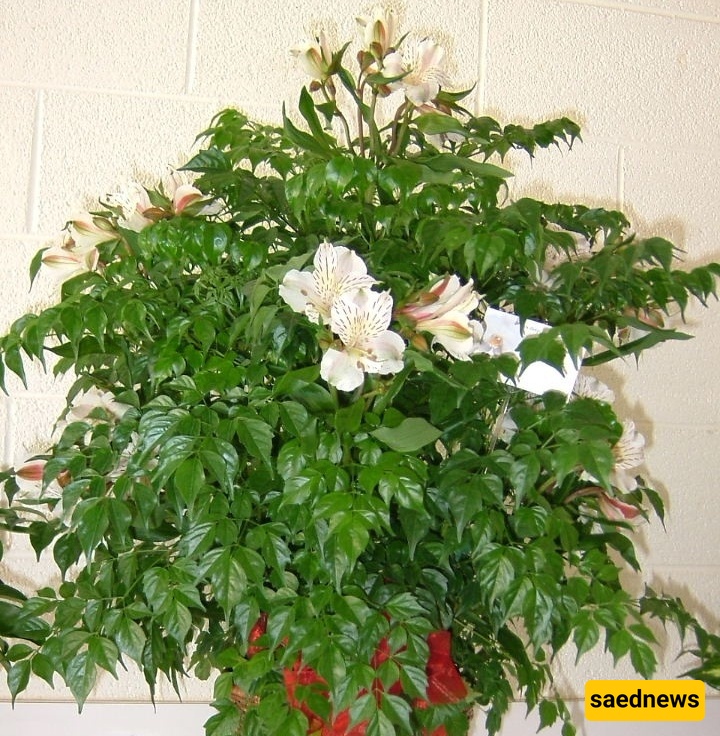
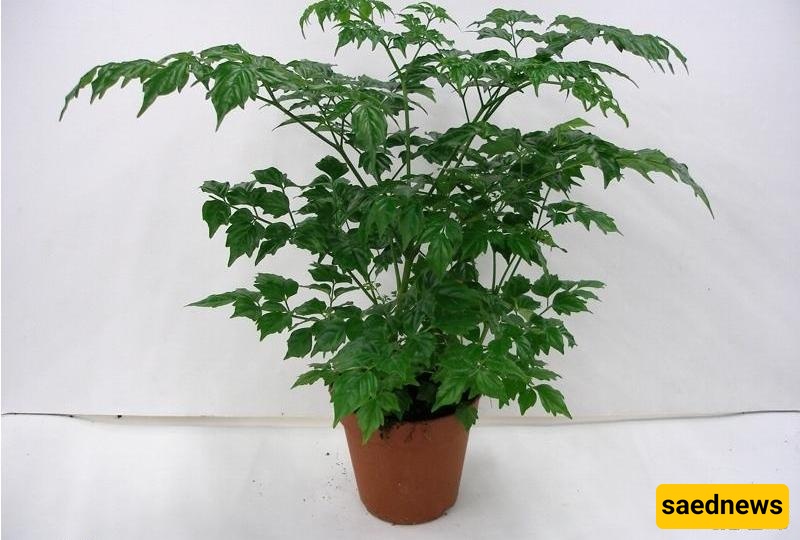
SAEDNEWS: Grows up to 2.5 meters tall and 30–90 cm wide. It has green-blue foliage, grows easily in pots, needs little care, and adapts well to indoor environments. It is an indoor plant.
According to Saednews,
Family: Bignoniaceae
Native region: China
The Emerald Tree is an evergreen plant native to the subtropical and Mediterranean regions of southern China and Taiwan. It exists in two forms: a tall evergreen tree that can grow up to 30 meters and is excellent for garden planting, and shorter varieties that reach a maximum height of about 3 meters, making them suitable for indoor environments. This plant has a very fast growth rate. The trunk diameter can reach up to one meter.
Its leaves are dark green, glossy, and highly ornamental, ranging from 20 to 70 cm in length and 15 to 25 cm in width. The beauty and shine of its foliage are the main reasons it is popular as an ornamental plant.
The flowers are white or yellow, bloom in spring and summer, and are about 7 cm long. They are tubular, fragrant, and aromatic. After flowering, the plant produces long, narrow capsule-like fruits.
Watering:
The Emerald Tree prefers moist soil. It should be kept in consistently moist conditions, but the soil should be allowed to slightly dry between watering to prevent root rot and other problems.
Humidity:
This plant loves humidity. If the indoor air is dry, use a humidity tray filled with pebbles and water. Place the pot on top of the pebbles (without the pot touching the water directly). As the water evaporates, humidity around the plant increases.
Fertilization:
Regular feeding is necessary for healthy growth. Use liquid fertilizers containing all essential nutrients or slow-release fertilizers every few months. Fertilization encourages new leaf and branch growth.
Light Requirements:
When grown indoors, the plant should receive 4–5 hours of direct sunlight or partial sun daily. Insufficient light will cause weak, elongated, and unattractive growth, requiring frequent pruning.
Soil:
Use well-draining soil when planting in a pot. Over time, salts may accumulate in the soil and cause leaf tip burn. In such cases, the soil should be leached by flushing it with water until it drains clear from the pot. The soil pH should ideally be around 7.5.
Temperature:
This plant is suitable for subtropical climates. The ideal temperature range is between 28°C and 46°C. It should be protected from cold and strong winds, as exposure may damage or kill the plant.
Pruning:
When grown indoors or in a patio, pruning twice a year is recommended to maintain shape and encourage healthy growth.
Propagation:
The best propagation method is stem cuttings, although success rates may be lower compared to other plants. Take a 5 cm fresh tip cutting from a young shoot. Remove lower leaves, keeping only the top foliage. Dip the base in rooting hormone and plant it in moist potting soil. Cover with a transparent plastic bag to maintain humidity. Place in a warm, bright location. Once roots develop and new growth appears, pinch the tip to encourage bushier growth.