SAEDNEWS: 3D Virtual Fitting Room Mirror for Clothing: A Tool for Trying On and Viewing Clothes Without Wearing Them
According to academic research services reported by SaedNews and cited from Mehr News Agency:
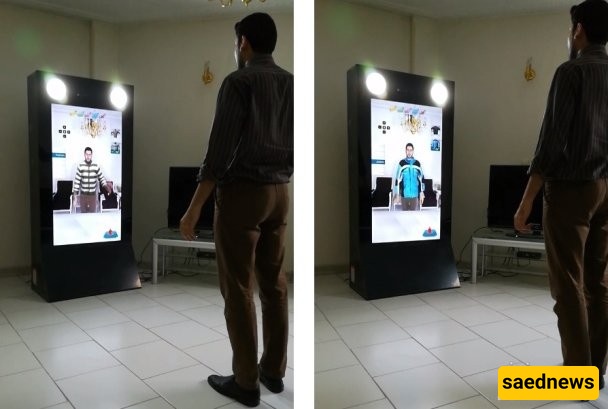
Iranian researchers have successfully designed and built a 3D virtual clothing fitting mirror (virtual fitting room).
Ali Rafiei, one of the researchers of the “design and construction of a 3D virtual clothing fitting mirror” project, stated that he and a team of graduates from universities across the country aimed to establish a company to develop this virtual fitting mirror technology.
He explained that the 3D virtual fitting mirror is a system that allows users to try on and view different types of clothing without physically wearing them, and the team has succeeded in acquiring the technical knowledge required to build it.
Rafiei described the system’s operation, saying that when an object is placed in front of the smart mirror, detection systems first determine whether it is a human. Then, the individual’s body dimensions are scanned using advanced 3D sensors, and a three-dimensional body model is created.
He added that the collected data is processed through complex algorithms, enabling 3D clothing models to be virtually placed on the person’s body.
He further noted that during operation, tracking systems continuously monitor the person’s position, allowing movement across all three spatial axes.

As the user moves or rotates, the virtual clothing adjusts in real time, enabling the user to view the garment from all angles.
According to Rafiei, all of these processes occur in real time on the person while wearing their existing clothes, meaning there is no need to take them off.
Highlighting the benefits of the system, he said it offers a time-saving and immersive technological experience and allows users to try on a wide range of clothing models simultaneously.
He also stated that the system integrates several advanced technologies, including human detection systems, precise body-part recognition, advanced 3D tracking systems, motion recognition systems, a 3D graphics engine, and an intelligent user interface.
Additional features include 3D clothing modeling, categorization of designs, touchless control via hand gestures, size adjustment capabilities, high processing speed, full-axis movement, rotation tracking, and high security.
Rafiei also noted that the company plans to offer product sales, equipment packages, and lifetime usage at a cost approximately one-fifth that of foreign alternatives.
He added that potential users include clothing stores and brands, wholesale distributors, non-fashion companies during exhibitions for promotional purposes, sports clubs during fan events and gatherings, cultural and religious centers for promoting dress culture, and entertainment venues such as amusement parks.
He concluded that many experts believe this technology could revolutionize the fashion and clothing industry in the near future by significantly changing how clothing is tried on and sold in stores. He also emphasized that there has been strong international competition to develop such systems in recent years.
Finally, he stated that the product is now completed and ready for market entry, marking the first such system developed in Iran and the Middle East.
The project was completed by Ali Rafiei (MSc in Digital Electronics Engineering, Tafresh University), Hassan Panahi (MSc in Control Engineering, Shahid University), Dr. Mohammad Javad Abdollahi Fard (PhD in Digital Electronics, Amirkabir University of Technology and faculty member at Tafresh University), and Ali Zakeri (MSc in Digital Electronics Engineering, Tafresh University).