SAEDNEWS: Discovery of an unknown object on a child’s chest raises new questions about identity and burial practices.
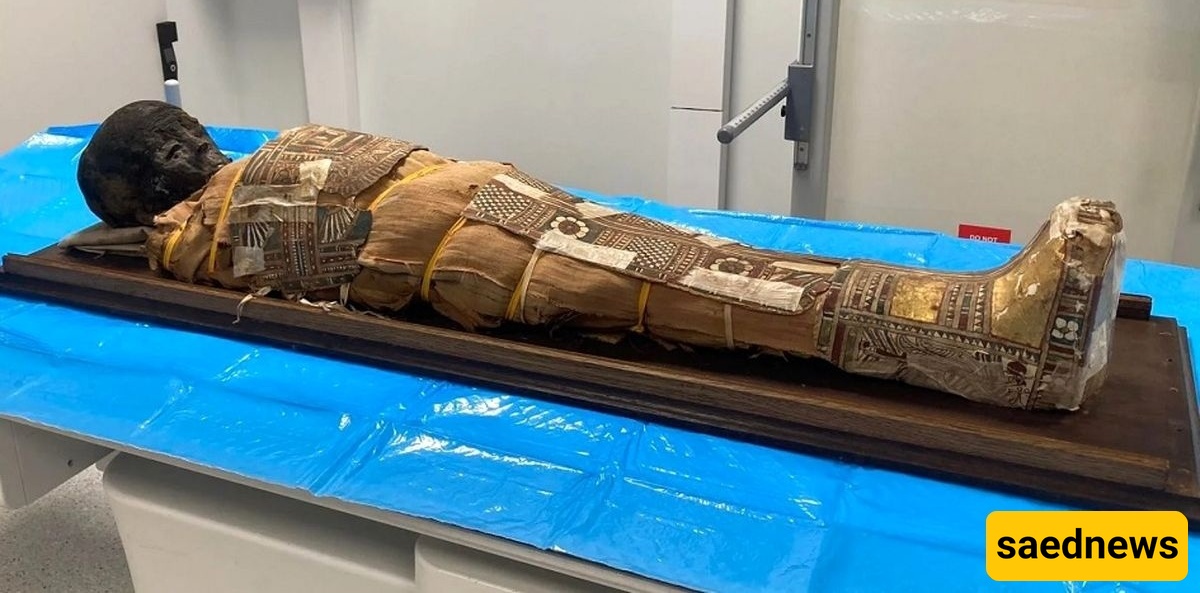
According to Saednews Society Service, a roughly 2,000-year-old Egyptian child mummy preserved in the city of Wrocław, Poland, has provided valuable insights into ancient Egyptian burial practices while also presenting a new mystery. During the first comprehensive scientific examination of the mummy, researchers discovered a hidden object on the child’s chest that may offer clues about his identity or funerary rituals.
This object was identified through CT scans without damaging the mummy. Scientists believe it may be a papyrus or some form of amulet intentionally placed with the body at burial. It could potentially contain the child’s name or a protective inscription intended for the afterlife. However, due to the fragility of the mummy’s outer covering (cartonnage), direct access to the object is currently not possible.
The mummy has been kept at the Wrocław Episcopal Museum since 1914, when Cardinal Adolf Bertram brought it to the city as part of a private collection of antiquities. Despite its long presence there, no systematic scientific study had been conducted until recently.
This changed in 2023, when, at the request of Archbishop Józef Kupny, the first full scientific investigation began. An interdisciplinary team led by Professor Agata Kobal of the University of Wrocław, in collaboration with the Mummy Research Center, examined the remains using advanced imaging techniques such as X-rays and CT scanning, without causing any damage.
The findings were published in the journal Digital Applications in Archaeology and Cultural Heritage, contributing significant data to global research on Egyptian mummies.
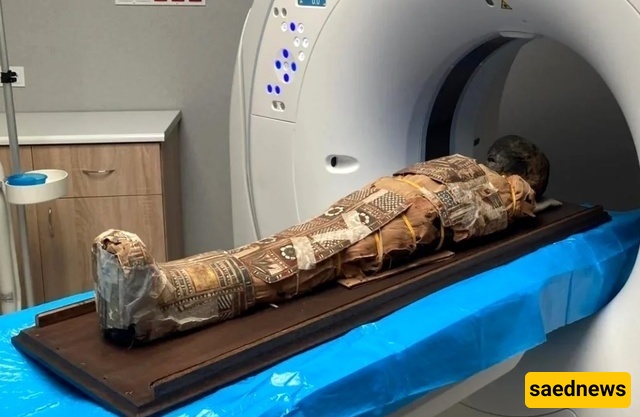
One of the most important findings is that the mummy belongs to an approximately eight-year-old boy. Researchers determined his age with high accuracy by examining dental development, one of the most reliable methods for age estimation in children.
He was about 123 centimeters tall, and his preservation state is relatively good. Anatomical features also confirmed the child’s sex, which is often difficult to determine in mummy studies due to complex layers of wrappings and preservation conditions.
However, the most important question remains unanswered: the cause of death. So far, no clear signs of injury or fatal disease have been found, leaving the case an unsolved mystery.
Although historical records related to the mummy’s origin were lost during World War II, researchers have relied on the artifact itself for clues.
Decorations on the cartonnage—the painted mummy casing—provide important information. The painting style, motifs, and symbols suggest that the mummy likely originated from Upper Egypt, particularly the regions around Kom Ombo or Aswan.
Elements such as lotus flowers, rose-like motifs, and a winged scarab align with funerary art from that region in the late Pharaonic period. One particularly interesting detail is the depiction of a rare composite deity, possibly “Nehebkau,” shown carrying a mummy—an image that may offer further insight into the area’s religious beliefs.
Perhaps the most intriguing discovery is an unidentified object located on the child’s chest. This item, visible in scan images, may be a papyrus scroll containing the child’s name or personal information.
However, accessing it is extremely difficult. The cartonnage is fragile and damaged, and any attempt to open it could cause harm. Researchers are currently exploring methods to study the object without damaging the mummy.
What once appeared to be just a lifeless museum artifact is now seen as the remains of a real child—someone who lived, died, and was carefully prepared for the journey to the afterlife.
And perhaps that hidden object on his chest will ultimately reveal his most personal secret: his name.
This research demonstrates how modern medical technology is transforming archaeology. High-resolution CT scans have allowed scientists to build precise 3D models of the mummy and examine different layers—from bones to tissues and wrappings—separately.
Studying mummies is highly complex because dried tissues and resin-soaked bandages behave very differently from living bodies. Researchers had to manually adjust scanning parameters and carefully analyze each layer.