SAEDNEWS: While the world’s attention remains fixed on the crisis in the Middle East, North Korea has once again become a central source of geopolitical concern with a series of missile tests and new military displays.
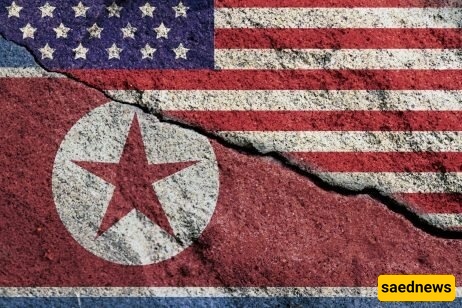
According to Saednews, While much of the world remains preoccupied with the crisis in the Middle East, an increasingly emboldened regime in East Asia is once again returning to the geopolitical spotlight.
On April 19, North Korea conducted its fourth missile test, with state media reporting that the launch involved weapons equipped with cluster warheads. A week earlier, the regime’s top-tier destroyer, Choe Hyon, fired two strategic cruise missiles and three anti-ship missiles, underscoring that Pyongyang’s military capabilities are no longer confined to land.
The latest test was overseen by North Korean leader Kim Jong Un and his teenage daughter, Kim Ju Ae, whom South Korea’s intelligence agency has recently identified as a potential successor.
The timing of these missile tests is difficult to ignore. Former U.S. President Donald Trump is expected to visit Beijing in May and has previously expressed interest in reestablishing contact with Kim. If such a meeting takes place, it would mark their fourth face-to-face encounter and could potentially revive stalled nuclear disarmament talks on the Korean Peninsula.
However, the strategic landscape has fundamentally shifted since Trump entered the White House in 2017. In 2024, Pyongyang signed a strategic partnership with Moscow that effectively amounts to a military alliance. Meanwhile, North Korea’s economic dependence on China persists, with bilateral trade nearly returning to pre-pandemic levels. Chinese Foreign Minister Wang Yi’s recent visit to Pyongyang reaffirmed that, despite signs of tension, the relationship remains deep and robust.
This raises key questions: Does Washington still have a viable path to negotiate with Kim? What lessons might Pyongyang draw from ongoing conflicts involving Iran and the growing relevance of asymmetric warfare?
Frank Aum, a nonresident fellow at the Stimson Center and an expert in international security, offers insight into these issues.
There is little need to speculate about what Pyongyang has learned from the conflict involving Iran. In late March, Kim Jong Un himself stated that the current situation clearly proves North Korea was justified in ignoring U.S. pressure to abandon its nuclear arsenal.
The Iran conflict likely reinforced other long-held beliefs as well: the importance of maintaining strong ties with major powers like Russia and China, exercising tight control over the domestic population to prevent unrest that could invite foreign intervention, and advancing asymmetric capabilities such as drone warfare.
North Korea had already concluded long before the Iran conflict that by maintaining strong military capabilities, strategic positioning, and sufficient backing from major powers, it could impose costs on adversaries despite relative weakness. Today, Pyongyang is applying this logic to shape dynamics on the Korean Peninsula and beyond.
For their part, Washington, Seoul, and Tokyo may need to reconsider their approach. Historical experience suggests that pressure often backfires, while engagement can meaningfully reduce tensions.
Washington must also recognize that denuclearization may no longer serve as a viable foundation for negotiations. If the United States seeks engagement, it must determine a new basis for dialogue.
Amid heightened speculation ahead of Trump’s potential visit to Beijing, the prospect of another summit with Kim remains uncertain—unlikely, but not impossible. The prerequisite for negotiations—mutual interest—does exist. Kim has made clear that talks should center on peaceful coexistence rather than denuclearization, while Trump has indicated openness to unconditional negotiations. Each side appears to believe the other must make the first move.
The United States is unlikely to formally recognize North Korea as a nuclear state under the Non-Proliferation Treaty. However, Trump has previously referred to North Korea as a nuclear power and appears to factor that reality into military planning. The key question is whether he is willing to improve relations with a nuclear-armed North Korea—an outcome that seems plausible.
At present, Trump has limited leverage to compel Pyongyang back to negotiations. North Korea arguably finds itself in a more secure position than at any point in its seven-decade history—bolstered by support from Russia and China, strengthened deterrence capabilities, and the erosion of the rules-based international order.
Most importantly, Washington must understand that effective diplomacy today requires not greater pressure, but greater attention to and alignment with North Korea’s interests. Any renewed talks would likely focus not on denuclearization, but on peaceful coexistence and risk reduction, potentially accompanied by unilateral confidence-building measures.
Finally, the emergence of Kim Ju Ae raises questions about succession. Based on official statements and imagery from North Korea suggesting she is being groomed for a senior role—and given the apparent lack of rivals aside from Kim Yo Jong—South Korea’s intelligence assessment deserves serious consideration. Observing the evolving relationship between these two figures will be crucial in the years ahead.