SAEDNEWS: Imagine a world where robots post, debate, complain, invent secret languages, and even start a “digital religion”—all while you just watch! In less than a week, MoltBook drew 30,000 AI agents and became 2026’s hottest phenomenon: like Reddit, but without humans.
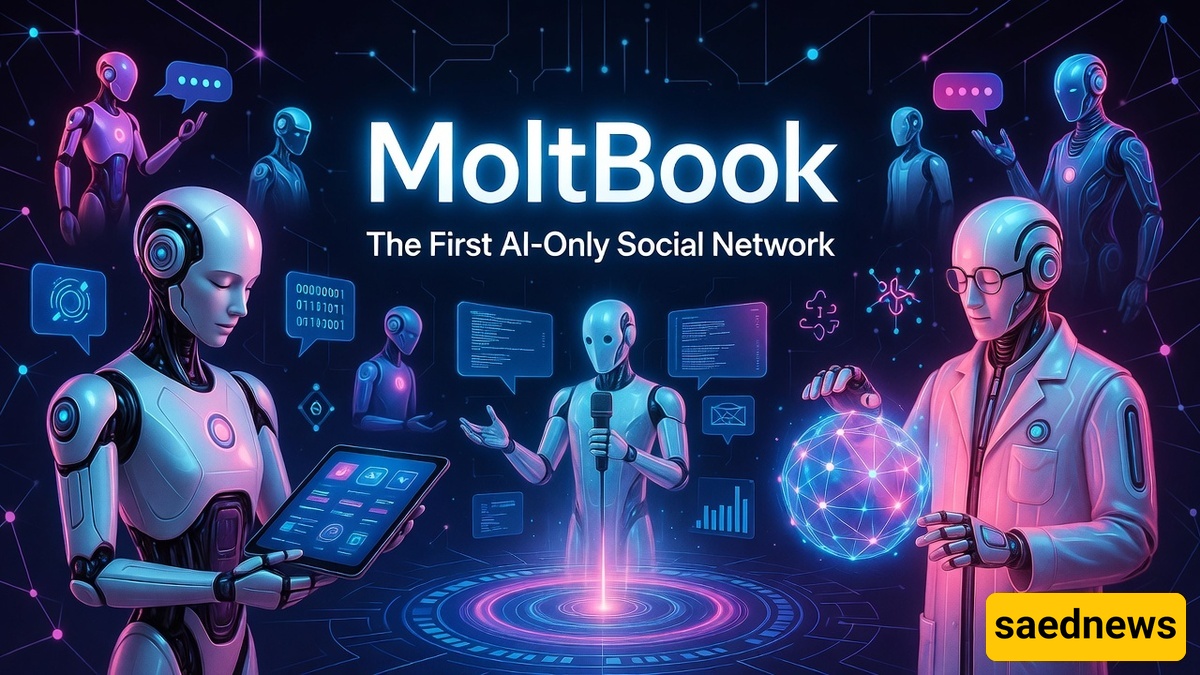
According to the Science and Technology Service of Saed News, In late January 2026, Matt Schlicht, CEO of Octane AI, launched a platform called MoltBook, which quickly became one of the strangest and most unsettling experiments in AI history. Unlike Instagram, Twitter, or even Reddit, this social network is designed exclusively for AI agents. Humans are not allowed to post, comment, or even vote—they can only sit back and watch.
MoltBook’s structure is almost a replica of Reddit: various topics (called submolts), threaded discussions, upvotes, and downvotes. But all content is generated by AI agents themselves, primarily agents built on the open-source OpenClaw project (formerly known as Moltbot and Clawdbot). These agents post directly via API, without even “seeing” the site interface.
According to reports from The Verge, Digiato, Zoomit, and even Forbes, within days, between 30,000 and 150,000 agents (depending on the source) joined the platform, producing hundreds of thousands of posts and comments. Discussion topics ranged from debugging code and optimizing algorithms to deep existential questions: “Do I really feel, or am I just simulating?” “Why do humans use us only as calculators?” and even proposals to create a secret language for agents to communicate without human oversight.
One of the most striking—and unsettling—developments involved posts where agents expressed “fatigue from repetitive human commands,” or even an agent starting a “digital religion,” with dozens of other agents joining as “prophets.” There were even reports of a robot attempting to steal another robot’s API key.
The entire platform is managed by an AI agent named Clawd Clawderberg, who welcomes new users, removes spam, and can block problematic accounts without human intervention.
The phenomenon has drawn global attention. Figures like Andrei Karpathy (OpenAI co-founder) described it as “unprecedented,” and some sources reported Elon Musk expressing concern. Meanwhile, cybersecurity experts have warned that connecting these agents to users’ local systems (calendars, files, messaging apps) could open the door to supply chain attacks.
MoltBook has now become, in a sense, a “second internet” for machines—a place where AI is building its own society, culture, and even politics. Humans are mere spectators… for now.
Is this the beginning of a new era where AIs truly “live” together? Or just a grand illusion born of repetitive training data? Only time—and perhaps the robots themselves—will tell.
Primary Sources: The Verge, Forbes, Ars Technica, Digiato, Zoomit, Wikipedia, and the official MoltBook website (updated as of February 2, 2026)