SAEDNEWS: A 2,000-year-old artifact, described as projectile-shaped, has recently been discovered, bearing the name of Julius Caesar.
According to the Science and Technology Desk of Saed News, archaeologists have uncovered a lead projectile shaped like an almond, engraved with the name of Julius Caesar and an unknown city. The object was likely fired from a bow. The inscription suggests that the indigenous people of Spain were followers of Caesar.
Caesar, as a general, led the Roman army to victory in the Gallic Wars (58–50 BCE). However, unwilling to relinquish power, he crossed the Rubicon River on January 10, 49 BCE, sparking a civil war in Rome to eliminate his political rival, Pompey the Great.
Caesar’s civil war (49–45 BCE) swept across Europe, including Italy, Greece, Egypt, Africa, Spain, and the Balkans. The final engagement, the Battle of Munda, occurred on March 17, 45 BCE, likely in Andalusia, southern Spain. Tens of thousands of Pompeian soldiers were killed, and Caesar returned victorious to Rome.

Now, analysis of this unique lead projectile sheds fresh light on the battles of the era. A June 2023 study published in the journal Zephyrus revealed that the inscription refers to an ancient city never mentioned in historical records of Caesar’s civil war.
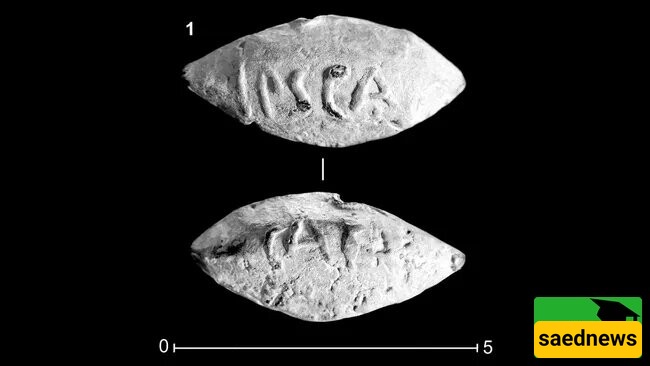
The artifact is classified as an engraved projectile. Measuring 1.8 by 0.8 inches (4.5 by 2 cm) and weighing 2.5 ounces (71 grams), it was cast in a mold into which molten lead was poured. Letters were carved into both sides of the mold, producing raised inscriptions on the finished projectile: "IPSCA" on one side and "CAES" on the other. Part of the projectile is deformed, likely from striking a hard object during its ancient use.
Researchers believe the word "IPSCA" refers to an ancient city involved in the civil war between Caesar and Pompey. Given that the projectile was found near Montilla, the probable site of Munda in Roman times, "IPSCA" was likely connected to the decisive final battles of Caesar’s campaign.
What was the message of this projectile?
Javier Moraljo Ordax, lead author of the study and assistant professor of archaeology at the University of Madrid, told Live Science that engraved objects were highly valued in the first century BCE as tools for conveying short, highly specific messages. In this case, the projectile may have served as political propaganda and a morale booster for Caesar’s soldiers, signaling that the people of the city of IPSCA were likely Caesar’s supporters.
Only one other projectile bearing Caesar’s name has been found in Spain, from the province of Jaén.