SAEDNEWS: Turkey’s Foreign Minister said Egypt could potentially join a military agreement established in Mecca alongside Saudi Arabia, Pakistan, and Turkey, emphasizing that the alliance is not directed against Iran.
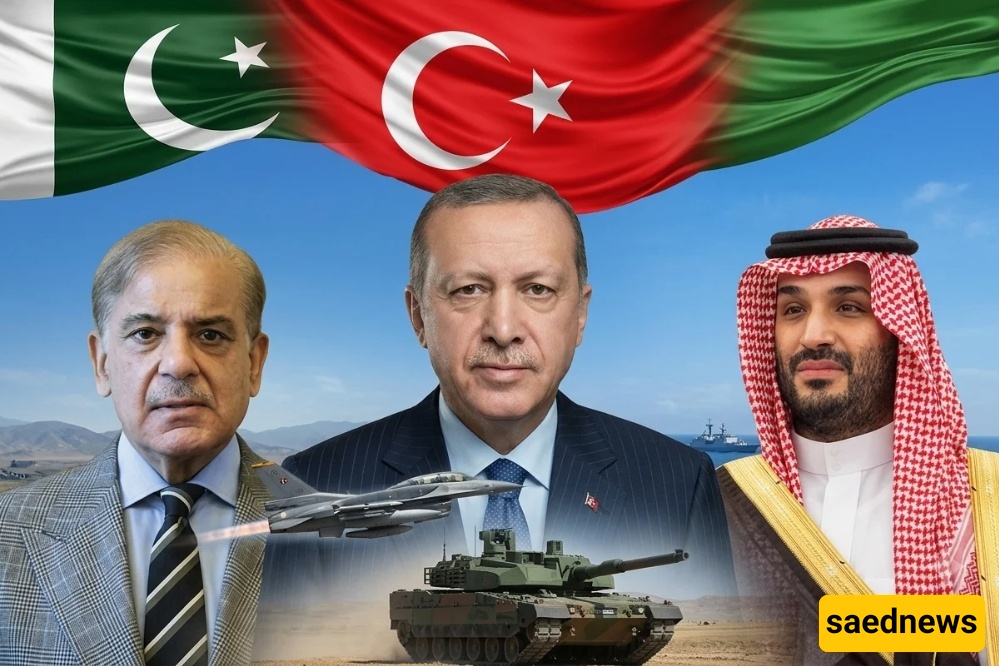
According to the political desk of Saed News, Turkish Foreign Minister Hakan Fidan said in an interview with Anadolu Agency that the “Mecca” trilateral alliance could expand and is not directed against any country, including Iran.
Previously, some analysts had described the Mecca alliance as a political cover for Saudi Arabia to address regional crises, particularly the war in Yemen. They had also argued that the possibility of any country joining the alliance indicated that it was largely political and propaganda-oriented.
However, Fidan claimed that negotiations over the agreement had begun before the outbreak of the war between Iran, the United States, and Israel.
He said: “Now that we are coming together with these countries, naturally, we are establishing a defense organization. This is not about saying, ‘Let’s attack and do this or that together.’ Therefore, as long as these countries are not attacked by any party, whether from within or outside the region, this alliance cannot have hostility or engage in conflict with any country.”
He also stressed that Iran is not the “target” of the agreement. Fidan added: “Those who do not attack the countries that have signed the agreement are not the target of this agreement.”
The Turkish foreign minister’s emphasis on activating the mutual-defense clause comes after Saudi Arabia and Pakistan signed a “Strategic Mutual Defense Agreement” in Riyadh on September 17, 2025. However, despite Yemen’s repeated drone and missile attacks on Saudi Arabia in recent weeks, Pakistan has never agreed to intervene.
In another part of his remarks, the Turkish foreign minister said Egypt could join the joint-defense agreement between Turkey, Saudi Arabia, and Pakistan after certain technical issues are resolved.
Fidan claimed that other countries in the region are also interested in joining the “Mecca Agreement,” with Egypt being one of them.
Fidan further claimed that the defense agreement between Turkey, Saudi Arabia, and Pakistan is technically similar to Article 5 of the NATO treaty, under which an armed attack against one member is considered an attack against all members.
However, there are substantial operational and structural differences between NATO and the current trilateral agreement. Unlike NATO, which has a permanent joint command structure with clearly defined authorities for crisis situations, the trilateral agreement does not establish a higher coordinating body or unified headquarters for the armed forces of the three countries.
In the event of a war, this institutional gap could leave operational decision-making dependent on diplomacy and lengthy negotiations among the military leadership of the participating countries.