SAEDNEWS: The time for performing the Eclipse Prayer begins when the sun or moon starts to be eclipsed. As a recommended precaution, the prayer should not be delayed until the eclipse begins to subside and the sun or moon starts to return to its normal state.
According to Saednews, The Prayer of Signs (Salat al-Ayat) becomes obligatory when certain natural events occur. Some unusual phenomena in nature can frighten people and, in some cases, may even lead the uninformed toward superstitious or polytheistic beliefs.
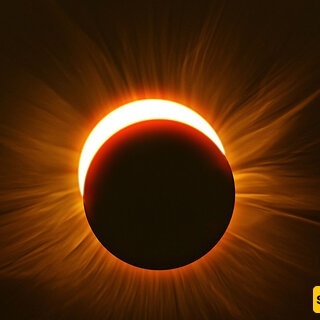
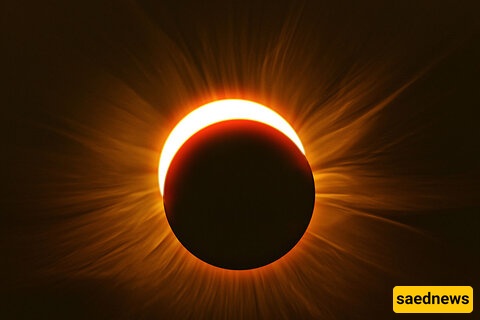
A solar eclipse, or kusuf, occurs when the Moon passes between the Sun and the Earth, causing the Moon’s shadow to fall on part of the Earth. As a result, observers in certain parts of the world see the Moon cover part or all of the Sun’s disk.
A solar eclipse can occur in three main forms: total, partial, and annular. In each case, a portion or all of the Sun appears to be obscured.
Salat al-Ayat is one of the obligatory prayers that becomes required when certain natural events occur, including solar eclipses, lunar eclipses, earthquakes, and other extraordinary events.
According to the rulings, it becomes obligatory in the following circumstances:
A solar or lunar eclipse, even if only a small portion of the Sun or Moon is obscured.
An earthquake.
Any unusual natural event that causes widespread fear among people, such as an extraordinary black, red, or yellow wind, severe darkness, land subsidence, a mountain collapsing, a frightening heavenly sound, or a fire that sometimes appears in the sky.
Except for solar eclipses, lunar eclipses, and earthquakes, the event must cause fear among most people. An event that is not frightening, or that frightens only a small number of people, does not make the prayer obligatory.
If one of these events occurs in a particular city, Salat al-Ayat is obligatory only for the people of that city and not for people living elsewhere. However, if a nearby area is considered part of the same city because of its close proximity, the prayer is also obligatory there.
When an earthquake, thunderstorm, lightning, or a similar event occurs, Salat al-Ayat should be performed immediately. If a person does not perform it at that time, it remains obligatory for them for the rest of their life, and whenever they perform it later, it is considered a valid performance of the prayer.
According to the consensus of the jurists, there is no difference between a partial and a total solar or lunar eclipse regarding the obligation of Salat al-Ayat. However, if a person was unaware of the eclipse while it was occurring, making up the prayer is not obligatory in the case of a partial eclipse.
The prescribed time for Salat al-Ayat during a solar or lunar eclipse begins when the eclipse starts and continues until the eclipse begins to end. As a precaution, the prayer should not be delayed. It should be performed before the eclipse begins to clear.
If a person delays the prayer until after this period, they can no longer perform it with the intention of either a current (ada) or make-up (qada) prayer.
In areas where the Sun rises after the eclipse has already begun to clear, Salat al-Ayat should be performed before the eclipse completely ends, without intending it as either a current or make-up prayer.
If the solar eclipse is not total, people who only learn about it afterward are not required to perform Salat al-Ayat.
Salat al-Ayat is obligatory for people living in cities, villages, and other areas where the eclipse is visible, even if an individual person does not personally see it.
For determining which locations fall within the area where the eclipse is visible, the testimony of two trustworthy people, or information from experts that provides certainty, is sufficient. Clouds, dust, or similar conditions that prevent visibility do not remove the obligation.
If a person is uncertain whether the eclipse was visible from their city or village, they are not required to personally investigate whether an eclipse occurred.
In ruling 1499 of his Tawzih al-Masa'il, Imam Khomeini states that if a person learns after the Sun or Moon has returned to its normal state that the entire Sun or Moon had been eclipsed, they must make up Salat al-Ayat. However, if they discover that only part of it had been eclipsed, making up the prayer is not obligatory.
Grand Ayatollah Sayyid Ali al-Sistani likewise holds that if a person was unaware of a solar or lunar eclipse and learns after the eclipse has ended that the entire Sun or Moon had been eclipsed, they must perform the make-up prayer. If they discover that only part of the Sun or Moon had been eclipsed, making up the prayer is not obligatory.
Grand Ayatollah Naser Makarem Shirazi states that if a person learns after the prescribed time has passed that the entire Sun or Moon had been eclipsed, they must perform the make-up Salat al-Ayat. However, if the eclipse was not total, making up the prayer is not obligatory.