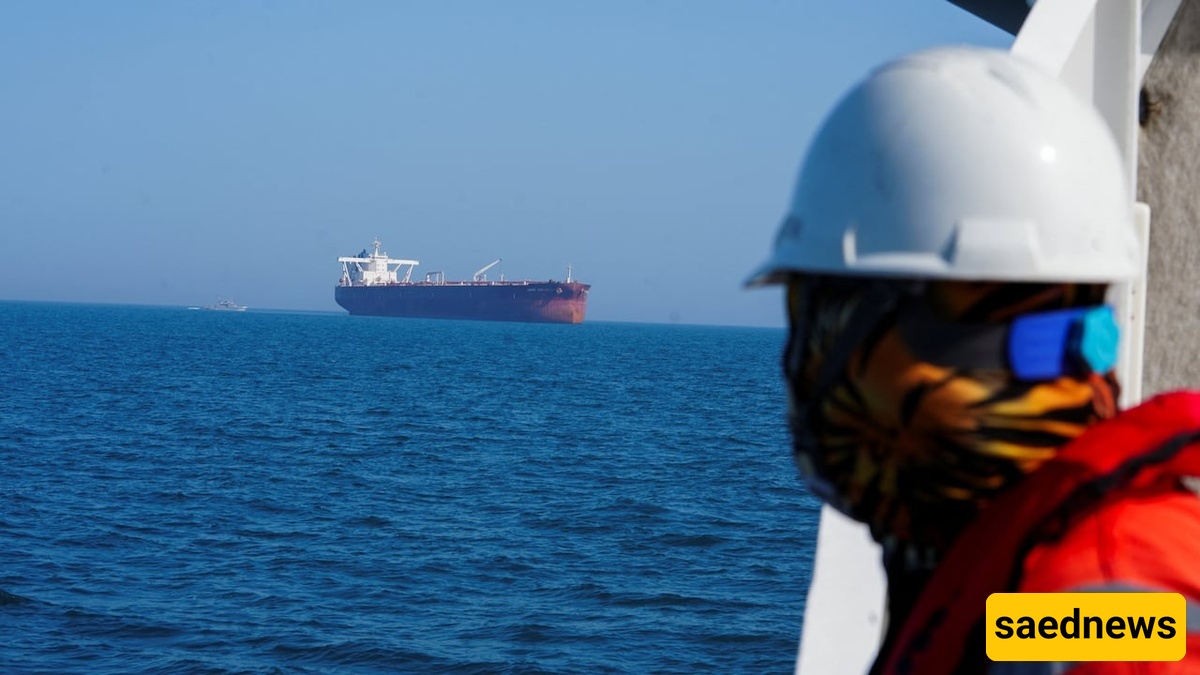
SAEDNEWS: For decades, the Strait of Hormuz was the world’s energy lifeline. Today, amid Iran-U.S. tensions, it has become more than a vital sea route—it is also a battleground for cognitive warfare.
According to the political service of SaedNews, the Khorasan newspaper wrote:
While public attention has been focused on conflicting figures reported by Western media about whether the Strait of Hormuz is open or closed, the situation on the ground suggests that the reality is not simply a “black-and-white” one. Hormuz is neither a completely open commercial gateway nor a fully sealed barrier. Instead, it has become a “gray zone,” with available evidence indicating that its management remains in Iran’s hands.
On one side, U.S. sources and financial institutions associated with the mainstream establishment emphasize the continued flow of oil. Reports citing daily traffic of between 8 and 15 million barrels appear intended to portray the “failure of the closure policy.” However, a closer examination of the origins of these figures raises serious questions. Many of these statistics were published during periods when U.S. electoral politics required a “demonstration of success” and efforts to maintain control over fuel prices.
Mehdi Mohammadi, a strategic affairs analyst, points to a key issue in his analysis: Why did media outlets that had described the closure of the strait as a major headline only weeks earlier suddenly change their position and begin emphasizing that it was “open”? This shift in narrative, he argues, is part of an effort to shape public perceptions. When financial institutions describe the strait as operating at three-quarters of its prewar level, they are effectively “normalizing” an emergency situation in order to prevent a price shock in global markets.
Regarding the question of whether the sudden change in tone among Western media is the result of successful U.S. military pressure to reopen the strait, the article argues that field evidence points to a different conclusion. It presents the shift as being driven less by a military victory than by an operational need to manage the domestic crisis in the United States and obscure the lack of change on the ground.
A key technical question arises: If the Strait of Hormuz is open and oil flows have returned to normal, why do Gulf states such as Qatar, Oman, and Pakistan continue to pursue diplomatic mediation aimed at “reopening” the strait?
According to the article, these repeated diplomatic contacts are strong evidence that conditions in the strait are far from normal. These countries, which are directly affected by severe restrictions on their energy exports, have recognized who holds the key to controlling the waterway. The article also argues that the United States needs the strait reopened because of the existing restrictions.
Consequently, the narrative of an “open strait” presented to global markets is directly at odds with what the article describes as “contractionary management” in the region. It claims that, under the current circumstances, oil tanker traffic has fallen to roughly 30–35 percent of its prewar level. High marine insurance costs, particularly War Risk Insurance, and operational risks are cited as evidence that the route is no longer a freely accessible maritime highway, but rather a dangerous and closely monitored passage.
One of the strategic changes highlighted in recent months is the shift in the behavior of U.S. forces. Previously, maritime confrontations were accompanied by U.S. retaliatory actions against Iranian coastal areas, including islands and military facilities. But why, despite continued missile and drone attacks by Iran’s Islamic Revolutionary Guard Corps Navy against vessels described as violating restrictions, has there apparently been no corresponding U.S. missile response against the Iranian coastline?
The article interprets this silence not primarily as restraint, but as the result of a strategic assessment by U.S. Central Command, or CENTCOM. It argues that U.S. planners have concluded that geography gives Iran a major advantage in southern Iran and that Iranian control of the area exceeds what can realistically be challenged through direct military confrontation. In the words attributed to American strategists, “you cannot fight geography.”
According to the article, this shift in the balance of power has encouraged the United States to move the conflict toward the arena of competing narratives, because, at least under current conditions, it has fewer tangible achievements to demonstrate on the ground.
The article raises another possibility: Why would Iran avoid completely shutting down the route?
It argues that Iran may be using the waterways it controls as part of a broader strategy to continue exporting its own oil, including through vessels operating under third-country flags. According to this interpretation, some of the roughly five million barrels reflected in lower-end estimates may consist of Iranian oil exported by circumventing sanctions and using foreign-flagged vessels.
The article presents this as evidence of Iran’s strategic management of energy flows. Under this approach, the strait is not necessarily being used to completely prevent enemy oil exports; instead, maintaining a degree of traffic allows Iran itself to preserve an economic lifeline.
The article also notes that oil traffic through the Strait of Hormuz has never reached absolute zero. Even during periods of intense conflict, it argues, limited quantities of oil continued to move through alternative routes, albeit with significant risks and restrictions.
The situation surrounding the Strait of Hormuz is presented as a microcosm of the broader conflict between Iran and the United States. The article argues that Washington is using “cognitive warfare” to portray the waterway as open and thereby conceal what it describes as setbacks on the ground.
Although oil prices have not risen explosively, the article attributes this not to the strait being fully open, but to a combination of factors including weaker Chinese demand, the use of strategic reserves, and supply management in global markets. It also points to recent remarks by Donald Trump regarding the replenishment of relatively depleted U.S. oil reserves with Venezuelan crude as an indication of deeper pressures within global energy markets.
Ultimately, the article characterizes what is happening in the Strait of Hormuz not as a temporary technical disruption, but as the consolidation of a “new geopolitical reality.” In this interpretation, control matters more than unrestricted maritime traffic.
Iran, the article argues, is exercising control over a critical artery of global energy supplies, while alternative narratives emerging from Washington are portrayed less as reflections of conditions on the ground and more as attempts to ease political pressures.
The article concludes by asserting that the real balance of power in the Strait of Hormuz should be assessed not through official statements or satellite-based assessments, but through the missiles and drones operating over the waterway, which it portrays as demonstrating Iran’s ability to exert influence over the strait.