SAEDNEWS: Iran Adviser to Supreme Leader: If the U.S. Attacks Iran, Israel Will Be Struck; Tehran Ready for Talks Under Two Conditions
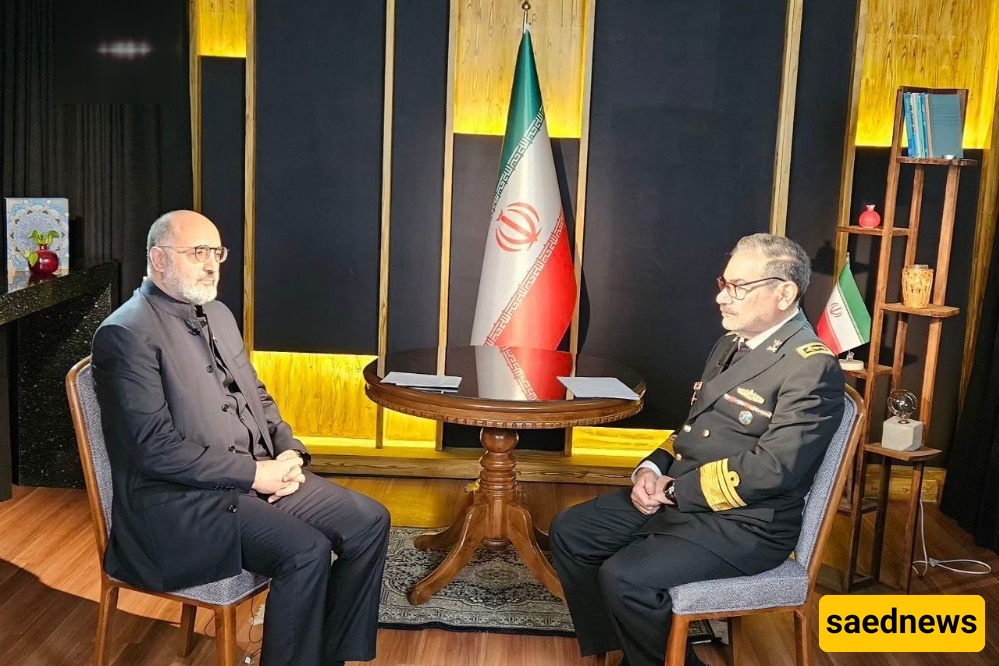
According to the Political Service of the Saed News website, Admiral Ali Shamkhani, adviser to the Leader of the Islamic Revolution, appeared in military uniform in his latest interview with Ghassan Ben Jeddou, director of Lebanon’s Al Mayadeen network.
In this lengthy interview, Shamkhani stated that Iran is fully prepared for any potential war and stressed that if the United States attacks, Iran will certainly strike Israel. He emphasized that Tehran is willing to negotiate with the U.S. under two conditions, and that if an atmosphere of mutual understanding free from threats is created, an agreement on the nuclear issue is possible.
Shamkhani categorically ruled out negotiations on any topic other than the nuclear issue, stressing that even talks on this subject are conditional upon two specific requirements.
He also firmly rejected the possibility of transferring enriched uranium out of Iran, saying there is absolutely no reason for such a move. One of the most important foundations for any understanding, he said, is the Supreme Leader’s religious decree (fatwa) prohibiting nuclear weapons.
At the beginning of the interview, in response to Ben Jeddou’s question about whether his attire carried a political message, Shamkhani said:
“It carries a practical message. We are ready.”
He added:
“We are effectively living under wartime conditions and feel the shadow of war. Therefore, we are prepared for any scenario that may arise. From a military perspective, this readiness means accepting the possibility of war—not threatening it or seeking it. But we are facing unjust conditions, unjust war, and unjust threats imposed by our enemies, and they are preparing for this war with all their might.”
Asked about the main reason behind a war against Iran, Shamkhani explained that the Leader of the Islamic Revolution has pointed out that the enemies’ objective is to “swallow” Iran—and that the Iranian people and the Islamic Republic now stand as the obstacle to that goal.
On whether war is inevitable, Shamkhani said that as military forces, they must assume war is unavoidable. However, politically speaking, time still exists and opportunities must be used wisely. Complex problems need solutions, and one correct path is diplomacy and dialogue.
If diplomacy is strengthened alongside military readiness, and if proposals sent to Iran are free of threats, based on logical conditions and without arrogance, there is hope to prevent an unjustified catastrophe. These, he said, are early stages, and he believes preventing war remains possible.
Regarding negotiations with the U.S. and the West, Shamkhani said the Islamic Republic of Iran has repeatedly shown readiness for practical negotiations directly with the United States—no one else. Europe, he said, has proven incapable of effective action. After Trump’s withdrawal from the nuclear deal in 2018, Europe failed to do anything, and before the June war, it again demonstrated its inability to act. Trump did not even allow Europe to intervene.
Thus, the issue is solely with the United States and solely about the nuclear file. On the nuclear issue, he said, reaching an agreement is possible.
Dialogue and negotiations can occur if threatening rhetoric and tools are abandoned, and if talks are conducted fairly, bilaterally, and with the aim of reaching mutual understanding—away from unreasonable and illogical demands.
Ben Jeddou asked whether Iran could show flexibility—such as transferring enriched uranium, possibly to Russia—to convince the U.S. that Iran is serious about not pursuing nuclear weapons.
Shamkhani replied that the West may not understand—or may refuse to understand—that producing and possessing nuclear weapons is forbidden. When such a prohibition is declared in a religious ruling by the Supreme Leader, there is no doubt that nuclear weapons are outside Iran’s practical domain.
In the fifth round of previous negotiations, Iran clearly stated three “no’s”:
We do not seek nuclear weapons.
We will not produce nuclear weapons.
We will never store nuclear weapons.
He added that the West must therefore pay a price. Iran’s enrichment up to 60% was not for military purposes. This level of enrichment has existed for over three years, during which the West imposed international resolutions, threatened to activate the snapback mechanism, and intensified sanctions.
Iran’s nuclear actions, he said, are responses within this equation, and any flexibility would require compensation.
When Ben Jeddou pressed further, suggesting the enriched uranium could leave Iran, Shamkhani firmly replied:
“No, not outside Iran.”
He explained that enrichment levels could be reduced from 60% to 20% if concerns exist—but only if the other side pays the price. There is no reason to transfer enriched material abroad, and concerns can be addressed domestically under supervision. Transporting such materials abroad is unnecessary and risky.
When asked about Russia possibly transferring the uranium, Shamkhani said Iran has no intention of pursuing such an idea.
Shamkhani noted that some enriched uranium is buried under rubble, and due to inherent risks, no action has yet been taken to retrieve it. Therefore, Iran does not currently know the exact amount remaining and is negotiating with the IAEA to find a safe way to estimate it.
He reiterated that 60% enriched uranium is a tool to counter enemy plots and to prepare for negotiations. Addressing concerns through supervised domestic measures is the simplest and safest approach.
Asked about meetings in Turkey and possible direct talks with the U.S., Shamkhani said negotiations—direct or indirect—are possible if the two main conditions are met: no threats and no unreasonable demands.
Initially, talks may be indirect to assess whether an atmosphere of understanding exists. If it does, they could quickly shift to direct negotiations.
When asked whether a future agreement could include non-nuclear issues, Shamkhani responded firmly:
“Absolutely not. Only the nuclear issue.”
He stressed that limiting talks strictly to the nuclear file is a declared and non-negotiable condition.
Responding to the Supreme Leader’s warning that war would become regional, Shamkhani said the expansion of conflict from a limited clash to a full-scale regional war would be due to two main factors:
The widespread military deployment of the enemy across the region, from which threats are launched against Iran. Limiting Iran’s response solely to its own territory would be militarily impossible.
Experience has shown that restraint—such as during the June war—did not benefit Iran, and this was proven through several fundamental realities.
Asked whether Iran would target U.S. bases across the region if war broke out, including beyond the Persian Gulf, Shamkhani said Iran has clear intelligence showing that threats have previously originated from some regional territories.
He stressed that Iran’s patience and restraint will not be repeated, and regional actors have been informed accordingly. He added that regional efforts to prevent war are viewed by Iran as sincere and necessary to avoid a catastrophic conflict initiated by the United States.
Ben Jeddou noted the strong reaction to Shamkhani’s recent statement that Iran would directly strike Israel if attacked. Asked to confirm, Shamkhani said:
“We do not separate objectives or philosophies. Israel and the United States are not two separate entities; they are one.”