SAEDNEWS: A strange mermaid, appearing part fish, part monkey, and part reptile, is being studied by scientists to uncover hidden mysteries.
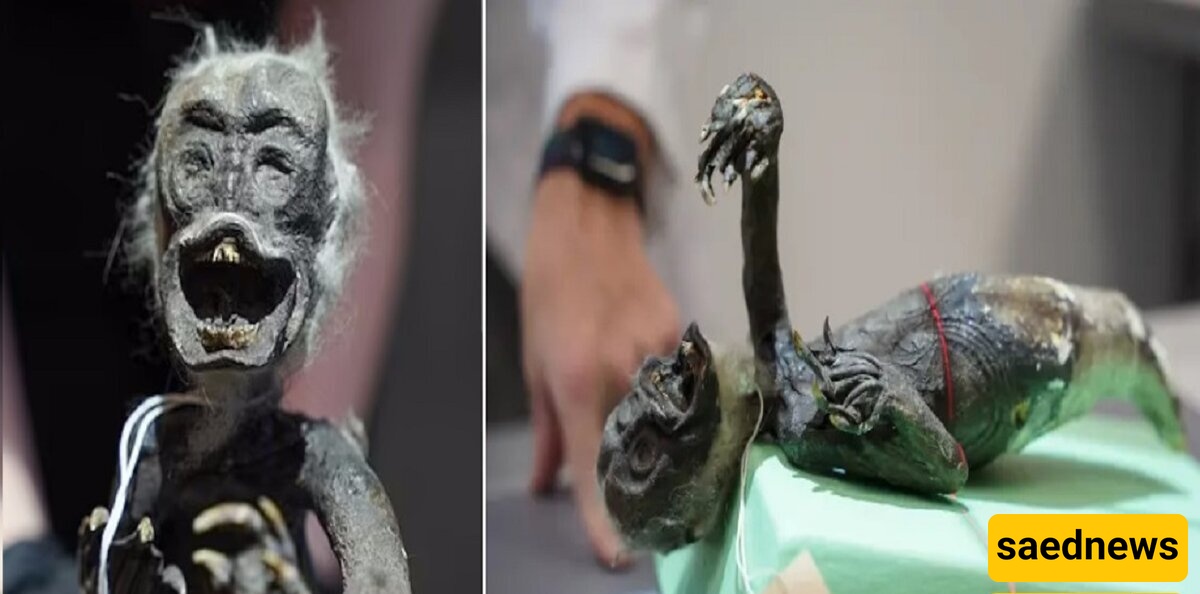
According to Saed News’ Society Desk, citing Young Journalists Club, a mummy returned from Japan by an American sailor was donated in 1906 to the Clark County Historical Society in Springfield, Ohio.
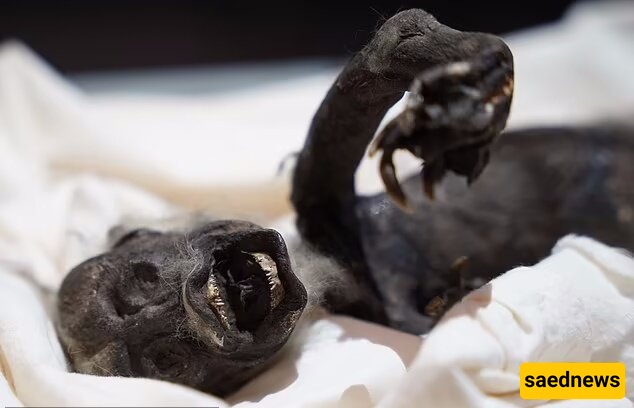
With a face that seems to be making a grimace, large claws, strange teeth, a fish-like lower body, and a gray, fur-like layer of hair, the creature has elicited both disgust and fear from museum visitors for decades.
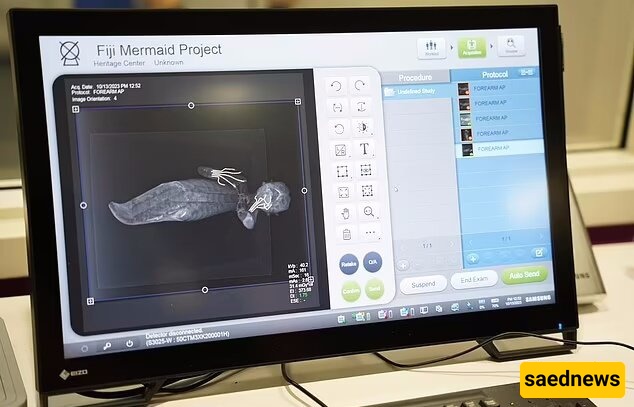
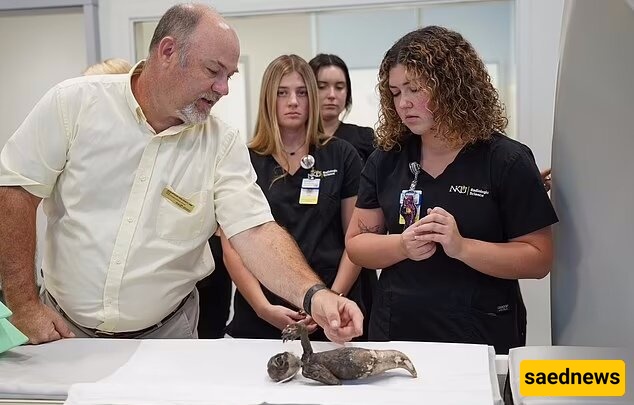
Now, in an effort to uncover the true nature of this so-called “mermaid,” the specimen has been X-rayed and scanned with a CT machine for the first time, raising hopes that its secrets might finally be revealed.
A Patchwork Creature
Joseph Cress, a radiologist at Northern Kentucky University, says, “It appears that its external features are a hybrid of at least three different species. It has the head and torso of a monkey, hands resembling those of amphibians like alligators or lizards, and a fish tail; much about it remains unknown.”
Natalie Fritz of the Clark County Historical Society identifies the oddity as a “Fiji Mermaid,” a hoax popularized by P. T. Barnum. Barnum, whose life inspired the 2017 blockbuster The Greatest Showman, displayed a similar specimen before his New York museum burned down.
In Japan, some legends suggest that tasting mermaid flesh can grant immortality.
Recently, another mummified mermaid’s secret was uncovered. That mermaid was kept and venerated for 40 years in a temple in Asakuchi, only later to be revealed as a fabrication made from cloth, paper, and cotton, adorned with fish scales and animal hair.
Fritz notes, “Fiji mermaids were part of collections and exhibits in the late 1800s.” She also believes the mummy in Ohio may date back to the 1870s, a period when records show the original donor served in the U.S. Navy.
Peering Inside
Dr. Cress says the CT scans allow researchers to take cross-sections of the mummy, hoping to determine whether any part of it was once a real animal.
“This gives us more data,” Cress explains. “We can see how deep the nasal passages go, or whether the ear canals connect to the brain. We’re examining the entire Fiji mermaid, not just the head and face, but the chest and tail as well.”