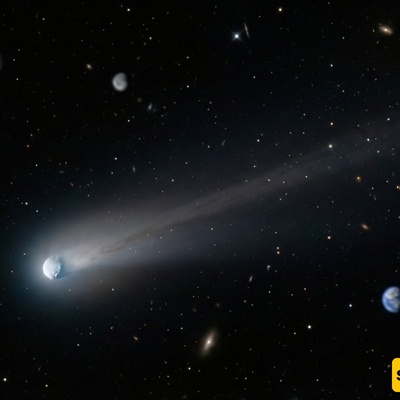
SAEDNEWS: Atlas, an Ancient Traveler from Another System, Passed by on December 20. This journey, spanning billions of years, will never happen again.

According to the Science and Technology Desk of Saed News, on Friday, December 19, 2025, comet 3I/ATLAS—the third interstellar visitor ever identified by humanity—passed by Earth during its one-way journey through the solar system, offering astronomers around the globe a rare opportunity to observe it up close.
Yesterday, ATLAS reached its closest point at a staggering 270 million kilometers from Earth. To put this distance in perspective, it is nearly twice the distance between Earth and the Sun. This multi-kilometer comet was not visible to the naked eye, but telescopes worldwide captured a dazzling feast of light and data.
ATLAS is now officially on a trajectory to leave our solar system forever.
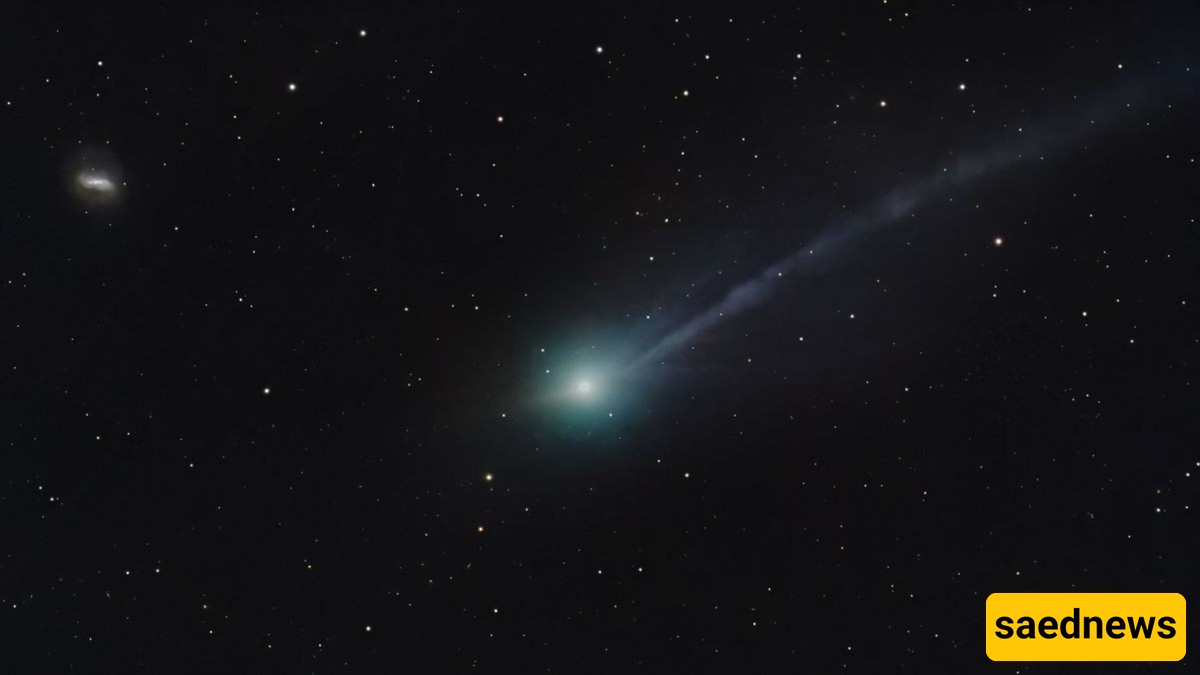
If you missed the recent viewing opportunity, there is still hope. According to NASA, the comet can be tracked with small telescopes in the pre-dawn sky until next spring. Additionally, Italy’s Virtual Telescope Project plans to broadcast live images of ATLAS as it heads toward its next destination.
The significance of 3I/ATLAS lies in its origin: it is an interstellar object, meaning it was born outside our solar system. It is also likely the oldest object ever observed in our cosmic neighborhood—a time capsule that has wandered through billions of years of empty space before reaching us.
On November 16, 3I/ATLAS displayed both a long tail and a secondary “anti-tail.” Satoru Murata, a photographer based in New Mexico, captured a stunning image of the comet that day, showing both its elongated primary tail and its reverse secondary tail.
While speculative theories about alien spacecraft circulated online, scientists are confident that ATLAS is a natural phenomenon. It was first discovered in July while racing along Jupiter’s orbit at an astonishing 221,000 kilometers per hour. After passing near the Sun in late October, it is now officially on its way out of the solar system.
Next Stop: The Solar System’s Giant
ATLAS’s journey is far from over. Its next destination is Jupiter. NASA predicts that the comet will reach its closest point to the gas giant on March 15, 2026, passing just 54 million kilometers from the planet—much closer than it did to Earth.
This close approach presents a golden opportunity for spacecraft orbiting Jupiter, such as the Juno probe, to study the visitor in detail. Afterward, ATLAS will continue its voyage, passing by Saturn, Uranus, and Neptune, though at greater distances.
Despite all observations, 3I/ATLAS remains an enigma. Its exact size is uncertain, with estimates ranging from a 440-meter rock to a 5.6-kilometer-wide mountain. But the greatest mystery is its birthplace. Which star system did this traveler come from? Perhaps, given the vast distances of interstellar space, we may never know.