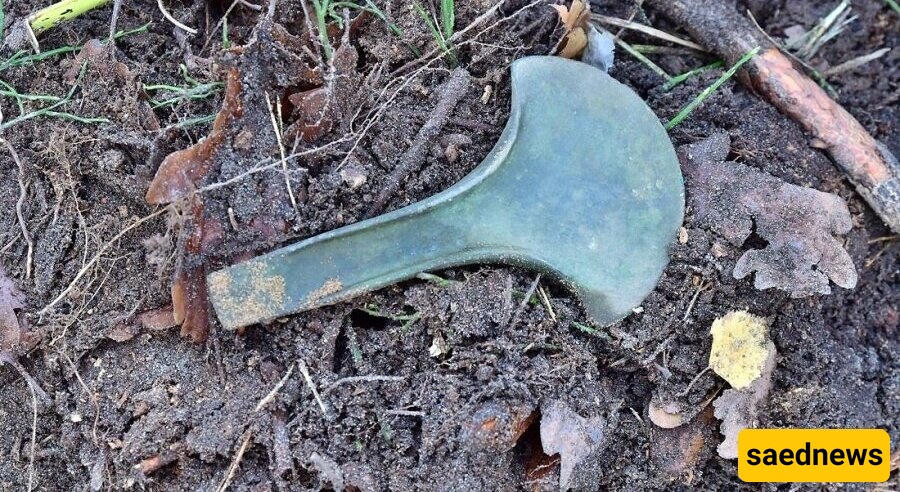
SAEDNEWS: An amateur metal detectorist in Poland’s Kociewie region has discovered one of the rarest archaeological finds in the area in recent decades.
Amateur metal-detecting in Poland—whether for personal interest or commercial purposes—is illegal unless authorized by local authorities, and all finds must be reported, according to Saed News, citing Faradid.
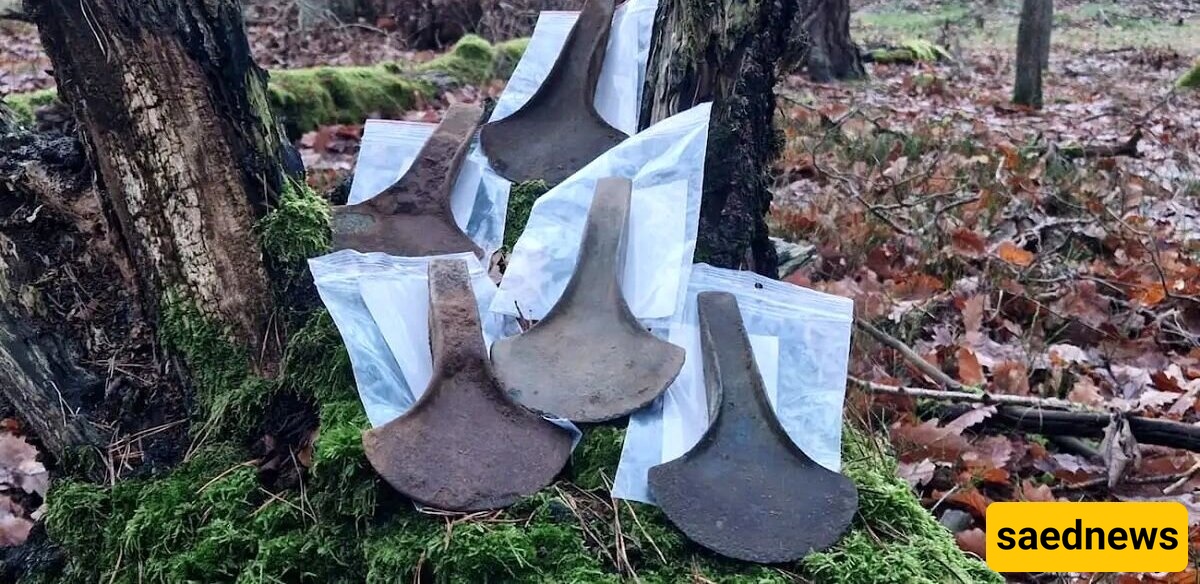
The discovery occurred in Kuchywie, a region of forests and farmland in northern Poland. Denis Kenkol had previously obtained the necessary permits for metal-detecting in the area. Upon uncovering the axes, he immediately reported the find to local authorities responsible for protecting archaeological sites.
“Ignoring archaeological oversight was not an option,” said Igor Strzok. “The extraction of these artifacts was conducted under the supervision of our colleagues from the Provincial Office for Monument Protection, ensuring the site remained intact.”
The five axes were buried together in a shallow pit, 20 to 30 centimeters deep, beneath a layer of soil and leaves. Strzok notes that artifacts from this period are rarely found in the area, making this discovery exceptionally unique.
Strzok believes the axes are likely linked to Baltic cultures originating from contemporary Lithuania or northeastern Poland.
The axes feature long, narrow handles with raised edges and broad blades. Piotr Klimaszewski, head of the Archaeological Monuments Office, examined the artifacts and concluded that they were likely ritual offerings, possibly associated with trade or religious practices of the Bronze Age communities in the region.
The find sheds new light on cultures that flourished in Poland over 3,000 years ago. While individual Bronze Age axes have been discovered previously, a group of five buried together has never been found.
Strzok notes that the last comparable discovery was nearly 20 years ago in the Lublin region, where Bronze Age hoards typically consisted of bracelets or chest ornaments, making this find a remarkable archaeological surprise.
In the coming days, the five axes will be transferred to the Archaeological Museum in Gdańsk for further study and preservation.